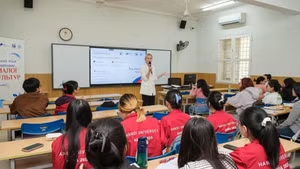
The 2025–2026 academic year closed with 4.87 million preschool children and 19.08 million general education students attending school. The enrolment rate for children aged three to five in kindergarten reached 94.5%. However, during the same period, roughly 1 million children aged three to five remained absent from the classroom; the upper secondary school attendance rate in the Mekong Delta stood at only 53.3%, compared with 84.6% in the Red River Delta. These figures demonstrate that while the door to education has opened wider, disparities in access and learning conditions remain pressing issues for the new academic year.
This issue becomes clearer when examining school infrastructure. According to data from the Ministry of Education and Training, the country still lacks 45,691 classrooms and 27,084 functional rooms; in certain disadvantaged areas, there are still 6,477 temporary or borrowed classrooms in use. Concurrently, localities are implementing a “100 days and nights” campaign to complete 100 inter-level boarding schools in border communes before August 30, 2026.
At the 2026 conference of Directors of Departments of Education and Training, Truong Anh Dung, Director of the Department of Planning and Finance under the Ministry of Education and Training, stated that investment resources in the coming period should continue to prioritise the consolidation of schools and classrooms, alongside the addition of classrooms, subject rooms, teachers’ public-duty housing, boarding facilities, and teaching equipment, especially in ethnic minority, mountainous, border, and island areas. This reality underscores the need to eliminate infrastructure bottlenecks need to be removed by allocating resources to the places facing the most acute shortages and to the groups of learners most in need of support.
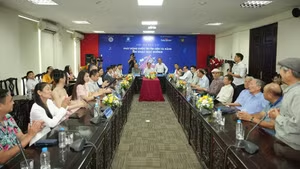
The 2025–2026 academic year also marked an important step in institutional refinement, laying the groundwork for many new policies to be implemented in the coming school year. Standing Deputy Minister of Education and Training Pham Ngoc Thuong emphasised the need to “properly identify the issues being raised, discuss difficulties and obstacles frankly, and agree on highly actionable and feasible solutions that can create clear changes from the very start of the new academic year”. Tasks must be defined in the spirit of “clear people, clear work, clear timelines, clear responsibilities, clear authority, and clear results”.
That spirit is also reflected in the theme of the 2026–2027 academic year: “Renewing thinking, creating robust changes, achieving substantive results”. The true measure of reform the number of policies issued or tasks assigned, and instead lies in the tangible results achieved in practice. The efficacy of decentralisation and the delegation of authority, the proactiveness of localities, and the transformative changes in each school and classroom will most clearly reflect the extent to which policies take root in everyday life.
For those goals to become concrete results in each school, teachers play a key role. Vu Minh Duc, Director of the Department of Teachers and Education Managers, noted that the Ministry of Education and Training will continue to improve mechanisms and policies to create a legal foundation for attracting, rewarding, and retaining teachers, while coordinating with the Ministry of Home Affairs to review staffing quotas and report to the central authorities on supplementing education staffing for the 2027–2031 period.
The ministry will also urge localities to recruit all allocated staff, reorganise educational institutions to streamline management apparatuses, increase the number of teachers directly engaged in teaching, and proactively place orders for teacher training based on demand.
Addressing the teaching staff issue, therefore, is not only about increasing the number of teachers, but more importantly about restructuring and effectively using existing human resources, ensuring recruitment sources, and creating motivation for teachers to feel secure in long-term commitment to the profession.
While teachers are the decisive factor in teaching quality, data is rapidly becoming a pivotal governance support tool for the entire sector. The national education database now manages information on about 50,000 educational institutions, 27 million students, and 1.4 million teachers. The sector has created more than 10.3 million digital school records and 1.2 million digital diplomas and certificates. This is only the beginning. Data will demonstrate its value when used to forecast teacher demand, identify school and classroom overload, track students’ learning progress, support resource allocation, and reduce administrative procedures for schools.
From another perspective, the expansion of learning opportunities is also taking place outside the traditional general education system. In the past academic year, 523,436 learners attended lower and upper secondary continuing education programmes, up by more than 50,000 compared with the previous school year; the upper secondary graduation rate in continuing education reached about 94%; and continuing education institutions, vocational education–continuing education centres, and community learning centres organised programmes to update knowledge and skills for more than 24 million learner turns.
Coupled with the strategic orientation of developing vocational secondary education, vocational education, high-quality colleges, universities, and human resource training for new technology sectors, the education system is gradually opening up more development pathways beyond general education. These pathways will only gain standing and public trust if they are guaranteed by programme quality, transferability, links with enterprises, and clear employment opportunities.
The 2026–2027 academic year will be a year that tests the implementation capacity of the entire sector. An additional classroom in a place still facing shortages, a teacher recruited to the right position, a digital school record used effectively, a continuing education centre operating more flexibly, and a vocational programme more closely linked with enterprises are all concrete steps towards the ultimate goal: improving the quality of learning opportunities for the people.
The true measure of reform is reflected in whether every citizen can learn earlier and better, with more choices and broader development opportunities. When policies are implemented in a coordinated manner across each locality and school, the new academic year will contribute significantly to preparing the country’s human resources, civic capacity, and competitiveness for the years ahead.