Integrating three policies into a unified framework
International experience showed that successful nations rarely select just a few schools to receive additional funding based solely on reputation. Instead, they typically combine three policy layers: the overall capacity of leading universities; excellence within specific fields or interdisciplinary clusters; and centers with the mission of transforming research into technologies, products, and human resources.
Resolution No. 71-NQ/TW identifies higher education as the core driver for developing high-level human resources and talent, as well as for fostering science, technology, and innovation. The Resolution sets a goal for at least two higher education institutions to rank among the world’s top 100 in specific fields by 2035; it also mandates network restructuring, the creation of special mechanisms, increased autonomy coupled with accountability, and the concentration of resources. This constitutes the organizational and human resource pillar.
Decision No. 21/2026/QĐ-TTg identifies 10 strategic technology groups and a list of 30 strategic technology products. This represents the pillar concerning technology priorities and product targets.
Decision No. 1483/QĐ-TTg adds a third pillar: a system of laboratories and research and testing centers designed to advance technology through the stages from research to market.
However, if these three pillars are implemented along three independent administrative tracks, Viet Nam risks a scenario where universities chase academic metrics; technology programs pursue short-term tasks; laboratories focus on equipment utilisation rates; and enterprises appear only at the very end of the process. The bottleneck is no longer the lack of a priority list, but rather the absence of a framework for the seamless division of responsibilities among training institutions, technology owners, and organizations that bring products to market.
On the other hand, the resources of Vietnamese universities remain limited and fragmented compared to leading global institutions. International benchmarking indicates that global standing is closely linked to resource intensity per student and faculty member, the share of revenue from research and industry partnerships, the scale of intellectual capital, institutional architecture, and the capacity to transform resources into talent, technology, and impact.
Therefore, the selection of elite universities cannot rely solely on rankings; it must also take into account evidence regarding resources, academic quality, governance capacity, and accumulated technology transfer outcomes.
Linking universities with strategic technologies
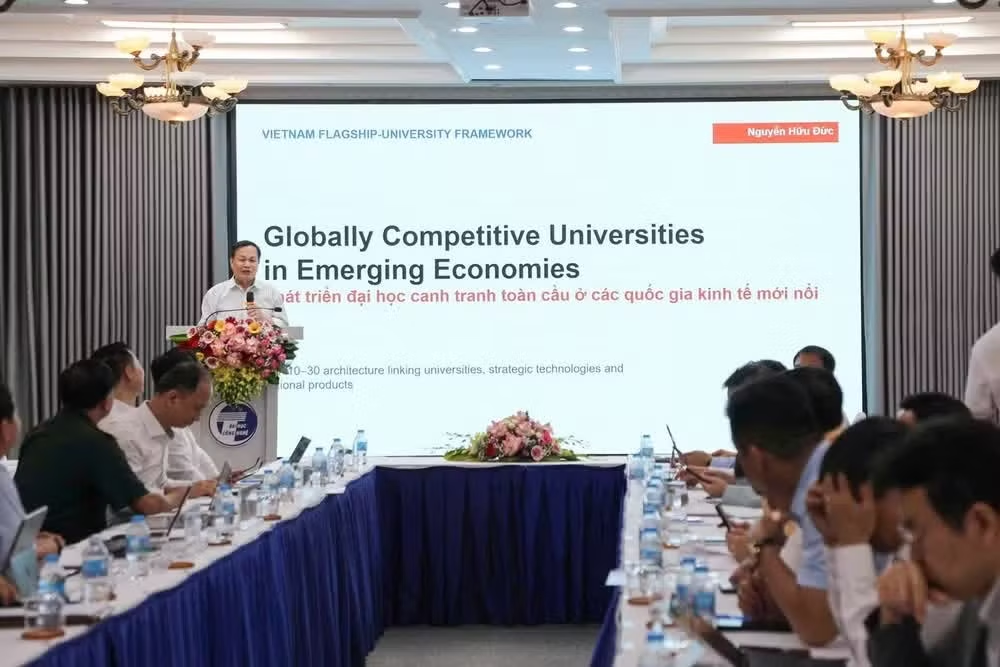
A “3-10-30” structure should be proposed as a policy design to create an “implementation backbone” connecting three objectives: developing three elite, key universities; mastering ten strategic technologies; and creating thirty strategic technology products.
An elite university must be an institution with comprehensive competitiveness—meaning that excellence in quality and capability is demonstrated across the entire system, rather than just within a single research group.
Each university may comprise specific key schools or fields and focus on strategic technology products aligned with its assigned mission. The role of this tier is to integrate disciplines, mobilise substantial resources, manage interdisciplinary and inter-regional programs, cultivate talent, attract international scholars, and establish shared platforms of national scale.
The selection of these three universities should not be predetermined based on administrative hierarchy or current size. Selection should be based on competition or the assignment of tasks grounded in the national mission, leadership capacity, workforce quality, research and training achievements, knowledge capital intensity, partnership mobilisation capabilities, and a 10-year transformation plan. Tasks are subject to periodic evaluation; resource allocation increases based on performance milestones, and mechanisms exist to withdraw or reassign tasks if commitments are not met.
The ten key universities are organized around ten strategic technology clusters, though this does not strictly follow a “one technology per university” model. A single university may lead multiple related technologies, while a complex technology might be developed by a multi-university alliance with a clearly designated lead institution.
It is mandatory for each technology domain to have an academic entity responsible for the long-term management of personnel, doctoral training, core technologies, data, standards, and international collaboration networks.
Key universities serve as the link between application-oriented basic research and technology development. Each unit must possess at least one center of excellence (or elite field) and one or two strategic technology products; feature a highly respected chief technology architect or chief engineer; maintain a portfolio of mastered core technologies; and meet specific targets regarding workforce training, intellectual property, research contracts, technology transfer, and contributions to strategic products.
The thirty strategic technologies—linked to thirty strategic technology products—represent the operational tier closest to the market. These should not be equated merely with a building or a collection of equipment; rather, they constitute research and innovation organisations comprising core teams, scientific leaders, appropriate infrastructure, intellectual property management processes, corporate partners, and technology-to-product roadmaps.
Such organisations may be based at educational institutions or research institutes, or structured as alliances, but they must be organically integrated with postgraduate training and shared-use networks.
Operational mechanism for elite universities
First, a two-step selection process. The preliminary screening evaluates foundational capabilities: mission, leadership, excellence of the team, research culture, infrastructure, track record in training, research, and technology transfer, as well as intellectual capital. The in-depth appraisal stage aims to evaluate 5-to-10-year plans, task portfolios, partnerships, lifecycle budgets, risks, and expected outputs. International councils and industry experts should participate at levels appropriate to each category.
Secondly, “mission contracts” should be signed instead of merely granting administrative designations. These contracts must clearly define state requirements, responsible entities, guaranteed resources, granted autonomy, milestone-based outputs, and conditions for continued funding.
Funding models should include long-term foundational support for elite universities, program-based funding for key universities, and stage-specific funding linked to technology and product development. Flexibility in reallocating funds among personnel, equipment, data, testing, and international collaboration—within the scope of committed outcomes—must be permitted.
Thirdly, organization should follow a “3-10-30” matrix rather than relying on three separate lists. Each elite university must publicly identify the technologies and products it leads; each key university must specify its strategic technology products and partner enterprises; and every strategic technology product must be backed by a university for training and one or more enterprises to address market demand.
This matrix must be updated on a national digital platform, alongside information regarding equipment, experts, services, and results.
Fourthly, a “gate-based funding” mechanism should be applied. For strategic technology products, significant capital disbursement occurs only after agreed-upon technical and commercial “gates” (milestones) are successfully passed.
For key universities, these gates involve the formation of core teams, doctoral programs, core technologies, patents/technology transfers, and contributions to specific products. For elite universities, evaluation gates focus on system-wide capabilities: faculty quality, internationalisation, knowledge capital, talent development, interdisciplinary governance, and national impact. Metrics must measure quality, scale, and transformational capacity; published figures or rankings should not serve as the sole yardstick.
Fifth, there must be mechanisms for entry, exit, and resource reallocation. The three-year and five-year evaluation results outlined in Decision 1483 should become guiding principles for the entire architecture.
Entities falling below 70% of their commitments must implement recovery programmes; those that continue to underperform face reduced mandates, leadership changes, replacement of operating organisations, or the transfer of strategic technology products to a different consortium.
Conversely, entities exceeding their commitments should receive expanded funding and autonomy. “Elite” status is thus a state maintained through performance, not a title granted once and for all.
Implementation roadmap
The 2026–2027 period requires the development of a national capability map. This entails a comprehensive review of universities, institutes, laboratories, research groups, equipment, experts, patents, standards, and enterprises across the 10 technologies and 30 products.
Based on this, criteria will be published, a preliminary selection process conducted, capability gaps identified, and pilot consortia selected. This timeframe also aligns with the deadlines set by Decision 1483 for establishing selection criteria, indicator sets, shared operational regulations, and digital platforms.
The 2027–2028 period focuses on signing mission-based contracts and restructuring. Implementation need not wait for the full “3-10-30” framework to be in place. Initial efforts can target universities, fields, and strategic technology products that already possess a solid foundation; this involves approving plans for human resources, lifecycle investment, and partnerships, while simultaneously restructuring existing laboratories to eliminate redundancy. New investments should only be pursued when upgrading, interconnecting, sharing resources, or outsourcing services proves insufficient to meet needs.
The 2028–2030 period focuses on operations based on outcome-driven milestones. Priorities include finalising core technologies and products capable of generating spillover effects; securing initial customers from the public sector or leading enterprises; developing domestic standards and accreditation systems; and directly involving doctoral students and young engineers in projects.
By the end of 2030, an independent assessment will be conducted to determine whether to expand, adjust, or replace participating entities; the initial list will not be automatically maintained.