Restoring lives after the floods
On the morning of September 14, water levels in most rivers in Quang Tri began to recede after reaching their peaks, however, many roads and residential areas remained flooded and isolated. Several sections of National Highways 9B and 15D and Provincial Roads 588A and 586 remained submerged, with water levels ranging from 0.4m to more than 1m.
On Provincial Road 588A alone, the section from Ba Long spillway bridge to Km 11+240 was more than 5m under water. Many spillway bridges and culverts in La Lay, A Doi, Dakrong, Truong Son, Lia, Huong Phung, Kim Ngan, and other communes remained impassable.
The floods also caused damage to agricultural production in the province. Initial reports showed that around 344.5ha of rice had been flooded and flattened, while more than 12.5ha of crops in Hieu Giang Commune were submerged. More than 7,000ha of aquaculture area yet to be harvested were at risk of damage from floodwaters.
In Tan Lap Commune, a fishpond covering around 800m² burst, while several other ponds overflowed. In Khe Sanh Commune, several fishponds suffered broken banks, covering a total area of around 5,000m². In Sen Ngu Commune, the roofs of five households were blown off or partially damaged.
Nguyen Van Thuan, a resident of Trieu Phuoc Village in Lao Bao Commune, said the Se Pon River rose rapidly during the night of September 12, with floodwaters entering his house and reaching around 2.5m at one point, damaging many household belongings. As the water receded, his family focused on cleaning and sanitising the house.
Initial statistics showed that by the morning of September 14, 312 houses in Lao Bao Commune had been flooded, along with 105 houses in Quang Tri Ward, 126 in Ba Long Commune, and 48 in Nam Hai Lang Commune. Many roads within the communes and roads leading to residential areas remained flooded, making travel and efforts to support residents difficult.
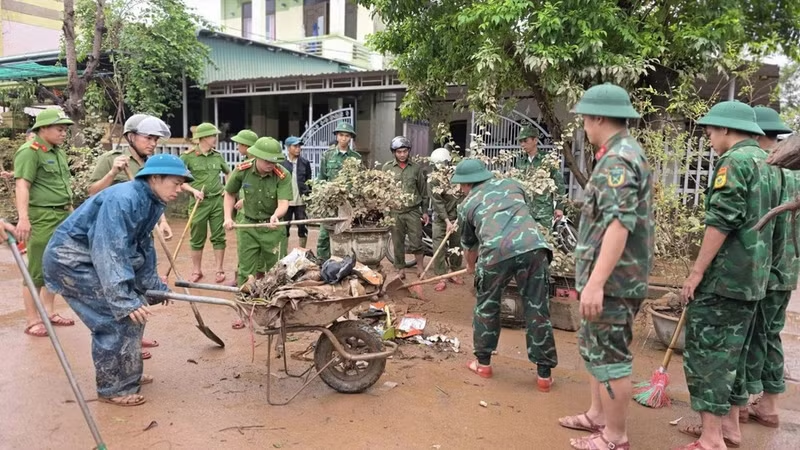
Tran Anh Vu, Chairman of the People's Committee of Lao Bao Commune, said more than 300 houses in the commune had been flooded to depths of 1-3m. Military, public security, border guard, militia, and civil defence forces were clearing roads and alleys while helping residents return relocated belongings to their homes. The Quang Tri Provincial Military Command had deployed nearly 1,500 regular military and border guard personnel and militia members, along with hundreds of vehicles, to take part in efforts to address the flood aftermath.
At My Thuy Beach in My Thuy Commune, large waves that began on September 11 and intensified from noon on September 12 eroded the shoreline by 6-7m, with some sections losing nearly 10m, damaging many coastal facilities. Nearly 100 people, including border guards, military and public security personnel, local officials, and residents, were mobilised to move belongings to safe places. Local authorities continued to warn residents against approaching areas that had been deeply eroded and stood ready to relocate belongings if the waves intensified further.
In Hue City, rainfall from September 12 to 14 was generally 100-300mm in the plains, with some areas receiving more than 300mm, while the midlands and mountainous areas recorded 350-700mm. Nham Station (A Luoi 2) recorded 770mm, while Bach Ma Peak recorded 1,305.6mm. The heavy rain caused localised flooding in some low-lying areas, with water levels of 20-70cm and around 1m at the deepest points.
In A Luoi area, four homes were affected. Local authorities mobilised forces on the ground to reinforce houses, move belongings, and evacuate residents in dangerous areas to safety.
Reopening roads and addressing vulnerable points
Heavy rain caused landslides on many roads in Quang Tri and Hue City. On National Highway 49 in Hue City, two locations suffered landslides involving around 150m³ of soil and rock, disrupting traffic for about 30 minutes before being cleared. In A Luoi 1 Commune, the commune Military Command mobilised more than 30 officers and soldiers to work with residents to clear soil and rocks and reopen the only road connecting the commune centre with Par Ay Village.
In Quang Tri, around 20m³ of soil and rock that had slid onto National Highway 15D in Ta Rut Commune was temporarily cleared, restoring normal traffic. At Km10 on National Highway 15D leading to the La Lay International Border Gate, around 40m³ of soil and rock had slid onto the road, preventing people and vehicles from passing. Other landslides occurred in the communes of Dakrong and Truong Son and on the inter-commune road through Tram Huong Phung.
On the morning of September 14, local authorities in Le Thuy Commune mobilised personnel and vehicles to fill sandbags and reinforce a subsidence site on the riverside road through Thach Tan Village, ensuring the safety of the infrastructure and local residents.
Previously, on July 27, the road and embankment in the area had suffered subsidence and landslides along a section more than 60m long, with an average width of 3.5m and a depth of 0.5-1m, damaging around 200m² of the roadbed and road surface and 60m of stone embankment.
Amid the risk of further landslides due to heavy rain and rising river levels, 40 public security officers, military personnel and residents filled, transported, and stacked sandbags to reinforce the area, while machinery was used to level and clear the site. After more than half a day, the road section was temporarily reinforced.
In Nam Hai Lang Commune, three barges broke their mooring lines due to rising floodwaters, drifted away, and became stuck near the My Chanh railway and road bridges. As of the morning of September 14, the authorities continued to deal with two barges that remained trapped.
Le Duc Tien, Vice Chairman of the Quang Tri Provincial People's Committee, instructed authorities to inspect and assess the site, ensure the safety of railway, road, and waterway traffic, and asked the Ministry of Construction to direct its specialised units to coordinate in addressing the incident and ensuring the safety of the infrastructure and the downstream area of the My Chanh railway bridge.
Under the salvage plan, the forces will use cranes and excavators in combination with divers to remove the barges from the area. If necessary, the barges will be cut apart to free them from their trapped positions. The largest barge is expected to take around one day to deal with, while the smaller barge, which has capsized and is partially submerged, will be more difficult to salvage.
The entire operation is expected to take around four days. Initial inspections showed that the incident had not seriously affected the structure of the My Chanh railway bridge or the railway line through the area.
In Hue City, the incident involving the Star City, a vessel with a payload capacity of more than 24,000 tonnes that ran aground in the waters off Binh An in Chan May Bay, has been dealt with. On the morning of September 14, the Thua Thien Hue Maritime Port Authority said two tugboats had pulled the vessel off the shoal and taken it to a safe anchorage in the waters of Hue Seaport in the Chan May maritime area.
Following the floods, Hue City and Quang Tri Province continued to closely monitor weather developments and water levels in rivers and warn of the risks of flooding, flash floods, and landslides. Local authorities were also asked to accelerate the harvesting of the remaining summer-autumn rice crop to minimise losses.
Voluntary forces, militia, public security and other local forces continued to be stationed in areas that remained deeply flooded or isolated, inspecting bridges, culverts, and spillways; organising warnings and barriers; regulating traffic; and firmly preventing residents from passing through unsafe areas.
The Provincial Border Guard Command maintained personnel and vehicles ready for disaster prevention and search and rescue operations, and coordinated with local authorities and boat owners' families to notify, account for and maintain contact with fishing vessels at sea.
Reservoir management units were also asked to step up inspections and monitor infrastructure safety, proactively adjusting operations in line with developments in rainfall and flooding. Local authorities were instructed to review reservoirs and dams at risk of becoming unsafe so that timely measures could be taken.
Water levels in some rivers are falling, but slowly. The Civil Defence Commands of Hue City and Quang Tri Province have asked local authorities to continue maintaining forces on duty, stand ready for rescue and emergency response, and support residents in areas that remain isolated, while remaining vigilant against the risks of deep flooding, fast-flowing water, landslides, and flash floods.