The plan aims to organise the Prime Minister’s dialogue with young people 2026 (hereinafter referred to as the programme) in accordance with the law on youth and government decree No. 13/2021/ND-CP dated March 1, 2021.
It also aims to promote the role and responsibility of, and close and coordinated cooperation among, ministries, sectors, central-level agencies and youth organisations in organising and implementing policies and laws concerning young people.
Alongside this, the plan seeks to widely disseminate among young people nationwide the Party’s guidelines and the State’s policies and laws in general and those concerning young people in particular; and create a forum for young people to express their thoughts, aspirations, recommendations and proposals associated with the development of science and technology, innovation and national digital transformation.
The plan requires the programme’s contents to be practical and focused, closely aligned with the dialogue theme and the functions and tasks of ministries and sectors. The organisation must ensure solemnity, thrift, effectiveness and safety, with clear assignment of responsibilities, timelines and specific deliverables for each agency and unit. The results of the dialogue must be fully and promptly compiled to advise the Prime Minister on the issuance of a directive document following the programme.
The theme of the Programme is “Promoting the role of Vietnamese young people in start-ups and innovation, contributing to promoting growth and creating jobs”, in the form of a direct dialogue between the Prime Minister and young people in 2026.
The programme will focus on the following contents.
First, reviewing the results of the formulation and implementation of policies and laws on young people, with a focus on policies related to employment, start-ups, innovation, training and human resource development; identifying difficulties, obstacles and shortcomings, and proposing solutions to improve policies in the coming period.
Second, discussing mechanisms and policies to improve the quality of education, training, vocational education and occupational skills for young people, including: strengthening training in digital skills, technology skills, foreign languages and skills to adapt to labour market requirements; supporting young people in improving their professional capacity, productivity and labour efficiency to meet the requirements for the development of new industries and sectors and the digital economy.
Third, discussing mechanisms, policies and solutions to support young people in vocational training and employment, start-ups, establishing businesses, innovation, improving the quality of human resources and labour productivity, including:
Policies to access labour market information, vocational training, job seeking and self-employment; access to capital, credit, land, science and technology;
Supporting research, development, application and transfer of technology; promoting innovation, digital transformation and the application of artificial intelligence in production and business; supporting the establishment and development of youth start-up models and projects;
Fourth, discussing solutions to create a favourable environment for young people to participate in the development of enterprises, cooperatives, household businesses and new economic models; encouraging young people to develop production and business activities, participate in value chains, supply chains and domestic and international markets; promoting the pioneering and creative spirit of young people in sectors and fields with the potential to contribute to economic growth, thereby promoting the role of young people in developing production and business activities and driving economic growth;
Fifth, receiving, discussing and addressing recommendations and proposals from young people related to mechanisms, policies and issues within the scope of the dialogue; discussing and providing answers within the relevant authority, and providing orientations for addressing issues that require further study and coordinated handling after the Conference; monitoring, urging and compiling the results of the settlement of recommendations and proposals from young people.
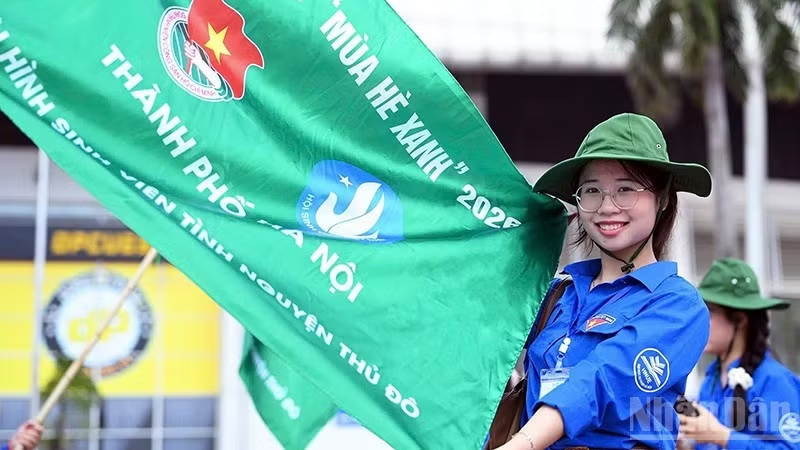
The Prime Minister will chair the Programme. Participants will include Party and State leaders, representatives of ministries, sectors and relevant central-level agencies. In addition, there will be around 300 delegates representing young people who are civil servants and public employees; members of the armed forces; young entrepreneurs; workers; pupils and students; rural youth; urban youth; ethnic minority youth; young people who are religious followers; and young people with disabilities.
![[Infographic] Key points from General Secretary and President To Lam’s opening remarks at the 14th PCC’S 4th plenum](https://en-cdn.nhandan.vn/images/j0QNt7m_5iy1OXpnUKiwG61aYhTv_B140GWhfriF26JwZbNNJ8LWetfvXUhz4Az6/1-8220.jpg.avif)