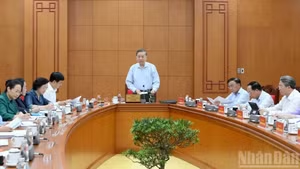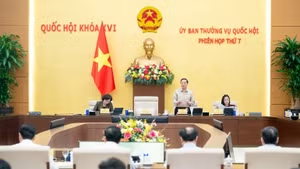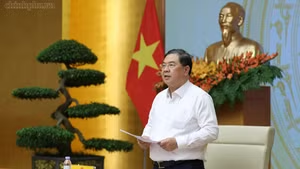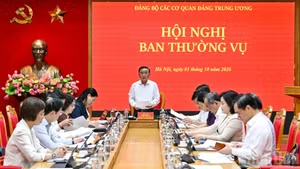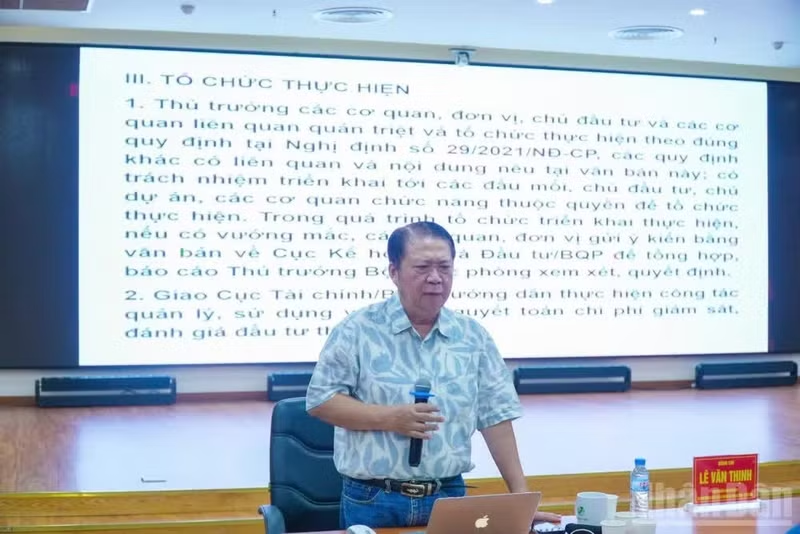
Speaking with a reporter from Nhan Dan Newspaper, expert Le Van Thinh, former Head of Division 1 under the State Authority for Construction Quality Inspection at the Ministry of Construction, said the Resolution has helped address many bottlenecks stemming from the “fear of responsibility” that has frequently been cited in transport infrastructure and public investment.
The greatest risk lies not in technical issues, but in fear of responsibility
Q: In public administration and the implementation of public investment, transport infrastructure and urban development projects today, what do you see as the biggest bottleneck holding back progress and breakthroughs?
A: In the implementation of large-scale projects, uncertainties such as fluctuations in material prices, complex geological conditions and changes in planning are ever-present. Yet the greatest risk sometimes stems not purely from technical or financial issues, but from legal risks and the fear of responsibility from decision-makers.
Officials responsible for implementation currently face a tension between the desire to contribute and experiment with new solutions and concerns over the personal legal risks they may face. The boundary between objective mistakes made in the course of innovation and violations committed for personal gain can sometimes be very thin.
When inspection and examination agencies apply existing regulations too rigidly, a defensive mindset can emerge, prompting officials to conclude that “it is better to stand still and achieve nothing than to do more and risk getting into trouble”. This can result in prolonged buck-passing and cautious, half-hearted implementation, further exacerbating project bottlenecks.

Q: From a project management perspective, how has Politburo’s Resolution No. 24-NQ/TW established a mechanism to protect officials?
A: In essence, Resolution No. 24-NQ/TW provides a form of “legal and psychological insurance” for those willing to take bold action. From the perspective of modern risk management, the Resolution directly addresses this bottleneck through four pillars.
First, it draws a clear distinction between “innovation and experimentation” and “violations and personal gain”. The Resolution calls for the establishment of a legitimate “risk appetite” and “risk tolerance” within the public administration system. With a clear framework distinguishing profiteering from objective mistakes made when adopting new approaches — such as BIM technology or new contracting methods — managers can feel more confident in approving solutions that optimise costs and project schedules.
Second, it promotes a shift from “mechanical compliance management” to “proactive risk management”. Rather than following the old administrative mindset that prioritises “following procedures over delivering results”, the Resolution encourages officials to respond proactively and flexibly to situations arising on construction sites, thereby helping keep projects on schedule and safeguard the common interest.
Third, it institutionalises mechanisms for “exemption from and mitigation of liability”. Considering exemptions or reduced liability in cases involving objective risks is comparable to establishing a “legal risk contingency fund”, helping relieve officials of the psychological constraints that may inhibit decision-making.
“Protection” must never mean “shielding wrongdoing”

Q: Some have expressed concern that this protection mechanism could be exploited to legitimise wrongdoing. How do you view the line that needs to be drawn?
A: This is a particularly nuanced issue and a key principle of Resolution No. 24-NQ/TW. The Resolution provides protection, but it absolutely does not “shield wrongdoing”.
This “legal shield” protects only those who act with proper motives and in the common interest of the country. At the same time, the Resolution calls for strict action against those who exploit the policy of encouraging officials to “think boldly and act boldly” as a cover for corruption, vested interests, negligence or professional incompetence.
Q: The Party’s policy is already very clear, so why, in practice, do many project owners and officials remain in a state of “acting while gauging reactions”?
A: This caution is entirely understandable and stems from three fundamental factors.
First, there is an institutional time lag. Party resolutions provide strategic direction, but for officials to feel confident enough to sign off on decisions, they need detailed decrees and circulars to serve as a “safety net”. Until subordinate legal documents are fully aligned, officials may still feel as though they are “walking a tightrope without a safety net”.
Second, there are lessons from past cases. Previous inspections and examinations have left some officials concerned that a decision considered appropriate at the time could later be judged differently. As a result, they may choose to “test the waters” and assess the attitude of their superiors, particularly whether those in charge are genuinely prepared to take responsibility and stand behind their subordinates.
Third, there are overlaps and inconsistencies among key laws. Laws governing land, investment, bidding and construction, among others, still contain conflicting provisions. A swift decision that complies with one law may inadvertently encounter obstacles under another.
These factors mean that the gap between policy and action cannot be closed immediately. Until the legal “safety net” is woven tightly enough, caution and the tendency to gauge reactions may continue to influence the decisions of those responsible for implementation.
Weaving a tighter “safety net” to unlock resources

Q: What key measures are needed to ensure that the spirit of Resolution No. 24-NQ/TW can truly break down officials’ reluctance and be translated into practice?
A: Resolution No. 24-NQ/TW is an invaluable “legal shield” and a powerful “tool for unlocking resources”. For this “legal shield” to deliver its full effect, the next steps need to be implemented in a coordinated manner.
First, the institutional framework must be swiftly translated into concrete regulations. Detailed legal documents guiding implementation should be issued promptly, clearly defining procedures and criteria for exemption from liability.
Second, regulatory “sandboxes” should be established, allowing breakthrough mechanisms and models to be piloted in a safe, controlled environment before being rolled out more widely.
Third, key laws need to be reviewed and amended. Consistency should be ensured among the Law on Bidding, the Law on Construction, the Law on Investment and other relevant legislation, so that the legal framework can keep pace with innovative thinking.
Fourth, greater emphasis should be placed on the resolve of leaders. What is needed are leaders who are genuinely prepared to take responsibility and work alongside their subordinates to tackle difficult issues.
Moving from policy to practice always requires a sufficiently clear framework so that those responsible for implementation can act proactively and with a strong sense of responsibility. Once the legal “safety net” is tightly woven through specific regulations, officials will be more confident in bringing their expertise and dedication to bear, helping create major projects of lasting significance for the country.
Thank you very much!
Resolution No. 24-NQ/TW: Inspiring officials to think boldly, act boldly and take responsibility
On August 22, 2026, on behalf of the Politburo, General Secretary and President To Lam signed Resolution No. 24-NQ/TW on promoting the pioneering and exemplary role, innovative spirit, and willingness to think boldly, act boldly and take responsibility among officials and Party members in the new era.
The Resolution aims to create a profound shift in both awareness and action, address the fear of making mistakes, avoidance of responsibility, buck-passing and inertia in the performance of public duties, while fostering an environment in which officials are encouraged to take the initiative, innovate, embrace creativity and assume responsibility in the common interest.