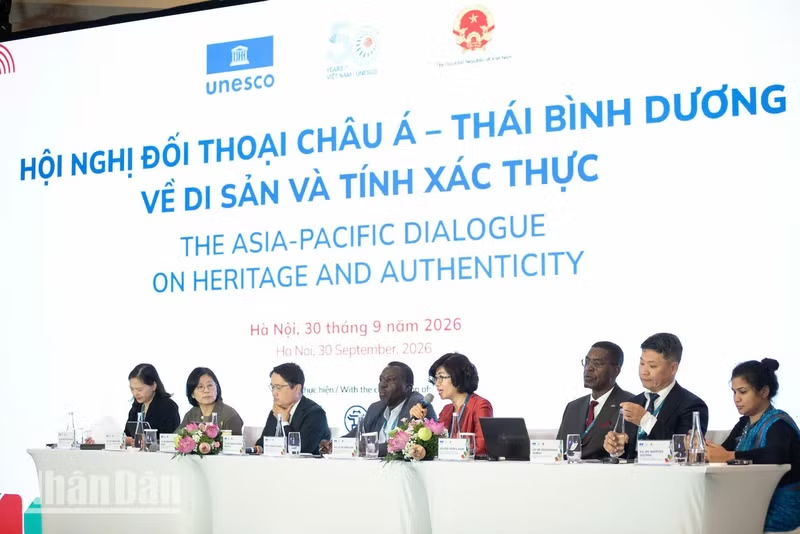
Co-chair of the Dialogue Professor George Abungu stressed the importance of incorporating the views of ambassadors and policymakers into the process of turning professional recommendations into concrete action. He expressed hope that the Ha Noi Document would fully reflect the participants’ aspirations before being submitted to the relevant authorities.
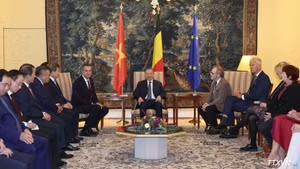
Ambassador Le Thi Hong Van, Secretary-General of the Viet Nam National Commission for UNESCO, who moderated the session, welcomed ambassadors and heads of UNESCO delegations who had travelled from Paris to Ha Noi to share national experiences and practical perspectives, contributing key messages to the World Heritage Committee and future international cooperation.
Representing the Republic of Korea, which holds the presidency of the 48th session of the World Heritage Committee, Ambassador Kim Ji-hee said understanding of authenticity had evolved significantly since the Nara Document of 1994. She stressed that authenticity should be considered in relation to the cultural, historical and environmental contexts in which heritage exists, supporting a multidimensional and flexible approach.
She also highlighted the 2025 Nairobi Document on living heritage, indigenous knowledge and community participation, noting that diversity and universality are complementary rather than contradictory. The key challenge, she said, is to balance flexibility in cultural expression with the need for authenticity claims to be supported by reliable scientific evidence and linked to the attributes underpinning a site’s outstanding universal value.
Ambassador Nguyen Thi Van Anh, Permanent Representative of Viet Nam to UNESCO and Vice-President of the 49th session of the World Heritage Committee, said authenticity should not be treated as a “frozen concept”, but understood with respect for cultural diversity and the ways in which communities transmit their heritage.
She proposed three practical directions: strengthening regional cooperation, including through a proposed Asia-Pacific Heritage Cooperation Network and regular training programmes for young experts; incorporating regional dialogue outcomes into the Operational Guidelines for the 1972 World Heritage Convention; and strengthening the role of diplomats as a bridge between national and international levels, experts and policymakers.
Other delegates highlighted the importance of living heritage, community participation, traditional knowledge and climate adaptation. UNESCO World Heritage Centre Director Lazare Eloundou Assomo said the Ha Noi Dialogue had “continued the success of the door opened by Nairobi” and pledged that the Centre would compile the discussions for submission to the World Heritage Committee at its forthcoming session in Istanbul.
The outcomes are expected to provide a basis for refining assessment methodologies and incorporating more diverse and inclusive approaches to authenticity into heritage management worldwide.