According to statistics from the Viet Nam General Confederation of Labour, as of the end of 2025, the country has over 10.2 million union members. Women account for approximately 56% of this total, working across nearly all economic and social sectors and contributing directly to national development.
In recent times, trade unions at all levels have begun to fundamentally innovate both their operational content and methods to better meet the essential needs of their members.
Greater emphasis has been placed on policy formulation, dialogue, collective bargaining, oversight, and the protection of female workers’ rights. Numerous initiatives — ranging from healthcare and childcare support to fostering happy families and improving the quality of life for female members — have been maintained and expanded.
Ngo Thuy Trang, Vice Chairwoman of the Dong Thap Provincial Federation of Labour, shared that the “Club for Pregnant Women and Mothers with Young Children” — an initiative by the grassroots trade union at Cong Tien Garment Joint Stock Company — focuses on addressing needs related to prenatal health, nutrition, childcare, breastfeeding, legal knowledge, and work-life balance.
Thanks to its humane and practical nature, the club grew from 500 to nearly 1,000 members in just under eight months, fostering a friendly and cohesive work environment.
In Ho Chi Minh City, Nguyen Kim Loan, Vice Chairwoman of the City Federation of Labour, noted that the city’s trade union is gradually shifting its approach from “care based on occasions or campaigns” to “care based on needs and circumstances with a long-term perspective”, focusing on programmes regarding health, workers’ children, housing, and livelihoods.
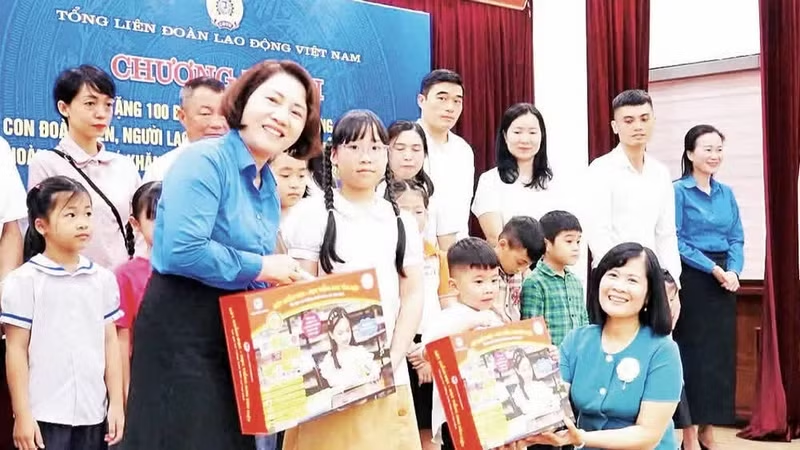
Meanwhile, the Nghe An Provincial Federation of Labour has expanded its support for workers’ children; beyond merely receiving gifts and scholarships, these children receive direct, ongoing support from various levels of the trade union. A prime example is the “Godmother” programme, which has supported 385 orphans during the 2022–2025 period.
In Dong Nai, surveys are conducted to understand the sentiments of female workers before these issues are brought to dialogue and collective bargaining, with a focus on wages, working hours, maternity benefits, childcare facilities, and skills training.
At the grassroots level, women’s affairs committees not only organise general labour and production emulation movements — such as the “Good at Work, Capable at Home” campaign — but also provide advice on income and welfare, monitor compliance with the Labour Code and collective bargaining agreements, and encourage male union members to share family responsibilities.
However, alongside positive results, activities concerning female workers have continued to face challenges and bottlenecks that need to be addressed. The quality of this work remains uneven across different levels, regions, and types of enterprises.
Efforts regarding dialogue, negotiation, oversight, and support for the professional development of female staff have not yet been commensurate with their contributions. Furthermore, grassroots committees for female workers lack sufficient resources, funding, and operational conditions.
In many places, the focus remains on publicity and campaigns centred around holidays and anniversaries. Benefits for female workers are often limited to superficial gestures — such as token support or gift-giving — rather than addressing core issues such as wages, labour quotas, working hours, health, and career opportunities.
Support activities tend to be casual rather than in-depth, making it difficult for shift workers to participate regularly. Meanwhile, the needs of female workers are becoming increasingly diverse, encompassing job quality, income, physical and mental health, parenting skills, work-life balance, and the ability to adapt to technological changes and shifts in production structures.
Thai Thu Xuong, Vice President of the Viet Nam General Confederation of Labour, stated that in response to practical demands, the focus of work regarding female workers must go beyond merely maintaining existing activities; it must align more closely with the lives and evolving needs of female union members and workers.
In its strategic direction for the 2026–2031 period — with a vision extending to 2045 — the Viet Nam General Confederation of Labour has determined that the focus, methods, and performance indicators for mobilising female workers and public employees must undergo a significant shift: moving from broad, general activities to substantive representation, care, and protection of their rights and interests.
In this new phase, success is no longer measured merely by the number of reported activities or classes held; instead, it must be gauged by tangible improvements in female workers' employment, income, working conditions, development opportunities, and quality of life.
This new era demands a significant shift: moving from campaign-style welfare provision to actively representing and protecting workers based on their actual needs and issues; transitioning from sporadic assistance to long-term partnership; and prioritising health, childcare, housing, nurseries, livelihoods, and the specific needs of distinct groups of female workers.
Huynh Thi Cam Hong, President of the Viet Nam Rubber Trade Union, emphasises that the care provided to female workers must be viewed holistically, encompassing their families, children, education, livelihoods, and personal autonomy.
Support strategies should evolve from immediate, one-off interventions to long-term partnerships — utilising models such as summer camps, educational support, micro-loans, and livelihood assistance — while mobilising resources sustainably and in ways tailored to the specific characteristics of each industry. True partnership means addressing the right needs at the right time, in alignment with the various stages of a worker’s life.
Bui Thi Bich Thuy, Vice President of the Dong Nai Provincial Federation of Labour, argued that dialogue and collective bargaining are crucial pathways for transforming specific needs — such as maternity support, lactation rooms, childcare facilities, and healthcare — into legal commitments and tangible benefits within enterprises. Employee welfare provisions must be adjusted in line with the cost of living and translated into measurable terms.
A key strategy for innovating work related to female workers involves enhancing the competencies and working methods of trade union officials.
Vu Thi Huong, Deputy Head of the Trade Union Affairs Department under the Thanh Hoa Provincial Federation of Labour, emphasised that officials in this field must shift from merely being “enthusiastic” to being “competent”, adhering to a comprehensive process: identifying needs, defining issues, providing advisory input, engaging in dialogue and negotiation, conducting oversight, and monitoring outcomes.
These officials require standardised skills in data analysis, dialogue, case resolution support, and the application of digital technology.




![[Video] Renewal and growth milestones of Ha Noi through the lens](https://en-cdn.nhandan.vn/images/1XgBTSIw0KyfD4abQsg-hd4ly6fBUHXC7_OAKyN4YwPfAhBw0Xs6rVX3rF0up9Tr6rLNn30Muc4bzp90E7yOqg/10-10-hanoi-cover.jpg.avif)