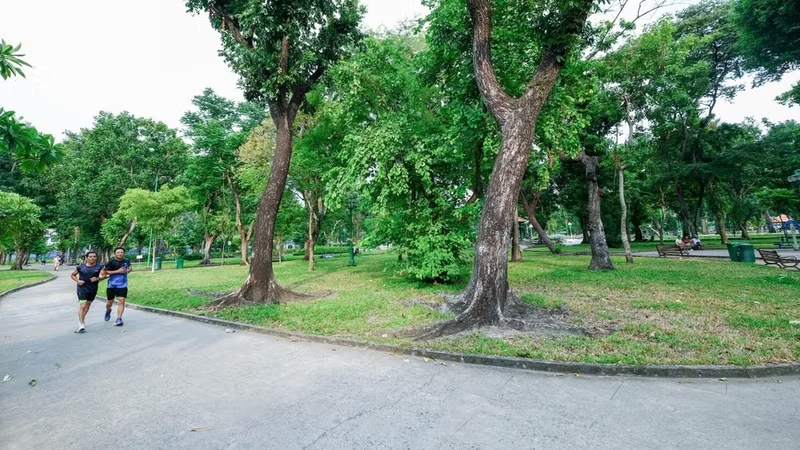
Creating additional development space and enhancing infrastructure capacity
The Ho Chi Minh City People's Council has recently adopted a resolution stipulating the formulation, appraisal, approval, and adjustment of plans for underground space in the city.
The resolution specifies Point a, Clause 3, Article 11 of the Law on Urban Development, dated August 28, 2026, adopted by the National Assembly. Its issuance responds to practical needs as Ho Chi Minh City implements numerous large-scale underground infrastructure projects, including urban railways, underground stations, transit-oriented development (TOD) areas, underpasses, and underground car parks. Demand for connections between underground spaces across projects is growing, while the city has yet to establish an overall underground space plan to serve as a basis for unified management.
Tran Chi Trung, Head of the Planning and Investment Division under the Ho Chi Minh City Department of Construction, said that as opportunities to expand above-ground space were limited in many areas, the rational use of underground space could provide additional room for development, reduce land-use conflicts, increase infrastructure capacity, and improve public transport connectivity.
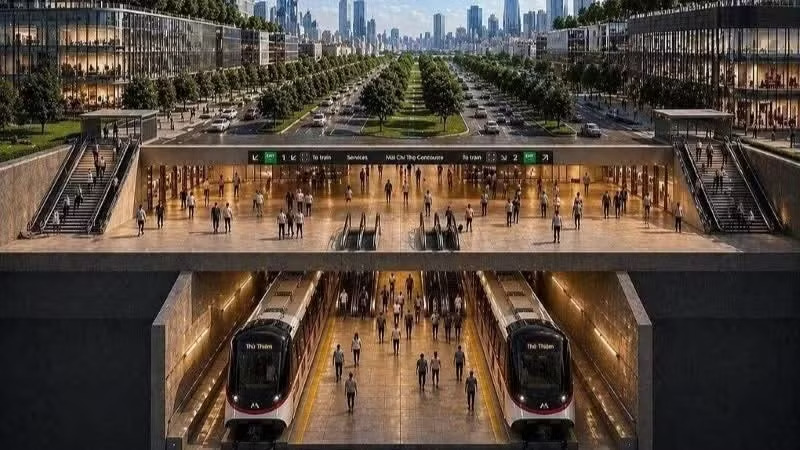
A recent survey by the Ho Chi Minh City Department of Construction found that, if underground space were used appropriately, a five-level underground car park at Le Van Tam Park could provide approximately 5,000 parking spaces for different types of vehicles. The proposal would not only help increase parking capacity in the city centre but also open up opportunities to make more effective use of underground space, ease pressure on above-ground transport infrastructure, and support the development of a more integrated and modern urban transport system.
The resolution also sets out technical provisions concerning the maximum depth at which underground space may be used in accordance with planning regulations without paying an underground space use fee; cases in which this depth limit is exceeded; underground space use fees; exemptions and reductions; and incentives, support measures, and policies to encourage investment in and the use of underground structures.
Under the city's regulations, within the boundaries of a land plot, land users may use underground space to a maximum depth of 15 metres, measured from the prescribed elevation datum, without paying an underground space use fee. If construction extends beyond the 15-metre depth limit, land users may proceed only if the project complies with planning regulations, does not overlap with other structures, meets technical safety requirements, and fulfils all financial obligations.
Dr Pham Viet Thuan, Head of the Ho Chi Minh City Institute of Natural Resources and Environmental Economics, said that the fee for underground structures was entirely new. He therefore suggested that the city should not retroactively collect fees for underground structures that had entered operation before January 1, 2027, and that the State should clearly stipulate that no underground space use fee would be charged in such cases.
In addition, during implementation, relevant departments and agencies should periodically review the fee coefficients, closely monitor actual revenue and funding needs, and conduct a review every three years to promptly propose adjustments to the City People's Council in line with market fluctuations.
Ensuring safety, public interest, and a long-term vision
Underground space is a development resource, but it also poses potential risks without proper planning and strict control. Geological conditions, groundwater levels, drainage capacity, the risk of subsidence, and impacts on neighbouring structures must all be assessed during the formulation and appraisal of plans.
“At present, many areas do not yet have an overall underground space plan. Appraisal agencies must proactively and carefully review above-ground zoning and detailed plans. In particular, they must proactively seek written opinions from defence and security authorities on projects that could affect national security, rather than requiring investors to contact those agencies themselves,” Dr Pham Viet Thuan said.
Recently, to implement the Law on Urban Development in conjunction with underground space planning, the Ho Chi Minh City Urban Railway Management Board selected three areas considered hubs connecting urban railway lines with underground spaces: Ben Thanh, Tan Son Nhat, and Thu Thiem. These areas will serve as the basis for selecting standards for underground stations. At least two stations in the Ben Thanh area are expected to be selected for investment as part of the Ben Thanh Hub, in connection with two metro projects: the Ben Thanh–Can Gio Metro line and the Ben Thanh–Thu Thiem Metro line.
Phan Cong Bang, Head of the Urban Railway Management Board, said that underground space was essentially one component of TOD, encompassing underground areas, above-ground spaces, and, potentially in the future, three-dimensional elevated spaces. The City People's Council has recently approved two resolutions related to underground space, which are expected to provide a basis for planning implementation and for inviting investors to participate.
Some experts also noted that, for the provisions to be applied promptly, underground space planning must take into account the relationships between different spatial levels, between underground structures and the surface, and between related projects. When integrated into a coherent overall plan, each structure will be better positioned to fulfil its function, minimise overlap, and facilitate future infrastructure development.
For Ho Chi Minh City, the immediate task is to review, update, and digitise data on underground structures, gradually building a unified information system to support planning, appraisal, licensing, and investment management. If data remain fragmented or are not regularly updated, conflicts between structures may still arise even after approval procedures have been improved.
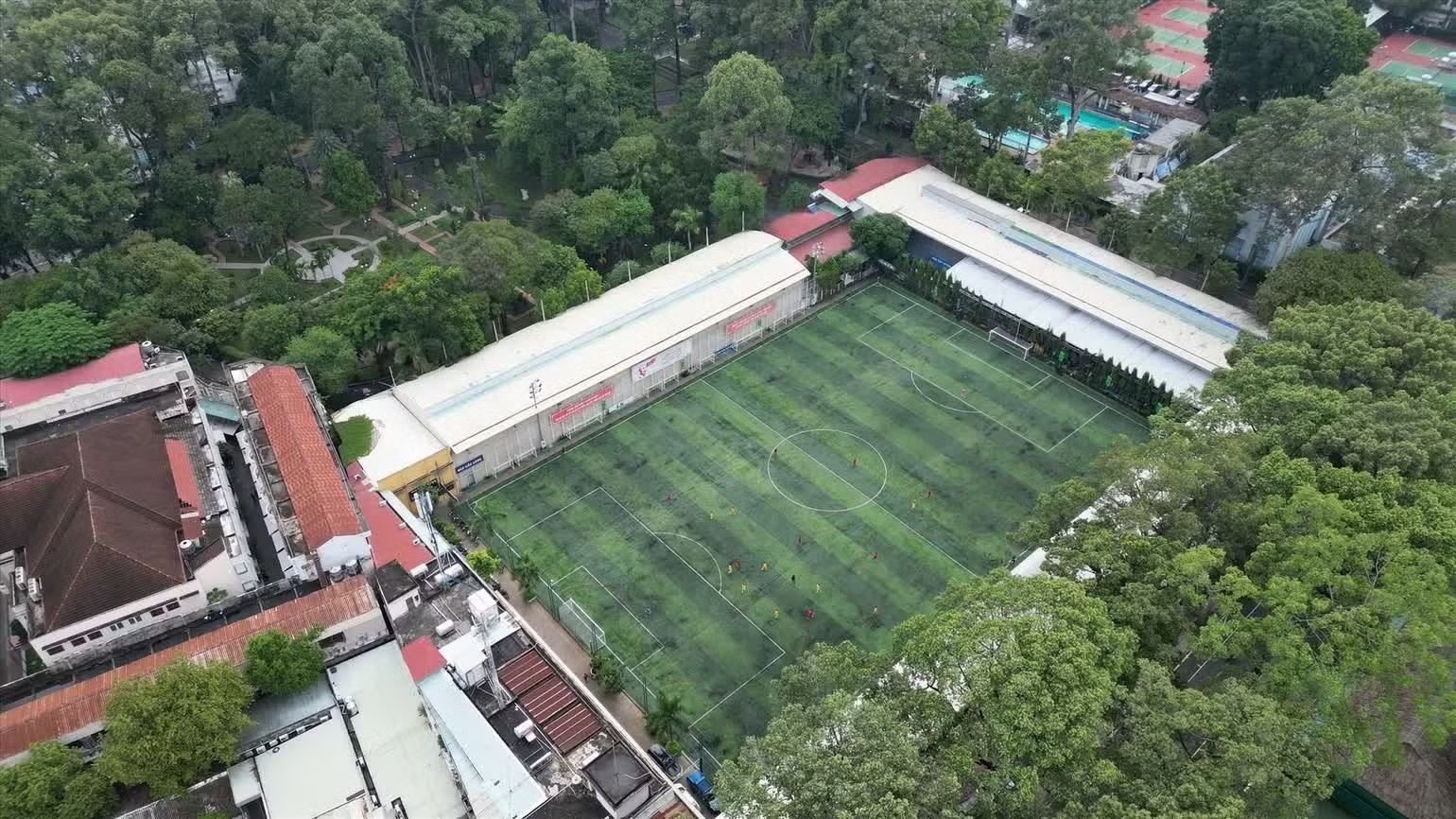
During 2010–2012, several investors registered to develop underground car parks in Ho Chi Minh City, including projects at Le Van Tam Park, the Trong Dong Theatre, Lam Son Square, and the football ground in Tao Dan Cultural Park. However, most of these projects failed to proceed for various reasons, including obstacles relating to planning, land-use coefficients, planning options, and development targets.









![[Video] Renewal and growth milestones of Ha Noi through the lens](https://en-cdn.nhandan.vn/images/1XgBTSIw0KyfD4abQsg-hd4ly6fBUHXC7_OAKyN4YwPfAhBw0Xs6rVX3rF0up9Tr6rLNn30Muc4bzp90E7yOqg/10-10-hanoi-cover.jpg.avif)