In this context, expanding development space and efficiently exploiting and using underground space are being given particular importance, as they become an inevitable trend and a strategic direction for developing modern, sustainable cities.
Urban underground space is part of the national territorial space and represents a valuable finite resource associated with the requirements of managing, exploiting, and protecting the territory. It also carries particular strategic value in terms of socio-economic development and national defence and security.
A shift in thinking
Amid the need to renew the growth model, thinking about urban space needs to undergo fundamental changes, shifting from “building underground” to “planning underground space” as an integral part of the urban structure.
In particular, a breakthrough requirement is to strongly develop underground space in major cities, growth poles, financial, commercial and logistics centres, and public transport hubs.
This is not merely a solution to address the shortage of land above ground; underground space needs to be regarded as a new layer of development space, planned, managed, and exploited in an integrated manner alongside above-ground and elevated spaces.
From the perspective of urban planning and development, underground space does not merely address the limitations of above-ground space; it opens a new development space where infrastructure, transport, commerce, services, and other urban functions are organised underground, laying the foundation for a multi-layered, modern, and sustainable urban structure.
More importantly, this represents a shift in the way development space is organised, from viewing underground areas as merely the “part beneath the city” to seeing them as a layer of urban space, and a decisive move from “managing individual underground structures” to “overall governance of the nation’s underground spatial resources.”
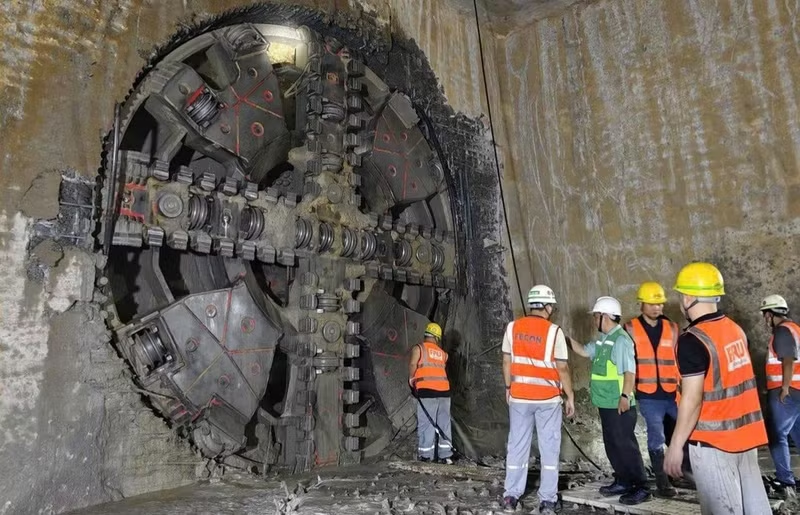
One perception that needs to change is that underground space must be viewed as a system. It is not simply a technical space; it can encompass urban railway systems and underground roads; public transport hubs; car parks; commercial and service centres; water supply and drainage systems; water regulation, drainage, and flood prevention facilities; underground reservoirs; energy systems; utility cables and pipelines; logistics facilities; public service and commercial spaces; and other facilities serving urban needs, including national defence and security facilities and civil defence infrastructure.
The experience of countries such as Japan, Singapore, and China shows that underground space is not merely a place for technical infrastructure but has become a “city within a city”.
Underground space has therefore emerged as a new economic resource, climate change-adaptive infrastructure, and a core component of the all-people national defence and people’s security posture in the new situation.
However, underground space can only realise its full value when it is planned as a network, with facilities systematically interconnected and integrated with the above-ground urban spatial structure.
Planning must take the lead
Underground space planning needs to be incorporated into overall urban planning from the outset, in coordination with land-use planning, transport development, technical infrastructure, public spaces, and above-ground urban functions.
Taking the lead in planning does not simply mean forecasting demand and reserving space for future underground facilities; it also requires proactively establishing the structure and network, connection corridors, and priority areas for underground development, thereby enabling connectivity between facilities and between underground and above-ground spaces.
Effective integration of the different layers of urban space will turn underground space into a new development resource, limiting fragmented development and conflicts between facilities while helping to reduce the costs of renovation and adjustments.
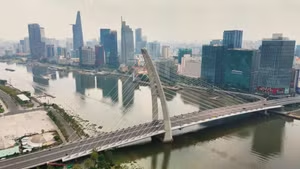
The development of underground space is not merely a long-term requirement at the national level; it has gradually been incorporated into the development strategies of major cities, particularly Ha Noi and Ho Chi Minh City, where the pace of urbanisation is rapid, building density is high, and demand for transport and infrastructure continues to grow.
In Ha Noi, underground space is recognised as part of the urban infrastructure and spatial structure, to be studied in an integrated manner with transport, technical infrastructure, urban centres, and new development areas.
For Ho Chi Minh City, alongside improving the quality of planning through breakthrough thinking and a long-term vision, integrated planning is needed for underground space, green space, river and water spaces, and cultural space.
The experience of the two cities shows that underground space is gradually shifting from being primarily a technical consideration to becoming a component of urban spatial development strategies.
Proactively planning underground space today means creating additional development capacity for the cities of tomorrow, paving the way for modern, efficient, safe, resilient, and sustainable Vietnamese cities.