The Ministry of Construction is proactively and actively developing mechanisms for the effective governance of the nation’s underground spatial resources. Ta Quang Vinh, Director General of the Department of Construction Infrastructure (Ministry of Construction), said that amid urbanisation and socio-economic development, the exploitation of underground space has become an objective and urgent requirement for urban development as well as for organising the country’s development space.
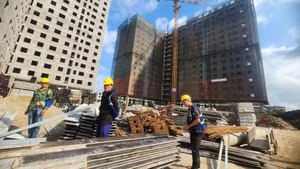
By the end of 2025, the national urbanisation rate had reached approximately 45%. As the pace of urbanisation continues to increase, surface land resources in major cities are becoming increasingly scarce, placing significant pressure on infrastructure systems. Resolution No. 19-NQ/TW dated July 28, 2026 on renewing Viet Nam’s development model identifies underground space as strategic infrastructure and a new security space and field.
Previously, Conclusion No. 224-KL/TW dated December 8, 2025 of the Politburo required that the legal regulations on underground space be completed in 2026. On that basis, the Ministry of Construction has begun developing the project “Exploitation, Governance and Protection of Underground Space”, with the consistent approach of making a strong shift from “managing individual underground structures” to “comprehensively governing the nation’s underground spatial resources”.
In the field of underground-space exploitation, given the position and stature of the capital, Ha Noi needs to take the lead in testing policies and approaches that have never before been applied in Viet Nam. To exploit the “third development layer”, policies and operating methods are much more complex than those for exploiting the ground and upper levels.
To date, underground space has mainly been exploited through individual projects, lacking synchronous connections between systems. Data on geology, existing technical infrastructure and planned projects remain fragmented. The mechanisms for dividing underground space into levels and layers are not yet clear; rights of use, obligations for protection and benefit-sharing have not yet been fully defined. The consequence is the risk of overlapping, technical conflicts and wasted resources.
The areas currently being studied by the Ministry of Construction include layered planning, connections with metro networks, the development of geological databases and 3D Building Information Modelling (BIM), the development of the underground-space economy, as well as mechanisms to support businesses and policy pilot schemes.
For the capital, the development of an underground-space plan must be closely linked to the orientation towards a polycentric, multi-centred urban model and transit-oriented development (TOD). Metro stations should not simply be passenger pick-up and drop-off points but could become connecting points between different layers of space.
According to the Department of Construction, the city is expected to have five national-level TOD areas, each covering approximately 100 hectares; 23 regional-level TOD areas, each covering approximately 50 hectares; and 134 other TOD areas, with a total exploitable area of approximately 5,000 hectares. To exploit underground space, benefit-sharing mechanisms among the State, businesses and communities need to be clearly stipulated; a fund for underground-space development should be established to reinvest in public infrastructure.
Recently, the city issued a plan to conduct research and develop specific policies and regulations on collection rates and exemption and reduction policies for revenues generated from the exploitation of increased value in TOD areas. One idea that should be considered is establishing an “underground-space governance belt” for each key urban subdivision, in which 3D digital data would become a mandatory tool for all underground investment projects.
Underground space is a resource capable of generating added value. Underground commercial and service models, smart urban logistics and multifunctional public spaces could contribute to increasing budget revenues and support reinvestment in metro systems and other public works.
Doctor and architect Dao Ngoc Nghiem, former Director of the Ha Noi Department of Planning and Architecture, noted that, based on the experience of many countries, in addition to underground-space planning, there is a need for a law on underground space.
When underground space is governed as a strategic resource, Ha Noi will have an additional “layer of space”, opening up new development opportunities and creating conditions to achieve major objectives of protecting and promoting heritage and urban identity, while improving the quality of living spaces.

![[Video] Renewal and growth milestones of Ha Noi through the lens](https://en-cdn.nhandan.vn/images/1XgBTSIw0KyfD4abQsg-hd4ly6fBUHXC7_OAKyN4YwPfAhBw0Xs6rVX3rF0up9Tr6rLNn30Muc4bzp90E7yOqg/10-10-hanoi-cover.jpg.avif)