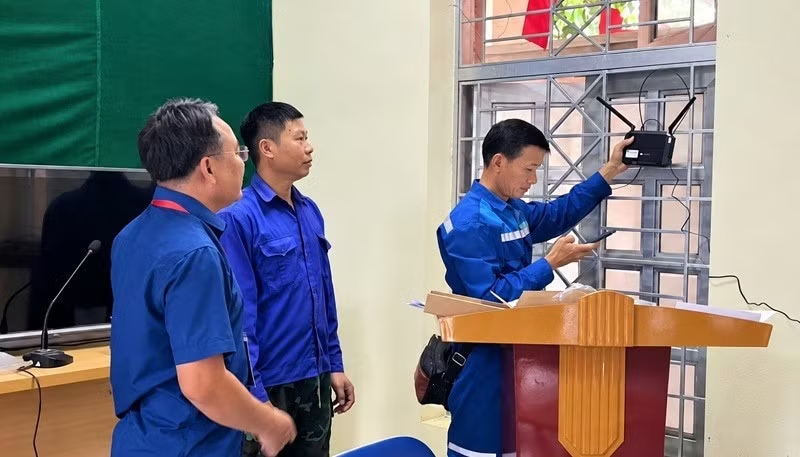
Under the initiative, each village in Muong Mun Commune has been provided with at least one Wi-Fi access point at its cultural house or community meeting venue, operating under the common network name “MUONGMUN_SO”. Access passwords and QR codes are managed separately by each village.
In areas with fibre-optic infrastructure, internet connections provide a minimum bandwidth of 100 Mbps. In locations relying on 4G or 5G mobile networks, data packages and connection speeds are selected according to the local conditions.
Before implementation, the commune conducted infrastructure surveys across all 18 villages, focusing on installation sites, electricity supply, fibre-optic connectivity, mobile network coverage, user demand, equipment security, and personnel responsible for network management.
Based on the survey findings, each village was provided with a solution suited to its infrastructure, including fixed fibre-optic connections, 4G/5G devices, or outdoor Wi-Fi access points.
Following the installation of internet connections, each village will organise at least one training session to guide residents in using Wi-Fi to access online public services, the VNeID digital identification application, public digital signatures, and cashless payment services.
Residents will also receive guidance on accessing reliable information sources and developing basic information security skills.
During the first 12 months of implementation, funding for the installation and maintenance of internet connections and Wi-Fi networks in the 18 villages will come from the 2026 budget for science, technology, innovation, and digital transformation, together with other lawful funding sources in accordance with regulations.
Extending Wi-Fi coverage to every village will help improve access to digital infrastructure and facilitate the wider implementation of the “Digital Literacy for All” movement in Muong Mun Commune.
The initiative will provide greater opportunities for residents, particularly older people, ethnic minority communities, students, informal workers, and vulnerable groups, to access digital services, develop practical digital skills, and gradually incorporate digital technologies into their daily lives.







![[Video] Renewal and growth milestones of Ha Noi through the lens](https://en-cdn.nhandan.vn/images/1XgBTSIw0KyfD4abQsg-hd4ly6fBUHXC7_OAKyN4YwPfAhBw0Xs6rVX3rF0up9Tr6rLNn30Muc4bzp90E7yOqg/10-10-hanoi-cover.jpg.avif)