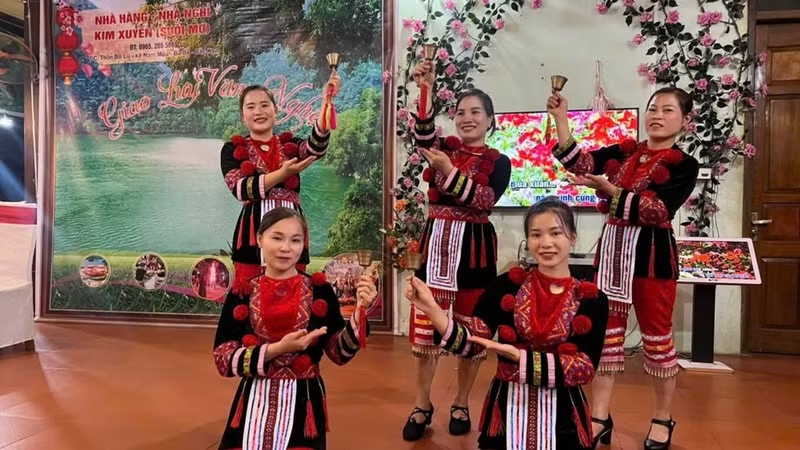
Trieu Kim Xuyen, Head of the Ba Be Community-based Tourism Chapter and Vice Chairwoman of the Thai Nguyen Province Tourism Association, has developed a homestay model since 2011 and is one of the pioneering women leading and participating in community-based tourism development in the Ba Be Lake area.
At her family’s homestay, women are involved in most of the work. Xuyen has encouraged women to establish cultural exchange clubs, including Then singing clubs. When tourists arrive, the teams organise exchanges, perform Then singing, play the tinh lute, dance and present distinctive folk and traditional melodies. These activities help introduce local culture while creating additional income and livelihoods for women.
In Ta Van Commune, Lao Cai Province, women’s role in developing community-based tourism is reflected in the linkage of various activities into an experience chain.
Giang Thi Senh, Chairwoman of the Ta Van Commune Women’s Union, said that in recent times, Muong Hoa Brocade Cooperative has effectively promoted its role in connecting households and linking activities from accommodation, cuisine and culture to traditional crafts, thereby forming a relatively closed experience chain for visitors.
Accordingly, one family provides accommodation, another serves food, while other groups organise cultural activities and folk art performances. Tourists stay at one house, enjoy meals at another family, and then continue to experience traditional crafts. Separate activities are thus connected into a product chain. This model has created jobs for many women, with incomes of around 5-6 million VND per month.
In Ta Phin Commune, Lao Cai Province, over the past 10 years, the Dao Do Community Cooperative, headed by Tan Ta May, has proved the success of the community-based tourism model, helping cultural values become livelihoods for local women.
Established in 2015 with seven members, the cooperative has so far gathered 120 people to participate in tourism and service activities and promote traditional crafts. A highlight is the use of folk knowledge about medicinal plants and the processing of traditional remedies of the Red Dao people into products serving tourists, from herbal baths and soaking remedies to healthcare products.
In rural, mountainous and ethnic minority areas, women are becoming increasingly involved in the service chain, from accommodation, cuisine and experience guidance to handicraft production, art performances and the development of products from agriculture and medicinal plants.
Assoc. Prof. Dr Bui Hoai Son, National Assembly deputy and full-time member of the National Assembly’s Committee on Culture and Society, emphasised: “Women’s greatest contribution to community-based tourism does not lie only in the number of services they take part in or the number of products they sell. More importantly, they are helping create a link between cultural preservation and livelihood development, between tradition and the market, and between local identity and the experience needs of modern society.
When women are given opportunities, equipped with knowledge and truly become subjects of the development process, community-based tourism will generate additional income and help culture live on in contemporary life.”
Women’s role is shifting from “participants” to “creative subjects and economic actors”. When women can create economic value from their communities’ own cultural capital, they gain a stronger voice in economic decisions, as well as access to knowledge, technology and broader social relations.
Although women have many ideas and traditional skills in supporting start-up capital and production linkages, experts in the tourism sector say one of the difficulties facing rural and mountainous women in general today is the lack of resources to renovate and build homestays, purchase equipment, improve products or promote them on digital platforms.
The market is also a weak point for many models. There are good products rich in identity, but their makers do not yet know whom to sell to, where to sell them or how to tell the story behind the products.
Therefore, supporting women in connecting with markets, building brands and bringing products onto sales channels is an important part of the development process. At the same time, the use of culture for tourism development must ensure that communities remain the subjects and benefit fairly. A handicraft, a dish, a folk melody or indigenous knowledge only truly becomes a development resource when the people who preserve those values have a voice in the process of using them and receive commensurate benefits.
When provided with suitable conditions to bring their role into play, women will become an important force in promoting tourism development in a sustainable manner, in harmony with people’s lives.
![[Video] Viet Nam among Top three Asian destinations for return visitors](https://en-cdn.nhandan.vn/images/nyM650OGFWrOVWc-xajqN-rTZ68Rlmc1fiGJOhBRYHErj-E25MBpvJqrpphXazfrpe9t-fYCGuQU4CN0yXo3Rg/du-lich-vietnam.jpg.avif)


![[In Pictures] Nui Chua Rock Park: A million-year-old outdoor museum of landforms on the Khanh Hoa coast](https://en-cdn.nhandan.vn/images/nyM650OGFWrOVWc-xajqNz57td8idIAL_VG9puyG2UZEKOnmq1DVlT1--ZclbO3z2WBaWZhbt6O3e8kjPZqJMWkfEz7RO9qhcwg8o8LQFK8/ndo-br-cao-nguyen-da-moi.jpg.avif)