The resolution sets out eight key groups of tasks. Among them, reforming tourism governance and improving the quality of green, smart, safe and sustainable tourism destinations have been identified by the Politburo as important tasks to enhance adaptability and flexibility in response to environmental impacts and climate change. This places a requirement on Party committees and authorities at all levels to strengthen their capacity for modern and sustainable tourism governance.
In implementing the central Government’s policies, many localities have gradually reformed their tourism governance methods, focusing on the quality of growth and professionalism of the tourism industry.
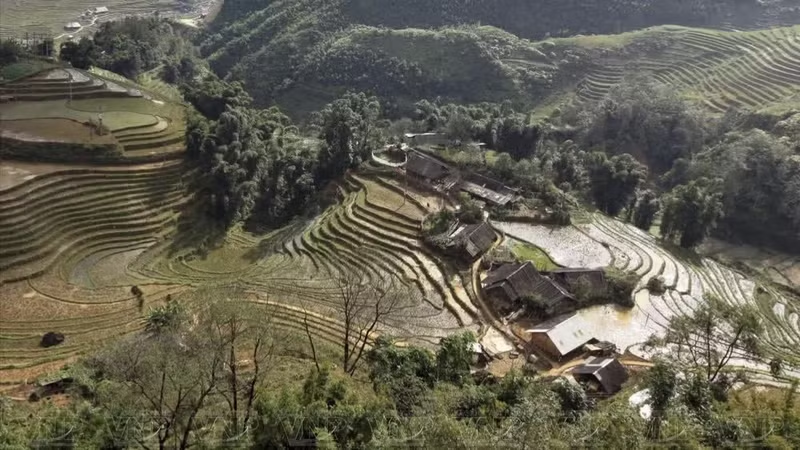
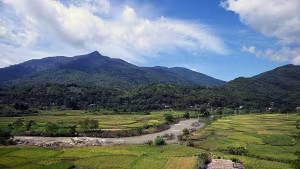
During the 2026–2030 period, the Lao Cai Provincial Party Committee’s Standing Board aims to build the province into a year-round tourism hub, rather than relying on peak months. This goal is well-founded, as Lao Cai offers a wide range of tourism products, with attractions and destinations stretching from Thac Ba Lake to the highlands of Mu Cang Chai and Sa Pa and onwards to border areas and border gates.
However, this opportunity also places greater demands on “green” governance, as rising visitor numbers mean destinations must take into account carrying capacity, the environment, waste, domestic water supplies, landscapes and the capacity of infrastructure. If development becomes too rapid and lacks proper management and oversight, Lao Cai’s existing resources could be damaged and become difficult to restore.
With a long-term vision, the Standing Board of the Provincial Party Committee has determined that tourism development projects and plans must provide strategic direction for sustainable and coordinated tourism development, and that these principles must be embedded in the awareness and actions of the entire political system.
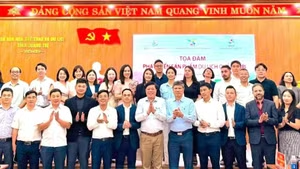
Accordingly, implementing Resolution No. 26-NQ/TW together with Directive No. 33-CT/TW of the Lao Cai Provincial Party Committee’s Standing Board on strengthening the Party’s leadership over tourism management and development in the province will provide a foundation for maximising the sector’s strengths, removing “bottlenecks”, creating momentum for breakthroughs and contributing to the locality’s overall growth.
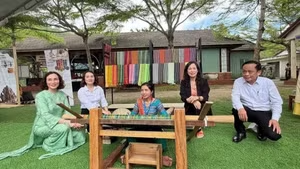
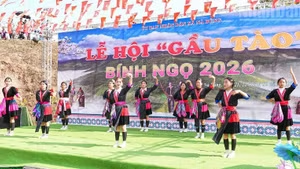
By applying technology to destination management, Lao Cai is seeking to minimise the impact of tourism activities on the natural environment, particularly landscape values and biodiversity, while encouraging ecotourism models suited to the potential of each locality. The Provincial Party Committee’s Standing Board regularly urges Party committees and authorities at all levels to strengthen tourism linkages among communes and wards, with a focus on effectively utilising highland ecological spaces and landscapes, cultural markets, traditional festivals and the cultural life of ethnic communities.
The province has prioritised investment in environmentally friendly outdoor walking trails, professional off-road racing tracks and paragliding sites. Supporting tourism infrastructure along routes, including rest stops, signage systems and standardised public toilets, is also gradually being built and upgraded.
With the goal of turning the Sa Pa National Tourism Area into a model of professional and high-quality tourism, gradually reaching international standards, the Standing Board of the Provincial Party Committee has focused on improving service quality and destination management capacity, while addressing outstanding issues that affect the province’s tourism brand.
With tourism given priority as an economic sector, Sa Pa Ward and surrounding communes will not develop industrial activities or invest in additional hydropower projects, while high-rise apartment developments will not be encouraged. These measures aim to protect and preserve the distinctive landscape and spatial character of the tourism town.
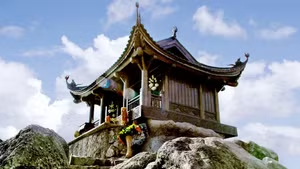
The Party Committee and authorities of Sa Pa Ward are advising on and proposing special mechanisms to mobilise resources for synchronised transport and technical infrastructure; preserve and restore historical and cultural sites, complexes and traditional houses; and study plans for investing in a railway system connecting the airport with the mountain-top area. Through these coordinated solutions, the Party Committee and authorities of Sa Pa Ward aim to create long-term development momentum and enhance the competitiveness of the tourism area.
Party committees and authorities at all levels in Lao Cai Province are also paying attention to promoting complementary tourism products and linking tourism with the development of medicinal plants. In recent years, the Standing Boards of the Party Committees of Ta Cu Ty and Lung Phinh communes have stepped up the cultivation of temperate-climate crops and deep processing of medicinal plants, accelerated the completion of local projects, particularly site clearance, and paid attention to the maintenance and repair of deteriorating roads.
![[Video] Viet Nam among Top three Asian destinations for return visitors](https://en-cdn.nhandan.vn/images/nyM650OGFWrOVWc-xajqN-rTZ68Rlmc1fiGJOhBRYHErj-E25MBpvJqrpphXazfrpe9t-fYCGuQU4CN0yXo3Rg/du-lich-vietnam.jpg.avif)