The city has capitalised on the distinctive advantages of different areas, gradually expanding its tourism space, enriching visitor experiences, and enhancing the competitiveness of its tourism sector.
Distinctive attractions
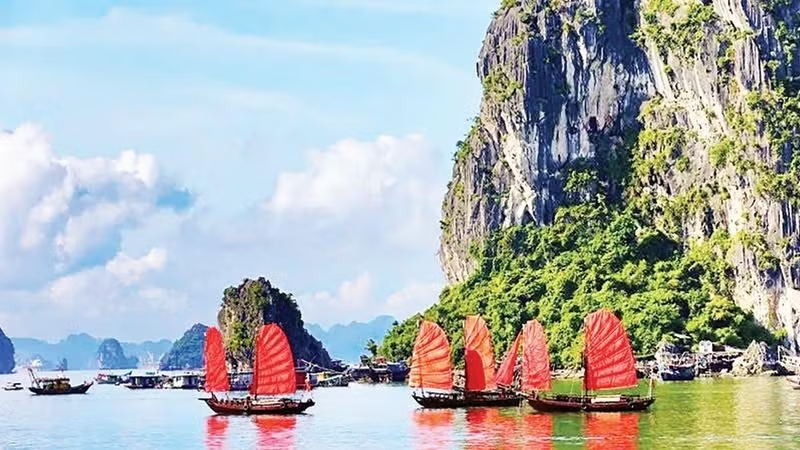
Recently, the Ha Long three-sided sailing boat tourism product has offered visitors new experiences by recreating the cultural setting of a fishing village on Ha Long Bay.
The image of three-sided boats with reddish-brown sails evokes memories of a bygone era associated with the lives of Ha Long fishermen. The now-restored boats take visitors along the coastal route from Bai Tho Bridge to the Planning and Expo Centre, creating a distinctive attraction compared with traditional sightseeing products on the bay.
Nguyen Thi Hoai Thu from Ha Noi said: “The appeal of this product does not stop at the beautiful scenery of Ha Long Bay. What makes it attractive to visitors is the traditional cultural values conveyed in a simple way, making them easy to remember and relate to. For me and other visitors, this was truly an impressive experience.”
Ky Thuong Commune is blessed with a system of streams, brooks, and waterfalls amid forests, with most of the commune’s area lying within the core zone of the Dong Son-Ky Thuong Nature Reserve. In recent years, the community-based ecotourism model in Khe Phuong Village has attracted both domestic and international visitors.
In particular, Ky Thuong boasts distinctive forest tourism potential; from high peaks such as Thien Son, Am Vap, Dong Tra, Khe Ru, and Ngon Mo, which are shrouded in clouds year-round, to streams, brooks, and waterfalls hidden among ancient forests, the area offers pristine beauty that captivates visitors.
Building on these advantages, the community-based ecotourism model in Khe Phuong Village has chosen to tap into the value of the forest as its distinctive identity, where visitors can step into a fresh green space and immerse themselves in the rhythm of the mountains and forests. Am Vap Farm has now truly become a destination where visitors can experience the traditional cultural values of the local ethnic communities.
Pham Thi Xuan from Phu Tho said: “I really enjoyed walking through the bamboo forest, cycling and kayaking along the crystal-clear stream, admiring the pristine beauty of the mountains and forests, and joining local people in harvesting bamboo shoots. It was truly an unforgettable experience.”
Creating sustainable value for communities
Blessed with scenic landscapes and surrounded by natural forests, Khe San attracts visitors with its clear, cool water, which is available year-round. These distinctive natural conditions encouraged Tran Van Ma’s family to invest in a sturgeon farming model, with plans to develop experiential tourism activities linked to fish farming.
Ma said: “The streams here have clean, cool water all year round, making them suitable for sturgeon farming. Our family’s fish farming operation is now stable and has initially generated high economic value. More importantly, visitors who come to experience the local scenery are very excited to tour our sturgeon farm.”
In the border area of Hoanh Mo, hills covered in the green of cinnamon, star anise, medicinal plants, and fruit trees are creating a new landscape, paving the way for OCOP products to be gradually linked with experiential activities. The velvet-antlered deer farming model operated by the Nghiep Doan Agricultural and Services Cooperative is one of the tourist attractions in Hoanh Mo Commune.
Vi Van Nghiep, director of the cooperative, said: “Our aim is not only to provide visitors with quality products but also to offer them new and distinctive experiences. We believe this is the foundation for creating sustainable value for the community.”
Not only mountainous areas but also many coastal areas of Quang Ninh are developing experiential tourism strongly. In Co To, alongside traditional beach tourism, unique agricultural experiences are helping to create a distinctive identity.
Images of foreign visitors planting rice in the fields, taking cattle out to pasture, and harvesting sweet potatoes on the remote island have become interesting and distinctive moments.
Nguyen Hai Linh, Head of the Co To Culture and Social Affairs Bureau, said: “This experiential space can be likened to a miniature northern Vietnamese village in the middle of the sea. The greatest attraction lies not in the production activities themselves but in the sincerity and hospitality of local people.”
Meanwhile, Van Don is also planning to pilot a marine and island ecotourism model linked to aquaculture in Bai Tu Long Bay, as well as visits to floating stalls showcasing Van Don OCOP products. Local businesses are also looking to develop water sports tourism products such as jet skis, banana boats, and inflatable water parks.
Quang Ninh currently boasts more than 630 historical, cultural, and scenic sites, including around 150 nationally and provincially recognised sites, as well as more than 120 traditional cultural festivals and hundreds of intangible cultural heritages.
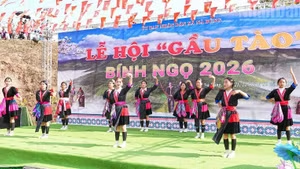
Each festival or cultural event is a vivid piece of the local cultural life, recreating the customs, beliefs, and traditional values that have been preserved across generations. This rich diversity creates unique experiential spaces where visitors can both immerse themselves in community life and explore the cultural depth of the region.
Nguyen Thuy Yen, Deputy Director of the Quang Ninh Department of Culture, Sports and Tourism, said: “Alongside stepping up tourism stimulus activities and expanding the visitor market, the tourism sector continues to focus on developing new tourism products, improving service quality, extending stays, and increasing visitor spending.”
She emphasised that Quang Ninh is focusing on marine and island tourism, high-end resort tourism, spiritual and cultural tourism, community-based tourism, night tourism, and experiential tourism.

![[Video] Viet Nam among Top three Asian destinations for return visitors](https://en-cdn.nhandan.vn/images/nyM650OGFWrOVWc-xajqN-rTZ68Rlmc1fiGJOhBRYHErj-E25MBpvJqrpphXazfrpe9t-fYCGuQU4CN0yXo3Rg/du-lich-vietnam.jpg.avif)




![[In Pictures] Nui Chua Rock Park: A million-year-old outdoor museum of landforms on the Khanh Hoa coast](https://en-cdn.nhandan.vn/images/nyM650OGFWrOVWc-xajqNz57td8idIAL_VG9puyG2UZEKOnmq1DVlT1--ZclbO3z2WBaWZhbt6O3e8kjPZqJMWkfEz7RO9qhcwg8o8LQFK8/ndo-br-cao-nguyen-da-moi.jpg.avif)