When present in travel experiences, OCOP products are no longer merely individual goods sold separately but have become part of a sustainable value chain.
Linking tourism with OCOP and cultural preservation
OCOP products carry stories about the history of local areas, community life, and folk knowledge passed down through generations.
Therefore, alongside consumption channels such as stores operated by producers, supermarkets, fairs, and online platforms, tourism spaces open broad room for products to be used and consumed during trips.
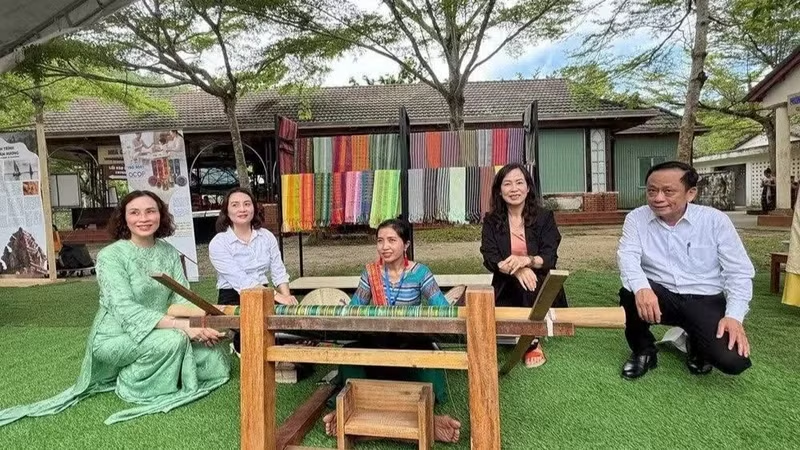
In this way, tourists do not simply buy finished products but can also trace the journey behind them, from raw material areas to production processes and cultural stories. Many localities are now actively bringing OCOP products into tourist sites and experiential activities. In Ninh Binh Province, three- to five-star products such as crispy rice, herbal tea, Van Lam embroidery, and Kim Son sedge products have been incorporated into services and cuisine at many high-end accommodation establishments.
The Ecohost community-based tourism model has also helped boost consumption of OCOP products through direct services and gifts.
With this approach, accommodation facilities are no longer merely places to stay but have become “living display spaces”, where tourists encounter local products during their stay while learning stories about the ancient capital.
Ninh Binh currently has about 1,000 OCOP brands, creating a considerable source of products to connect with tourism.
Ha Noi, with its 1,350 craft villages, is also a typical example of integrated services and craft villages. Ecotourism sites such as Phu Dong Green Park in Gia Lam Commune and the rural tourism site in Hong Van Commune combine educational activities, agricultural experiences, and recreation with on-site consumption of OCOP products.
Bat Trang Pottery Village is also a clear example, where tourists can directly choose and buy ceramic products, including many five-star OCOP products, shape pottery by hand, and visit and learn about the craft at the Centre for Vietnamese Craft Village Quintessence.
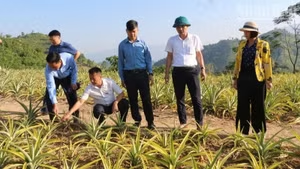
In Thai Nguyen Province, La Bang Commune is turning part of its tea raw material area into a destination where visitors can tour tea fields belonging to the group of “five great famous teas”, join farmers in picking tea, enjoy tea brewed by artisans on the hills, and buy OCOP products at the place of production.
In Da Nang City, 28 OCOP product display and introduction sites under the “Made in Da Nang” programme were established in 2026 at tourist areas, high-end coastal resorts, and Da Nang International Airport. On October 1, the model of bringing OCOP products into airports was also officially introduced at Tho Xuan Airport in Thanh Hoa.
In addition, hundreds of Thanh Hoa OCOP products have been brought to popular tourist destinations in Pu Luong, Thuong Xuan, Linh Son, and other areas.
Linking rural tourism with OCOP and cultural preservation creates “dual benefits”: increasing product value and contributing to rural economic restructuring, while preserving cultural values and indigenous knowledge.
Ha Van Sieu, Deputy Director of the Viet Nam National Authority of Tourism
These approaches are in line with the orientation being developed by the Viet Nam National Authority of Tourism in the project on “developing tourism in connection with the production and consumption of OCOP products — contributing to the preservation and promotion of cultural values and indigenous knowledge in Viet Nam’s rural areas.”
According to Ha Van Sieu, Deputy Director of the Viet Nam National Authority of Tourism, linking rural tourism with OCOP and cultural preservation creates “dual benefits”: increasing product value and contributing to rural economic restructuring, while preserving cultural values and indigenous knowledge.
From product introduction to market creation
Reality shows that bringing OCOP products into tourism spaces is only the first step. More importantly, it is necessary to create stable markets so that these products can participate in supply chains over the long term and generate value commensurate with the growing number of tourists.
According to Le Quoc Viet, Vice Chairman of the Da Nang Tourism Association and Chairman of the Xu Quang Destination Club, spending by international visitors in Viet Nam on gifts and goods accounts for only about 12-15%, lower than the Southeast Asian average of 22.5%.
If just 5% of the 19.5 million visitor arrivals targeted for 2026 were to buy a basket of local specialities worth 250,000 VND, Da Nang City’s tourism revenue would increase by about 244 billion VND per year, without incurring international transport costs or import-export procedures.
However, based on local practice, Viet also pointed out that many bottlenecks remain between potential and actual exploitation, including household-scale production that struggles to ensure large supply volumes; discount rates and long payment terms that exceed the capacity of many OCOP producers; packaging and design that have yet to meet the requirements of premium gifts; difficulties for high-end hotels and resorts in signing contracts with too many small suppliers; and a lack of data on the shopping habits of different groups of international visitors.
These limitations show that developing OCOP products in connection with tourism requires a linkage mechanism to standardise quality, design, supply capacity, and distribution methods, while helping tourism businesses access sources of goods suited to the needs of each visitor market.
Phuong Dinh Anh, Deputy Chief of the Central New-style Rural Coordination Office under the Ministry of Agriculture and Environment, said the country currently has more than 21,000 OCOP products.
The agency is advising on solutions to integrate OCOP development with tourism in localities with suitable conditions, bringing tourists to visit, experience, and shop directly at production sites, thereby opening the possibility of introducing products to international markets through tourists.
Placed in the new orientation, this requirement has become even more urgent. Politburo Resolution No. 26-NQ/TW (dated August 22, 2026) on developing Vietnamese tourism into a spearhead economic sector in the new era identifies the development of shopping tourism associated with high-quality Vietnamese goods and products recognised under the OCOP programme.
It also calls for stronger linkages among travel, transport, accommodation, services, and local products to increase domestic value, improve economic efficiency, and help Vietnamese businesses participate more deeply in value chains, global distribution channels, and on-the-spot exports.
In that ecosystem, OCOP is an important link. A product made in a rural area can become a story in a tour, a dish on a banquet table, an item in a resort space, an experience in a craft village, and a gift accompanying tourists wherever they go.
At that point, the value of OCOP does not stop at a single sale, and the value of tourism is not measured only by visitor numbers but also by its ability to create additional income and preserve identity for the communities where the products originate.