Unlocking two-way visitor flows through direct flights
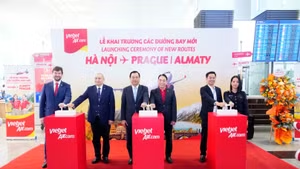
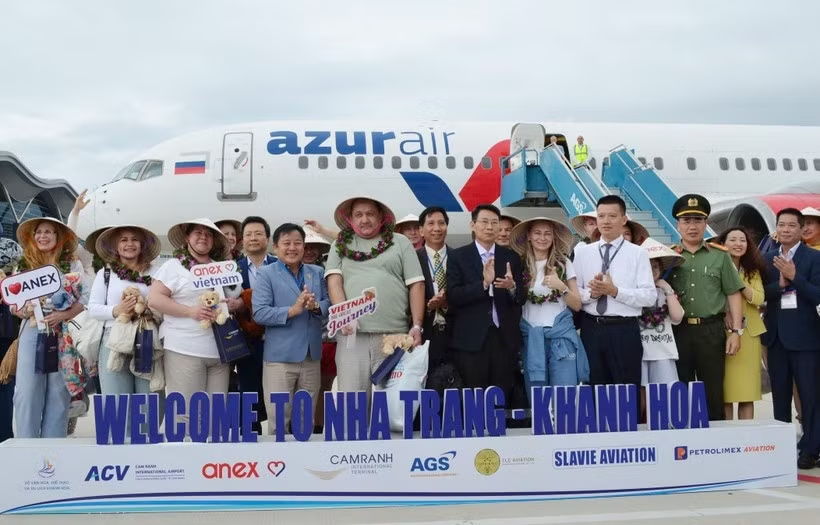
The first direct flight from Moscow to Nha Trang on September 23 has opened new opportunities to attract Russian tourists to Viet Nam’s coastal destinations. Alongside bilateral cooperation initiatives, the expansion of air routes connecting major cities in both countries is creating fresh momentum for two-way exchanges.
Nguyen Trung Khanh, Chairman of the Viet Nam National Authority of Tourism (VNAT), noted that Viet Nam–Russia cooperation has made steady progress in recent years, laying a favourable foundation for deeper collaboration in tourism.
According to VNAT’s Tourism Information Technology Centre, Viet Nam aims to welcome 25–27 million international arrivals in 2026. In the first nine months of this year, the country has already achieved around 70% of that target. Strikingly, Russian arrivals surged by 166% compared with the same period in 2025.
VNAT Chairman Nguyen Trung Khanh remarked that, given these positive signals, the target of one million Russian visitors in 2026 is entirely achievable.
Viet Nam offers a wide range of tourism products suited to Russian travellers, particularly coastal resort tourism, cultural tourism, sports tourism, MICE, and experiential discovery.
Chairman of the Viet Nam National Authority of Tourism Nguyen Trung Khanh
“Viet Nam offers a wide range of tourism products suited to Russian travellers, particularly coastal resort tourism, cultural tourism, sports tourism, MICE, and experiential discovery. Destinations such as Phu Quoc, Nha Trang and Da Nang remain especially attractive, with their favourable climate, beaches, islands, accommodation and service infrastructure proving highly appealing to this market,” he said.
Beyond efforts to draw more Russian visitors to Viet Nam, there is also considerable scope for growth in the opposite direction, with the market for Vietnamese travellers to Russia still underdeveloped. Russia continues to hold strong appeal for Vietnamese tourists.
When planning trips to Russia, Vietnamese visitors often highlight iconic sites such as Red Square, Saint Petersburg, grand palaces and the famed “White Nights”, alongside journeys on the country’s extensive rail network. Growing interest in discovery-based and experiential travel, particularly rail itineraries, is opening up opportunities to develop more tailored products for Vietnamese travellers.
Alexander Kardo-Sysoev, representative of the Russian Ministry of Economic Development in Viet Nam, expressed hope that both countries would continue advancing tourism cooperation. He also requested that VNAT share statistical data on Russian arrivals to support research and programme design.
The Russian side has invited VNAT representatives to attend the Viet Nam–Russia Tourism Working Group meeting, scheduled for December 2026 in Moscow.
Later this month, a delegation from the Centre for Strategic Research – a unit specialising in tourism research and training under the Russian Government – is expected to visit Viet Nam. The delegation will share expertise on attracting Vietnamese visitors with travel companies focused on the Russian market and host a plenary session at the Russian Centre for Culture and Science.
Easing visa bottlenecks and strengthening promotion of distinctive tourism products
Alongside positive results in visitor growth, Viet Nam–Russia tourism cooperation needs to address a number of visa-related issues, while also stepping up promotion and developing flagship products.
Recalling March 15, 2022, when tourism reopened after the COVID-19 pandemic, Viet Nam reinstated its unilateral visa-exemption policy for Russian citizens entering the country. From August 15, 2023, the permitted length of stay for visa-exempt visitors was extended to 45 days, while the validity of e-visas was increased to 90 days.
However, in practice, Vietnamese travellers to Russia still face certain difficulties with visa procedures. More flexible visa policies would help facilitate two-way visitor exchanges. Specifically, there is a need to further improve entry and exit procedures at Russian airports, including enhancing the efficiency of systems for checking and verifying international travellers’ personal information.
In addition, both sides should agree on and promote measures to facilitate payments in tourism, explore expanding convenient and secure payment methods, reduce costs and improve access to services for Vietnamese and Russian visitors. This would help enhance the overall visitor experience and boost two-way tourism between the two countries.
On the promotion and destination-marketing front, VNAT Chairman Nguyen Trung Khanh proposed that both sides intensify bilateral tourism promotion programmes and cross-promotion events, such as the Vietnamese Culture–Tourism Week in Russia and Russian Culture–Tourism Week in Viet Nam. At the same time, they should strengthen promotion on digital platforms, online media and social networks such as Facebook, TikTok and YouTube.
“Digital transformation and digital platforms are becoming effective channels for tourism promotion, making it easier for visitors to access information about destinations, products and services,” he said.
Building on discussions of key issues to enhance two-way visitor flows, management bodies and tourism businesses in Viet Nam and Russia need to focus on developing new products, encouraging visitors to explore each other’s culture and country through film tourism, arts tourism and specialised experiential offerings.
VNAT is currently focusing on developing and upgrading the international tourism promotion website at vietnam.travel, which is now available in 11 languages, including Russian.
The VNAT leader also called for both sides to increase the sharing of information and statistical data on visitor markets, support tourism businesses in accessing information and seeking partners, and study the feasibility of organising Russian-language training programmes for Viet Nam’s tourism workforce, especially tour guides.
According to Alexander Kardo-Sysoev from the Russian Ministry of Economic Development in Viet Nam, the Russian side has proposed coordinating with the Russian Centre for Culture and Science in Viet Nam to organise Russian-language training courses for tour guides and workers in the tourism sector. Russia will also work with relevant agencies and departments to study and improve entry and exit procedures, making travel more convenient for tourists.
Building on discussions of key issues to enhance two-way visitor flows, management bodies and tourism businesses in Viet Nam and Russia need to focus on developing new products, encouraging visitors to explore each other’s culture and country through film tourism, arts tourism and specialised experiential offerings.
“The demand for travel, sightseeing and cultural exploration among people in both countries is an important foundation for promoting bilateral tourist exchanges. The quality and spending patterns of two-way tourists are also changing in a more diversified direction, creating further opportunities for businesses to develop suitable products,” said VNAT Chairman Nguyen Trung Khanh.
As Viet Nam does not have an official tourism promotion office in Russia, intensified direct and online promotion activities are expected to help raise the profile of Viet Nam as a destination in the Russian market.