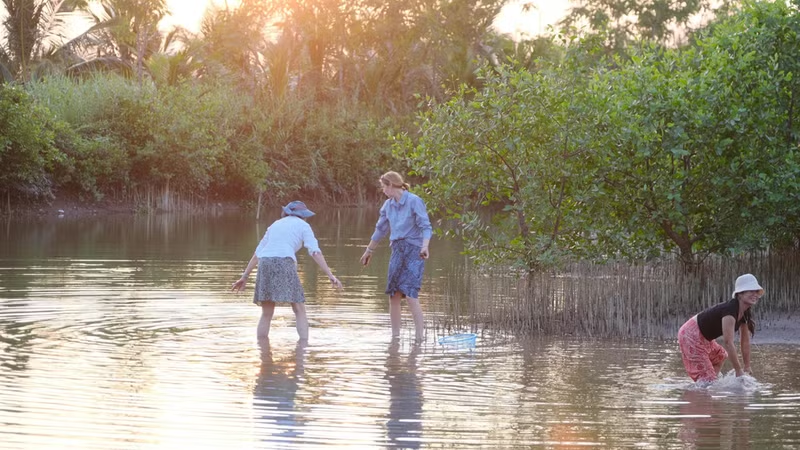
A natural treasure at the river’s end
Xuan Thuy Wetland Nature Reserve was designated a national park in 2003, covering a total area of 15,100 hectares, including a 7,100-hectare core zone and an 8,000-hectare buffer zone. Unlocking the potential of this area does not mean bringing large numbers of visitors into the forests or building more facilities. Instead, it requires a well-planned approach that generates value from nature while reinvesting part of that value in its conservation.
The area is a biological treasure trove, with 1,670 recorded species. Many plants, fish, reptiles, birds and crustaceans found here are listed in Viet Nam’s Red Data Book, the International Union for Conservation of Nature (IUCN) Red List of Threatened Species, or other legally protected lists.
In particular, Xuan Thuy National Park is considered a major international bird stopover in northern Viet Nam. From around October to April, tens of thousands of migratory birds escaping the northern winter stop to feed, rest and replenish their energy for the next stage of their journey.
Of the 222 bird species recorded here, the black-faced spoonbill is one of the rare species that holds particular appeal for researchers, photographers and nature enthusiasts. Around 90 to 100 individuals of this species arrive each migratory season.
Birdwatching involves more than simply standing at a distance and watching flocks fly past. Observers need to understand migration seasons, tidal patterns and feeding habits, choose suitable locations and wait patiently in silence. Such experiences could give local tourism a distinctive identity rather than replicate generic products available elsewhere.
On September 14, 2026, the Ninh Binh Provincial People’s Committee issued Decision No. 3374/QD-UBND recognising Xuan Thuy National Park, in Giao Minh Commune, as a tourist destination. This milestone gives the wetland a new status, marking a gradual shift from an area primarily dedicated to conservation and scientific research towards a destination within the province’s diverse tourism landscape.
Tran Song Tung, Standing Vice Chairman of the Ninh Binh Provincial People’s Committee, said that the park’s potential must be developed with a long-term vision that creates distinctive tourism products while preserving its natural resources and landscapes intact. Relevant departments and local authorities should work closely with the park to manage the area, invest in appropriate infrastructure and organise services efficiently and sustainably, ensuring that short-term growth targets do not damage the estuary’s unique ecosystem.
Building momentum to match its potential
Xuan Thuy is already on the tourism map. Three visitor routes have been developed: Where the Red River meets the sea, A day exploring Xuan Thuy Ramsar site and Where birds find sanctuary. These routes encompass 12 experiential stops, ranging from scientific research forests and mangrove nurseries to extensive shrimp-farming ponds, clam fields, the Ba Lat estuary, birdwatching huts, mangrove honey production models, fishing ports and traditional craft establishments.
Visitors can take boat trips along the Vop and Tra rivers, learn how mangrove forests retain sediment and protect the land, observe waterbirds, experience clam harvesting, sample seafood or explore the cultural and religious life of communities in the buffer zone. These attractions provide ample material for more immersive trips in which visitors can relax and explore while gaining a deeper understanding of the relationship between people and the sea.
Since 2023, Xuan Thuy National Park and its surrounding area have welcomed an average of 15,000 to 17,000 visitors annually. More than 10,000 visitors arrived in the first six months of 2026 alone. Tourism revenue across the area is estimated at around 7 billion VND (271,400 USD) a year. Average spending stands at approximately 480,000 VND (18.6 USD) per day visitor and 1.38 million VND (53.5 USD) per visitor staying one night.
These initial figures indicate market demand, but spending remains relatively modest for a destination of such significance as a Ramsar site, the core of a World Biosphere Reserve and an ASEAN Heritage Park. Visitors are predominantly domestic tourists, with numbers concentrated in summer. International tourists and specialist birdwatchers account for only a small proportion. Most tours last just one day, limiting both the length of stay and visitor spending.
After exploring the Ba Lat estuary, Nguyen Thu Ha, a nature enthusiast from Ha Noi, said her strongest impression was not of any single landscape, but of entering the world of the estuary: seeing trees growing out of mud, flocks of birds feeding on tidal flats and local people organising their lives around the tides. However, she noted that keeping visitors longer would require more seasonal birdwatching programmes, early-morning activities, community-based experiences and information systems to help visitors understand what they were seeing.
Her observations highlight the key bottlenecks facing tourism in Xuan Thuy: the natural resources are there, but they have yet to be fully developed into professional tourism products. Reception facilities, signposting, observation points, accommodation, food services and shopping facilities remain insufficiently coordinated. Souvenirs associated with the Ramsar site are limited, while the number of tour guides with in-depth knowledge of migratory birds, wetlands and biodiversity falls short of the needs of specialist visitors.
Doan Cao Cuong, director of Xuan Thuy National Park, said its recognition as a tourist destination was only the starting point. Going forward, the park would focus on developing products centred on wetlands, mangrove forests and migratory birds, while expanding experiential activities, environmental education, nature research and community-based tourism.
The park will advise on planning and identify suitable land to attract investors, establish coordination mechanisms for destination management, and strengthen links with tour operators, buffer-zone localities and communities. The aim is to extend visitor itineraries by connecting nature with local culture, traditional crafts and distinctive agricultural products, while gradually developing an environmental education centre, birdwatching sites and supporting visitor services.
The greatest challenge for Xuan Thuy is not simply attracting more visitors, but determining how to receive them. In such a sensitive ecosystem, uncontrolled development could disturb habitats, increase waste and noise, disrupt birds’ feeding and resting behaviour, and undermine the tranquillity that is the forest’s most precious asset.
Local communities in the buffer zone must also be central to this process. Residents understand the tides, clam beds, bird seasons and every small path through the forest. With training in hospitality, foreign languages, waterway safety and environmental protection, they could become knowledgeable local guides with first-hand experience. A meal prepared from local produce, an overnight stay in the community or a story about traditional fishing could create value that artificial structures cannot easily replicate.
As part of Ninh Binh’s expanded tourism landscape, Xuan Thuy also has opportunities to connect with established cultural, spiritual and ecological destinations, creating itineraries stretching from the mountains and forests of Cuc Phuong to the estuary, and from cultural heritage sites to wetlands of international importance. Such connections should not turn Xuan Thuy into a copy of crowded tourist destinations, but add a different dimension to Ninh Binh’s tourism offering — one that is more science-oriented, immersive and closely connected with nature.