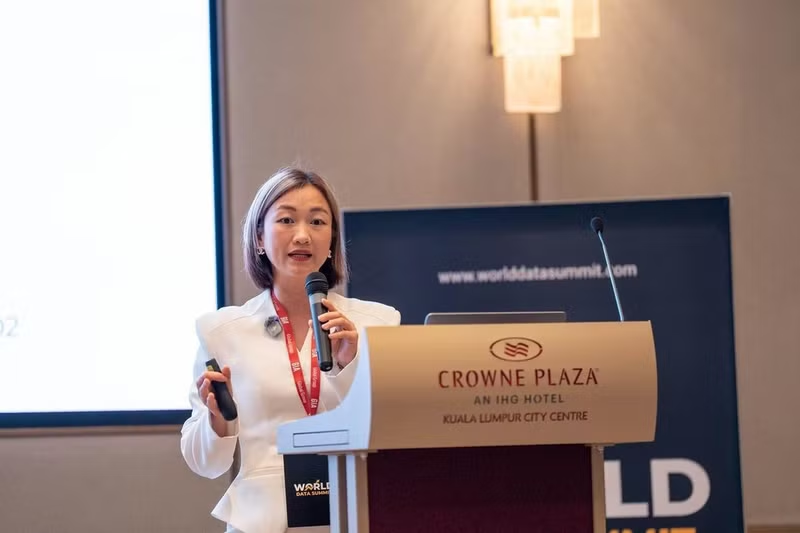
World Data Summit APAC 2026 took place in Kuala Lumpur, Malaysia, on October 29–30, featuring sessions and discussions on the application of data and artificial intelligence (AI) in organisations and businesses.
World Data Summit is an international conference series on data, data analytics and technology applications. Organised annually by GIA Global Group since 2018, it aims to provide a forum for connecting experts and managers in the fields of data, analytics and artificial intelligence.
This year’s event in Kuala Lumpur brought together businesses, managers and researchers from across the Asia-Pacific region.
At World Data Summit APAC 2026, Pham Thi Thu Hang, Director of 5S Media, shared the perspective of a Vietnamese SME founder on applying AI to management, creativity and improving operational capabilities.
As they grow, many SMEs face pressure to serve more customers, improve product quality and expand into new markets, despite limited human resources, time and budgets.
According to Hang, AI offers businesses additional support, but its effectiveness depends on identifying the right challenges, improving processes and preparing employees to adapt to new ways of working.
Rather than rolling out AI across the board, businesses can start with a recurring task, identify bottlenecks, test changes on an appropriate scale and evaluate the results before expanding their application. This approach enables businesses to learn proactively and gradually build their capacity to adopt technology.
Drawing on 5S Media’s practical experience, Pham Thi Thu Hang introduced the 5-RE Growth Cycle – a five-step approach to reorganising work through the application of AI. She hoped it would serve as a practical reference for SMEs seeking to adopt technology gradually in line with their resources and needs. The five steps are:
Review: Assess processes, management indicators, bottlenecks and the information needed for decision-making.
Reduce: Identify repetitive tasks, unnecessary steps and resources that could be used more efficiently.
Restructure: Redesign processes, roles and coordination within teams and projects through the application of AI and other appropriate technologies.
Retrain: Help employees and managers develop skills and become familiar with new ways of working, while clearly defining responsibilities for checking and approval.
Repeat: Monitor results, draw lessons, make adjustments and continue improving other processes.
Giving a specific example from 5S Media, Hang said that, in the advertising image design process, the team previously developed concepts and sourced numerous reference images for clients to choose from, before proceeding with design work and making revisions over several rounds.
With AI, the team can now generate visual options based on initial ideas, enabling clients to visualise concepts and provide feedback at an earlier stage. Once a suitable direction has been selected, designers continue developing and refining the product, while the client-facing team gathers feedback and coordinates the final adjustments. This AI-enhanced process has helped reduce the team's time and workload by at least 50%.
From a business management perspective, Hang stressed that AI is particularly useful for compiling information from relevant sources according to agreed indicators. AI-generated reports provide managers with a basis for monitoring progress and carrying out management tasks, while data verification, contextual assessment and accountability for decisions remain the responsibility of people.
Other tasks that can benefit significantly from AI support include market research, communications planning and corporate knowledge management. However, when adopting the technology, businesses need to verify information sources, manage access rights and maintain the professional oversight of their employees.
Through her presentation at the forum, the 5S Media Director sought to share a practical approach that SMEs could refer to when beginning to use AI: select a suitable process, establish baseline figures, conduct trials with the team and measure results over time. Relevant indicators may include time, quality, implementation capacity, customer experience and financial performance.
When businesses use their resources more efficiently, the additional time and capacity created can be devoted to strategic thinking, customer care, product development or business expansion. Turning these improvements into growth, however, also depends on market demand, business operations, service pricing and implementation capacity.
More broadly, efforts to achieve double-digit improvements in the productivity and competitiveness of the SME community could contribute to economic development in line with the Government’s overall objectives.