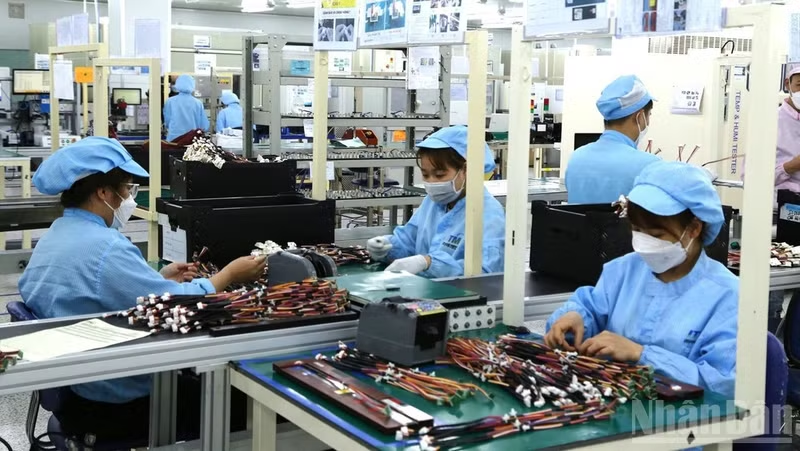
The achievement reflects strong momentum in goods trade, while highlighting the need to improve the quality of growth, diversify markets and enhance the competitiveness of domestic enterprises.
In October alone, goods trade turnover was estimated at 122.2 billion USD, up 47.6% from the same month last year. Exports continued to be a major driver, reaching an estimated 499 billion USD in the first 10 months, an increase of 27.4%. This performance provides momentum for Viet Nam to meet or exceed its full-year 2026 export growth target of 15-16%.
Export growth was recorded in both the domestic and foreign-invested (FDI) sectors. Processed and manufactured industrial products remained the main export category, accounting for 87.4% of total export turnover. Major markets, including China, the US, the European Union (EU), the Republic of Korea and ASEAN, also recorded positive growth.
Regarding the trade balance, Viet Nam is estimated to have posted a trade surplus of 6.8 billion USD in October, marking the second consecutive month of surplus and bringing the cumulative trade deficit for the first 10 months down to around 12.7 billion USD.
Despite this positive performance, the priority is not simply to expand trade turnover but also to improve the quality and sustainability of trade, strengthen the role of domestic enterprises and reduce dependence on a limited number of major markets.
According to the Import-Export Department under the Ministry of Industry and Trade, the ministry is drafting a strategy for goods import and export through 2030, with a vision to 2045. The strategy aims to link trade growth with higher levels of processing, greater application of science and technology, and more diversified and sustainable markets.
Under the draft strategy, merchandise exports are targeted to grow by an average of 15-16% annually during 2026-2030, while imports are expected to increase by 12-13%. Viet Nam aims to maintain a sustainable trade surplus, equivalent to 3-6% of total export turnover on average during this period. By 2045, the country aims to rank among the world's 10 largest trading nations in terms of export and import turnover.
A key priority is to increase the contribution of domestic enterprises to exports. Their share of total export turnover is targeted to reach 28-30% by 2030 and 38-40% by 2045. Meanwhile, processed and refined products are expected to account for 89-90% of exports by 2030 and more than 92% by 2045. High-tech products are targeted to make up around 50% of total manufactured and processed exports by 2030 and over 55% by 2045.
Market diversification is another key measure to mitigate risks arising from fluctuations in global trade. By 2030, no single market is expected to account for more than 25% of total exports or 35% of total imports. The combined share of the three largest export markets or regions is targeted to fall below 55% by 2030 and 50% by 2045.
Viet Nam also aims to expand its market reach, increasing the number of export markets with turnover exceeding 1 billion USD to more than 45 by 2030 and 55 by 2045. Exports to emerging markets in South Asia, the Middle East, Africa and Latin America are targeted to account for around 10% of total exports by 2030 and 15% by 2045.
In the fourth quarter of 2026, the Ministry of Industry and Trade will continue to promote exports, diversify markets and strengthen enterprises' capacity to meet international requirements. Priorities include making more effective use of signed free trade agreements (FTAs), exploring new markets and providing early warnings of trade defence investigations, tariff barriers, green standards, traceability requirements and rules of origin.