Flowers bloom from areca palm sheaths
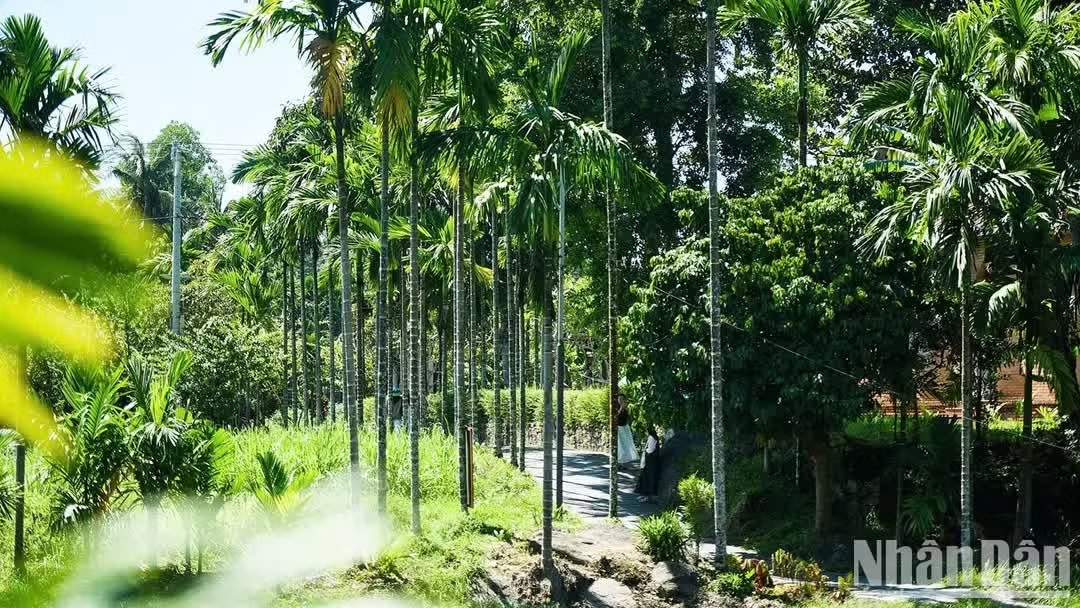
Thanh Binh Commune is not only renowned for the picturesque ancient village of Loc Yen but also boasts abundant raw materials, including vast expanses of lush areca palm gardens. Recognising the plentiful supply of areca palm sheaths, several cooperative members have boldly embarked on start-up ventures to produce handicrafts.
The Quang Nam Agricultural and Industrial Cooperative has created unique, environmentally friendly products from natural areca palm sheaths, including bowls, plates, trays, boxes, fans, and spoons, under the brand name Mo cau Xu Tien (Xu Tien Areca Palm Sheath Products).
Established in 2020, the cooperative was recognised in 2022 by the United Nations Development Programme (UNDP), the Women’s Initiative for Startups and Entrepreneurship (WISE) programme, and the Embassy of Canada in Viet Nam as one of 29 social impact enterprises.
To date, Mo cau Xu Tien products have achieved a four-star OCOP rating, with a domestic distribution network of more than 50 agents. The brand has also secured an official export shipment to the Netherlands. Phan Vu Hoai Vui, director of the Quang Nam Agricultural and Industrial Cooperative, said: “We will continue to explore new export markets with newer, higher-value products.”
Meanwhile, the Cau Xanh Dat Quang Cooperative is producing 100 designs of handicrafts made from areca palm sheaths. A section of the cooperative’s modest premises is devoted to displaying products, including handbags, flowers, baskets, trays, gift boxes, lanterns, and decorative items. Its areca palm sheath handbags have achieved a three-star OCOP rating.
With diverse designs that suit the trend towards green consumption, Cau Xanh Dat Quang products are now sold in numerous provinces and cities nationwide, generating average annual revenue of around 500 million VND.
The cooperative also purchases raw materials from local households and provides regular employment for 50 local workers, with an average monthly income of 4–6 million VND per person.
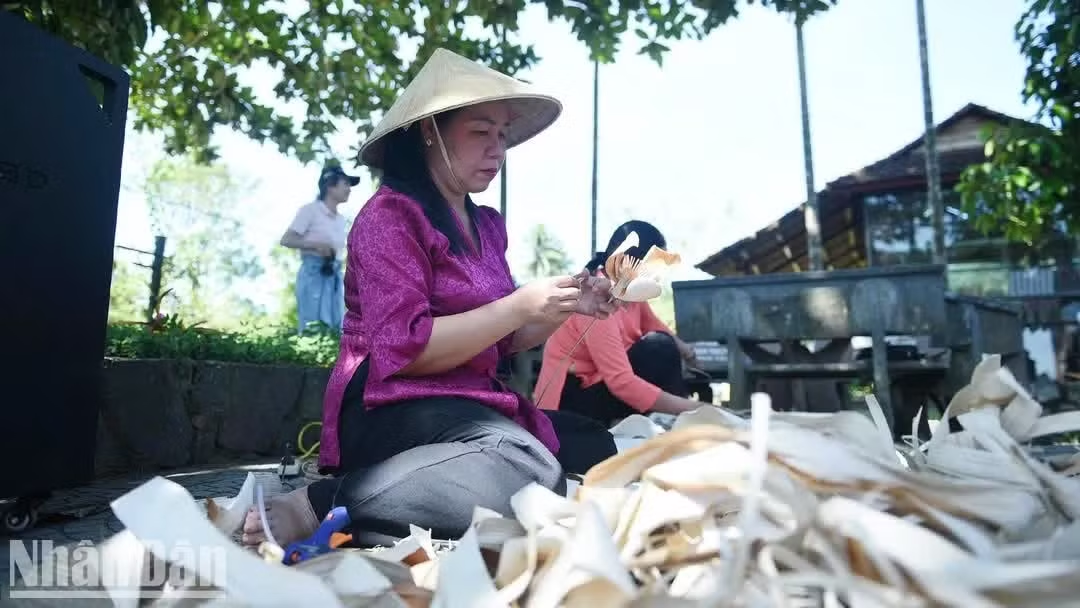
After joining the Cau Xanh Dat Quang Cooperative, 46-year-old Dao Thi Hong Nien decided that with an areca palm garden already at her home, she would expand her cultivation area to supply the cooperative with raw materials. She also works alongside other women to make products from areca palm sheaths, earning an average of 6 million VND a month.
Nien shared: “Previously, we grew areca palms only to harvest the fruit. Now, we can also make use of the sheaths as raw materials and work together to produce a range of household items, providing a stable income. I am very happy about this. My family is now registering to expand our areca palm cultivation area further.”
Speaking about future plans, Vo Thi Thu Thoi, director of the Cau Xanh Dat Quang Cooperative, said: “We will continue to apply for a four-star OCOP rating for our products, introduce more new designs, and strengthen trade promotion and sales channels so that our products can reach more markets and bring greater benefits to local residents.”
Diversifying sales channels
According to the Da Nang City Department of Agriculture and Environment, in 2026, the city agreed to include 213 products in its OCOP programme implementation plan. It is also focusing on supporting the development of new products, upgrading OCOP ratings, establishing commune-level OCOP centres, promoting e-commerce and digital transformation, improving traceability, and comprehensively developing OCOP products in line with its rural tourism development orientation.

As of July 2026, Da Nang has 477 OCOP products across the categories of food and beverages; medicinal herbs and products derived from them; handicrafts; and community-based and ecotourism services.
The city’s OCOP products are sold through 26 OCOP product introduction and sales outlets, supermarket chains, shopping centres, speciality shops, tourist destinations, e-commerce platforms, and various other distribution channels.
Since the beginning of 2026, the city has supported digital transformation for more than 124,000 business households. Within three months, 25,000 households had effectively adopted technological solutions and listed OCOP products and local specialities on dedicated e-commerce platforms.
In addition, the city regularly organises supply-demand matching and trade promotion activities and participates in domestic trade fairs and exhibitions. It has also expanded cooperation with distribution and export enterprises. A total of 19 OCOP products have been exported to the US, China, the Republic of Korea, Thailand, the Philippines, France, and the Netherlands, with export revenue estimated at more than 50 billion VND in the first six months of 2026.
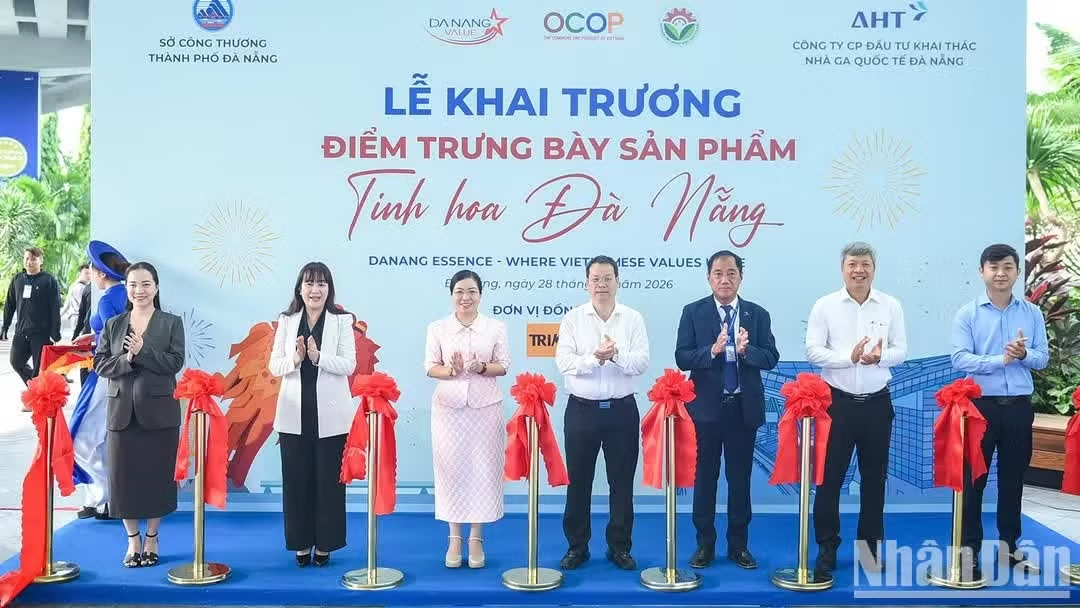
In parallel, the Da Nang City Department of Industry and Trade has advised the City People’s Committee on issuing programmes to promote and introduce Da Nang products for the 2026–2030 period, as well as a trade promotion programme to provide a basis for supporting businesses in product development, brand promotion, business networking, and market expansion.
Most recently, the department established two “Da Nang Quintessence” product display points at Da Nang International Airport and Koi Resort & Residence Da Nang in an effort to showcase nearly 100 of the city’s representative products. It will continue coordinating the operation of two additional “Da Nang Quintessence” sales outlets at Song Han Hotel and at Sheraton Grand Da Nang Resort and Da Nang Marriott Resort & Spa.
In the final months of the year, the Department of Industry and Trade will organise four promotional programmes at shopping centres and supermarkets across the city, as well as the Da Nang 2026 E-commerce Festival Connecting Local Products, to step up the promotion of “Made in Da Nang” products at destinations popular with tourists.