Sustainable livelihoods through tourism
Located approximately 15km from the mainland, Tan Hiep covers a natural area of over 1,640 hectares, the majority of which consists of forests, mountains, and a nature reserve. The population is concentrated on Hon Lao Island across three villages — Bai Lang, Bai Ong, and Bai Huong — comprising 596 households and 2,429 residents.
In 2009, Cu Lao Cham (an archipelago of eight islands) and Tan Hiep Commune were recognised by UNESCO as a World Biosphere Reserve. Residents and authorities continue to effectively maintain the “say no to plastic bags and single-use plastic products” initiative.
The environmental awareness of both locals and tourists has helped shape Tan Hiep into a green, eco-friendly destination. In 2025, Tan Hiep Commune was recognised as meeting the standards for a “model new rural area.”
Statistics showed that Cu Lao Cham is home to 624 species of higher vascular plants and approximately 1,035 species of terrestrial animals, including many endemic, endangered, and rare species.
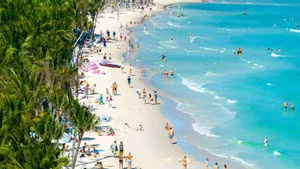
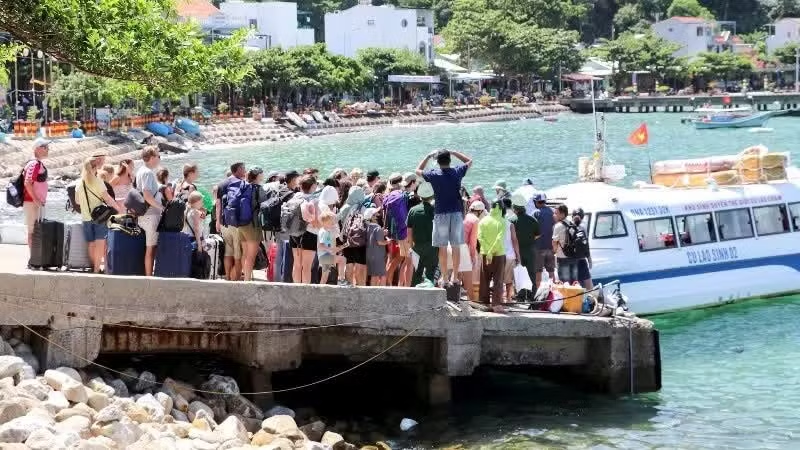
The Cu Lao Cham–Hoi An marine area supports over 1,000 terrestrial plant and animal species and more than 1,300 marine species; among them are numerous endangered and rare species prioritised for conservation both in Vietnam and globally. Every day, Tan Hiep Commune welcomes hundreds of visitors for sightseeing and leisure.
Do Van Ro, a member of the self-managed motorbike taxi team under the Cu Lao Tourism and Service Cooperative, shared that since tourism began to flourish on the island, he spends his days transporting visitors on sightseeing tours and his evenings fishing. “By driving visitors around the island each day, I earn an extra few hundred thousand dong. While transporting passengers, we also double as tour guides, introducing unique cultural aspects that only the locals truly understand. Furthermore, most of the island’s roads are steep and winding; without the right experience, accidents can easily happen,” said Ro.
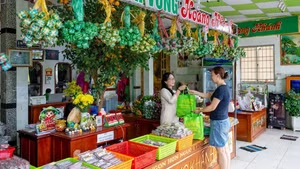
Le Thi Thu Van, owner of Van Duc Homestay, shared that her family’s livelihood previously relied primarily on the sea. As tourism on Cu Lao Cham developed, and with guidance from local authorities, her family began renovating their home and attending training courses on homestay operations.
“The number of tourists — especially international visitors — coming to Cu Lao Cham is growing steadily. We are happy to play a small part in that collective success,” Van said.
According to Pham Thi My Huong, Chairperson of the Tan Hiep Commune People’s Committee, the number of tourists welcomed on the island during peak season is double that of its resident population. To minimise impacts on the island's marine biodiversity, residents work alongside authorities and functional agencies as active advocates, directly monitoring and protecting the island’s environment.
“In the past, over 90% of the commune’s residents worked in the marine sector, while 10% engaged in agriculture. With the growth of tourism and the local shift toward a green, sustainable economy, the proportion of the workforce in the marine sector has decreased as people transition to roles in homestays, tourist boats, coral diving services, and food and beverage operations. Residents’ livelihoods have become more stable since engaging in tourism and services,” Huong stated.
Balancing conservation and development
Statistics from the Tan Hiep Commune People’s Committee indicate that in 2025, the total number of visitors to the island exceeded 278,000, including over 96,000 international tourists, marking a 3.5% increase compared to 2024. Overnight visitors totalled more than 7,800, up 73.6% from 2024, and the commune's total income reached over 138 billion VND.
Per capita income stands at 73.92 million VND per year, equivalent to a 10% increase compared to the same period last year. Notably, the commune’s total income has surpassed the target set by the local Party Committee for 2025 by 4.1%. In the first five months of 2026 alone, visitor numbers reached over 73,000, an increase of 1.04% compared to the same period in 2025.
According to Le Moi, Secretary of the Tan Hiep Commune Party Committee, the commune’s economic structure has long been shifting towards tourism and services as key sectors, integrated with nature conservation. Meanwhile, the marine economy and traditional trades are being maintained, contributing to livelihoods and raising local incomes.
To date, the commune has no households living in poverty under multidimensional criteria; 100% of residents have health insurance and access to electricity and hygienic domestic water; and there are no longer any makeshift or dilapidated houses.
However, due to its characteristics as an island commune — occupying a strategic position for national defence and security, lying within a World Biosphere Reserve, and consisting largely of special-use forests and nature reserves — there is limited space for economic, tourism, and residential development as well as essential infrastructure.
Tourism and service activities are heavily dependent on weather and seasonality, and local revenue sources remain unstable, even as demands for social welfare, environmental protection, water supply, healthcare, and national defence and security continue to rise.
Tan Hiep Commune holds a position of special importance regarding national defence, security, the ecological environment, and tourism. Its development must be aligned with the city’s overall green and sustainable growth strategy, steadfastly adhering to the principle of “conserving for development and developing for conservation.”
Da Nang Party Committee Secretary Le Ngoc Quang
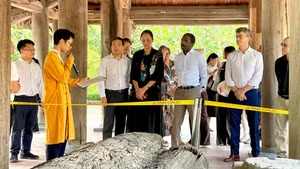
Da Nang Party Committee Secretary Le Ngoc Quang stated that Tan Hiep Commune holds a position of special importance regarding national defence, security, the ecological environment, and tourism. Tan Hiep must be integrated into the city's overall green and sustainable development strategy, steadfastly adhering to the principle of “conserving for development and developing for conservation.”
“Tan Hiep needs to urgently coordinate with municipal departments and agencies to finalise the approval of the commune’s zoning plan with a long-term vision. This involves effectively leveraging the island commune’s potential and advantages, creating new development spaces linked to the conservation of the World Biosphere Reserve, and generating momentum for local socio-economic growth," emphasised Secretary Le Ngoc Quang.

![[Video] Viet Nam among Top three Asian destinations for return visitors](https://en-cdn.nhandan.vn/images/nyM650OGFWrOVWc-xajqN-rTZ68Rlmc1fiGJOhBRYHErj-E25MBpvJqrpphXazfrpe9t-fYCGuQU4CN0yXo3Rg/du-lich-vietnam.jpg.avif)