Strategic building blocks
After eight years of implementing Resolution No. 36-NQ/TW of the Eighth Plenum of the 12th Party Central Committee on the Strategy for Sustainable Development of Viet Nam’s Marine Economy to 2030, with a vision to 2045 (dated October 22, 2018), Da Nang City has achieved many important results in developing the marine economy, responding to climate change and keeping pace with global trends.
From awareness to action, the thinking on marine economic development among Party committees, authorities, and people has become increasingly positive, both in exploiting and protecting marine and island resources. In some marine and island areas in the city, local people have shifted their livelihoods from fishing to combining tourism and services with the rational exploitation and sustainable use of resources.
For example, in the fishing village of Tam Tien (Tam Xuan Commune, Da Nang City), many fishermen and local residents not only sell “a few kilos of fish” to traders and buyers, but they have also proactively learned how to provide services and prepare dishes on site to serve tourists. Alongside the development of marine tourism services, they work closely with local authorities to protect the marine environment.
As one of the people who joined the community-based tourism model in Tam Tien at an early stage, Bui Thanh Xu (Ha Loc Village, Tam Xuan Commune) has witnessed clear improvements in the lives of local people since residents worked with local authorities and non-governmental organisations to turn the traditional lifestyle of the fishing village into a tourism product. However, what bring him the greatest delight is not only the income of tens of millions of VND each tourist season but also the increasingly clean marine environment. “Since more tourists have been coming, local people have become more aware of protecting the marine environment. Compared with before tourism development, the marine environment is cleaner, and aquatic resources are gradually recovering,” Xu said.
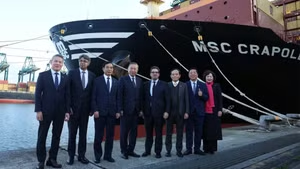
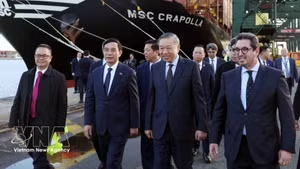
To reach out to the wider sea, Da Nang has been building a foundation to realise its vision of becoming an ecological and modern international coastal city. Alongside marine tourism and services, the city has identified the maritime economy as an important pillar of sustainable marine economic development. At present, the city’s seaport system serves as a major hub for cargo transport, supporting import and export activities, cargo transshipment, and the development of industry, trade, and services. Seaport operations contribute to the development of logistics, warehousing, multimodal transport, supporting services, trade, and related economic sectors.
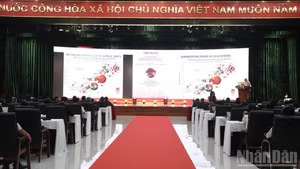
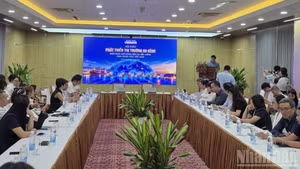
At the Da Nang International Logistics Forum 2026, many domestic and international experts and businesses said that, amid supply chain restructuring, digital transformation and green transformation, Da Nang needs to shift from investing in individual facilities to developing an integrated logistics ecosystem. This would enable the city to enhance its role from a logistics hub in central Viet Nam to a connecting point in the Indo-Pacific supply chain network.
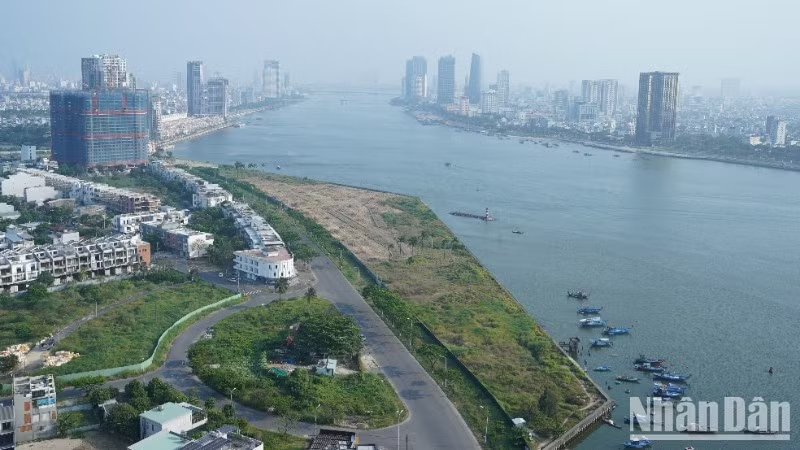
Alongside the expansion of development space following the merger, the city will continue to restructure its development space towards forming marine economic corridors and new growth-driving clusters. The city will develop a synchronised chain of coastal urban areas and modern service-tourism-logistics centres associated with the marine advantages of the new city.
Tran Nam Hung, Vice Chairman of the Da Nang Municipal People’s Committee
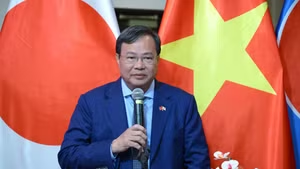
According to Tran Nam Hung, Vice Chairman of the Da Nang Municipal People’s Committee, the city is gradually forming a modern logistics ecosystem associated with seaports, a free trade zone, an international financial centre, a strategic transport infrastructure system, industrial parks, and high-tech parks. This is an important driving force for improving competitiveness, increasing the value of logistics services and promoting marine economic growth in a modern and sustainable direction. However, logistics service infrastructure and marine economic service sectors have yet to develop in line with their potential, as the formation of large-scale logistics centres is still at the stage of completing detailed planning and attracting strategic investors.
Tran Nam Hung said: “Alongside the expansion of development space following the merger, the city will continue to restructure its development space towards forming marine economic corridors and new growth-driving clusters. The city will develop a synchronised chain of coastal urban areas and modern service-tourism-logistics centres associated with the marine advantages of the new city.”
Harmonising environmental protection and economic development
Despite the results achieved, the city still faces limitations in the sustainable development of its marine economy. Although the scale of the marine economy has grown, it remains disproportionate to the locality’s potential and advantages, while infrastructure serving marine economic development has yet to meet the requirements of rapid and sustainable development. Some marine ecosystems are deteriorating and shrinking, while marine biodiversity and aquatic resources are declining.
In reality, the city is facing increasing pressure on the environment and tourism infrastructure as visitor numbers rise, resulting in localised overload of traffic, parking facilities, waste, noise, and other utility infrastructure. In addition, the negative impacts of climate change, sea-level rise, and coastal erosion are becoming increasingly evident.
According to several studies on the erosion and accretion of Da Nang City’s coastal strip, the area is subject to the strong influence of many complex factors, such as tides in the East Sea and currents and sediment from the Vu Gia-Thu Bon river system. Meanwhile, the city is also frequently affected by natural disasters, particularly floods, heavy rains, and storms, whose developments are becoming increasingly complex under the impact of climate change.
The sea remains Da Nang’s outstanding advantage, but the city needs to shift towards a green marine economy in order to reduce conflicts of interest in marine and coastal spaces, minimise environmental impacts, ensure sustainable growth, and adapt to climate change. The locality should continue to apply an integrated coastal zone management model and take the lead in thinking about marine spatial governance.
Assoc Prof, Dr Nguyen Chu Hoi, Standing Vice Chairman of the Viet Nam Fisheries Society.
According to Assoc Prof, Dr Nguyen Chu Hoi, Standing Vice Chairman of the Viet Nam Fisheries Society, the sea has the capacity to cleanse itself but always has a certain carrying capacity threshold. Accurately determining this threshold, while harmonising the relationship between environmental protection and economic development, will help Da Nang make more effective use of the values generated by the sea.
One of the reasons why the sustainable development of Da Nang’s marine economy remains challenging is that the marine space is extensive, interconnected, and used for multiple purposes, with numerous economic activities taking place alongside one another in the same area. Therefore, the exploitation and use of marine resources remain difficult and complex, involving the responsibilities and powers of many ministries and sectors.
Assoc Prof, Dr Nguyen Chu Hoi said: “The sea remains Da Nang’s outstanding advantage, but the city needs to shift towards a green marine economy in order to reduce conflicts of interest in marine and coastal spaces, minimise environmental impacts, ensure sustainable growth, and adapt to climate change. The locality should continue to apply an integrated coastal zone management model and take the lead in thinking about marine spatial governance.”
Tran Nam Hung, Vice Chairman of the Da Nang Municipal People’s Committee, said: “In the coming period, Da Nang aims to develop its marine economy not only on the basis of exploiting natural advantages but also by shifting towards a modern marine economy model with high added value, associated with innovation, logistics, international services, and the protection of marine ecosystems. The city remains steadfast in its approach of developing the marine economy in a green and sustainable direction, without sacrificing the environment for economic growth; at the same time, it will closely combine marine economic development with ensuring national defence and security and firmly safeguarding national sovereignty over the sea and islands.”