Focusing on taking advantages of resources
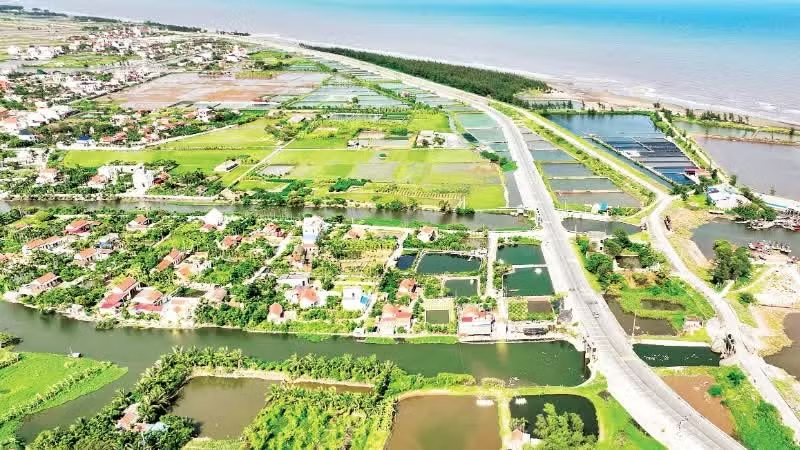
Ninh Binh province has a coastline of approximately 89.5 km, with 16 coastal communes and a population of nearly 600,000 people. This area has many potentials and advantages in the marine economy, including aquaculture, fisheries, fisheries logistics services, marine tourism, processing industries, etc. Many communes have advantages in land for industrial development, industrial clusters, and coastal transportation systems, creating new development opportunities.
With its wide tidal flats, stable salinity, and long coastline, along with the two estuaries of the Day and Can rivers running through it, Kim Dong commune receives annual alluvial deposits, creating large tidal flats and sandbars, favourable for aquaculture development. The commune currently has over 300 oyster and clam seed production farms, supplying more than 90 billion seedlings to the market annually.
Recently, the commune’s clam farming area received ASC certification from the international certification organisation Control Union, becoming the second clam farming area in Viet Nam to achieve this international certification. This is an important foundation for the locality to enhance product value, expand markets, and develop aquaculture in a sustainable direction.
According to data from the Fisheries and Aquaculture Inspection Sub-Department (Department of Agriculture and Environment), the province’s clam farming area currently reaches approximately 3,600 hectares, with an annual production of about 72,000 tonnes, mainly concentrated in the alluvial plains outside the dike in the communes of Rang Dong, Giao Ninh, Giao Minh, Kim Dong, Binh Minh, etc.
Clam farming has provided a stable income for the people and contributed significantly to the province’s fisheries economic structure. Along with the advantages of the aquaculture industry, Ninh Binh currently has more than 1,800 boats and vessels regularly going out to sea for exploitation, creating an abundant source of raw materials.
With a sustainable development orientation, linking conservation with efficient resource exploitation, Ninh Binh's marine tourism is expected to become a new highlight, contributing positively to the goal of making tourism a key economic sector of the province.
According to Bui Van Manh, Director of the Department of Tourism, based on resolutions, projects, and tourism development strategies, along with new support mechanisms and policies, Ninh Binh’s coastal tourism is positioned as one of the important development directions, contributing to enriching the local tourism product ecosystem.
In 2026, the province’s tourism sector will focus on effectively exploiting the coastal tourism areas of Thinh Long, Rang Dong, Quat Lam, and Kim Son with distinctive products associated with ecological experiences, community life, and coastal culinary culture. Along with this, localities will continue to invest in infrastructure, improve service quality, and build a safe, friendly, and attractive tourism environment for visitors.
Developing advantageous marine economic sectors
To effectively utilise the potential and advantages of the marine economy, several communes in the region have focused on developing sustainable tourism and livelihoods linked to the buffer zone of Xuan Thuy National Park.
With an area of over 7,100 hectares and a buffer zone of approximately 8,000 hectares, spread across the communes of Giao Minh, Giao Hoa, and Giao Phuc, Xuan Thuy National Park has collaborated with local authorities and people to build sustainable livelihood models in recent years.
Vu Quoc Dat, Deputy Director of the Xuan Thuy National Park Management Board, said that livelihood models based on mangrove forests, such as beekeeping and natural fisheries, contribute to increasing people's income and preserving “natural capital” in the long term. Among these, beekeeping for honey production is an effective approach.
Currently, the entire area has more than 20 households raising bees for honey with nearly 6,000 colonies, producing about 120 tonnes of honey per season, contributing to creating stable jobs for many local workers.
In its development strategy, Ninh Binh has identified the marine economy as a new growth engine, creating a ripple effect and linking development with other dynamic regions in the province and the region.
The Ninh Binh Provincial Party Committee has issued Resolution No. 16-NQ/TU on the Strategy for Marine Economic Development to 2030, with a vision to 2045, aiming to increase the proportion of the marine and coastal economy to over 20% of the province's GRDP by 2030. The average growth rate of the marine and coastal economy during the 2025-2030 period is projected to exceed 11% per year; the proportion of the marine and coastal economy in the province’s total GRDP is expected to exceed 20%,…
Following the orientation of sustainable marine economic development, Party committees and local authorities in the province have actively implemented the resolution’s contents and set specific tasks for implementation according to the roadmap. Coastal communes have proactively opened up high-tech aquaculture, deep processing, OCOP brand development, investment in fishing port infrastructure and logistics, and promoted marine experiential tourism, aiming for a modern and sustainable marine economic model.
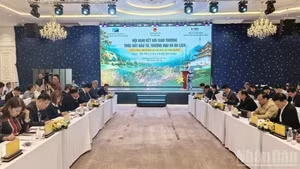
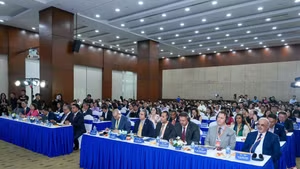
Tran Anh Dung, Vice Chairman of the Provincial People’s Committee, stated: The province is focusing on implementing a comprehensive set of tasks and solutions to promote the development of the marine economy, strengthen linkages between the marine economy and other economic sectors, and form a production-service-trade value chain associated with the sea, becoming one of the province’s important growth drivers.
To promote the development of the marine economic space, the province has developed the Ninh Co Economic Zone into a modern, multi-sector, comprehensive coastal economic zone with an area of nearly 14,000 hectares.
Nguyen Hoang Anh, Head of the Provincial Economic Zone and Industrial Park Management Board, said that the construction of the Ninh Co Industrial Park will prioritize the development of industry, logistics, port services, and coastal urban areas, strengthening close connections with coastal economic zones in the Northern region, and simultaneously serving as a nucleus for spreading and connecting marine economic sectors, industry, and urban areas in a modern and sustainable direction.
With a consistent guiding principle and a synchronized implementation plan, along with the decisive involvement of the entire political system, Ninh Binh province will maximise the potential and strengths of its coastal region, making the marine economy a new growth engine; promoting an economic structure towards industry and services, focusing on developing multi-sector economic zones, industrial parks, deep-water seaports, and logistics services, thereby improving the income and quality of life of people in coastal areas.