After nearly 40 years of Doi Moi, Viet Nam’s economic potential has made remarkable strides. The economy has grown in scale, infrastructure has improved, and the business sector has expanded rapidly.
However, the growth model remains heavily reliant on expanding inputs rather than improving the efficiency with which resources are used. As the scope for growth based on capital, labour, and resource extraction becomes increasingly limited, raising productivity has become an imperative that cannot be delayed.
Removing bottlenecks to help businesses improve productivity
At the 2026 National Productivity and Quality Forum held in Ho Chi Minh City, chaired by the Ministry of Science and Technology and organised by the Commission for Standards, Metrology and Quality of Viet Nam, Deputy Prime Minister Ho Quoc Dung stressed that: “Regional experience shows that no country can escape the middle-income trap without going through a period of decisive acceleration in productivity.”
According to the deputy PM, productivity in the new phase of development also needs to be viewed differently. It is no longer simply about working faster using traditional methods but about creating new value based on technology, data, and new management approaches, while ensuring quality and environmental requirements are met to satisfy increasingly demanding market standards.
At Tien Phong Plastics Joint Stock Company, productivity improvements are increasingly linked to digital and green transformation. Dao Thi Thanh Ngan, head of the company’s Strategic Development Division, said the business regards this as a “passport” to improving production efficiency without compromising the environment.
In 2024, the company’s total emissions exceeded 257,600 tonnes of CO₂e, with Scope 3 emissions accounting for as much as 86.55%. Most of the pressure to reduce emissions does not lie solely within the factory but is spread across the entire supply chain. Green productivity therefore requires coordinated changes involving businesses, partners, suppliers, and customers.
Also in 2024, the company saved 487,464 kWh of electricity, while cooling water at workshops with high consumption rates was fully recycled. The company aims to move towards Net Zero by 2030.
These figures show that ESG, green transformation and the circular economy do not necessarily have to be viewed solely as costs. They can also provide a means of reorganising production, thereby saving materials and energy, reducing waste, and improving efficiency.
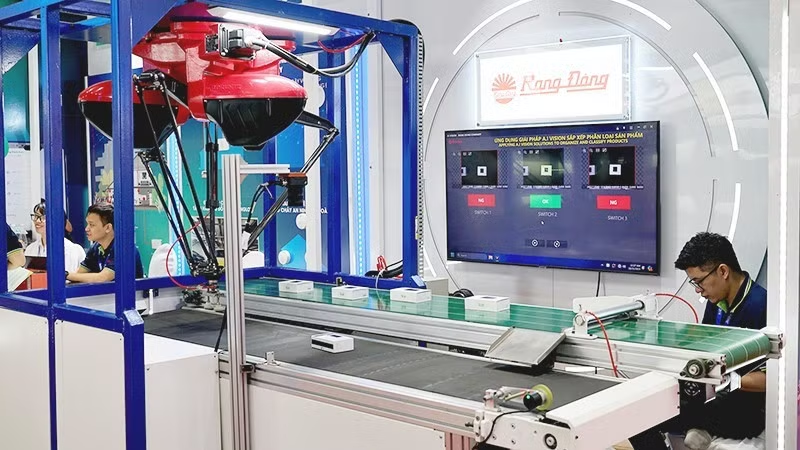
However, not every business has sufficient resources to pursue such a transformation. Tran Phuc Hong, CEO of TMA Innovation — a company specialising in smart manufacturing solutions and factory automation — and Vice Chairman of the Viet Nam Digital Technology Alliance (VNITO), points to a paradox: Viet Nam has developed the capacity to supply technology, with around 18,000 software companies, yet the level of software and AI adoption in manufacturing industries remains low. Most businesses are small and medium-sized enterprises with limited capital, human resources, and investment capacity.
The gap between “having technology” and “being able to use technology” is therefore becoming a productivity bottleneck.
According to Tran Phuc Hong, the state and business associations need to play a role in connecting technology companies with traditional manufacturing industries in order to bring “Make in Viet Nam” products into practical use. This should be accompanied by the establishment of mechanisms for valuing intellectual property, enabling start-ups to use patents as financial assets; streamlining procedures for experimental equipment used in R&D and semiconductor development; and simplifying sandbox mechanisms so that new technologies can be tested more quickly.
This is also an issue highlighted by Prof, Dr Vu Minh Khuong of the Lee Kuan Yew School of Public Policy at the National University of Singapore. He said Viet Nam is entering a period of transformation in its development model, with Resolution 57-NQ/TW and policies on science, technology, and innovation creating new momentum. AI and digital technology are being adopted relatively rapidly across the productive sector, while managerial, organisational, and operational practices in many places have yet to keep pace.
A business does not need a technology that is merely “good” in general terms. What it needs is a solution that can reduce costs, save energy, cut waste, improve quality, shorten production times or open new markets. When businesses’ practical problems become the focus of science and technology, the gap between research and production can be narrowed.
It was necessary to move from a traditional approach to innovation towards building an innovation ecosystem that places greater emphasis on practical outcomes and the ability to coordinate resources. In other words, instead of focusing solely on how many research projects have been completed or how many technologies have been developed, attention should be paid to what problems those technologies solve for businesses and how much they contribute to productivity.
Prof, Dr Vu Minh Khuong of the Lee Kuan Yew School of Public Policy at the National University of Singapore
Allocating resources to generate productivity
Vo Lan Phuong, CEO of Vriens & Partners Viet Nam — a government affairs consultancy, cited World Bank research showing that Viet Nam has an investment rate of around 32% of GDP, while labour productivity growth is only about 0.9%. Therefore, rather than simply continuing to increase investment, one proposed approach is to maintain investment at around 36% of GDP while raising productivity growth to approximately 1.8%. The key message is that greater investment does not automatically translate into higher productivity.
What matters is where resources are allocated; whether businesses shift towards sectors with greater productivity, added value, and innovation potential; and whether institutional costs are undermining businesses’ incentives to invest.
According to Vo Lan Phuong, Viet Nam needs to improve resource allocation, reduce compliance costs, move from blanket regulation towards risk-based management, establish mechanisms for testing new technologies, and enhance policy predictability so that businesses can see a long-term roadmap before making investment decisions. These are the conditions needed for businesses to truly become the driving force behind productivity growth.
Digital transformation and AI must be integrated into production lines and management processes rather than being confined to office management software. At the same time, attention must be paid to Vietnamese businesses’ capacity to absorb and master technology, particularly among small and medium-sized enterprises, while national quality infrastructure must be modernised and digitised to “stay one step ahead” of increasingly demanding requirements in global markets.
Deputy Prime Minister Ho Quoc Dung
Specifically, the combined strength of three groups — state-owned enterprises, the private sector and the public sector — needs to be mobilised. On the basis of Resolution No. 79-NQ/TW, each group and corporation should develop its own productivity programme with measurable targets, while extending these efforts across its supply chain. Support policies should also shift from being spread thinly across many areas to having clear priorities, with actual productivity gains used as the benchmark.
Ultimately, improving productivity is not merely a challenge for an individual business or economic sector. It is about how the economy uses every unit of capital, every kilowatt-hour of electricity, and every unit of natural resources to generate greater value.
When resources are allocated to where they are most effective, businesses have an incentive to invest for the long term, technology can be absorbed and mastered, and institutions can reduce unnecessary costs, and productivity will no longer be a slogan-driven objective but a measurable outcome for the economy.
“Improving productivity is a long journey. In the current context, we have no choice but to accelerate,” Deputy Prime Minister Ho Quoc Dung stressed.