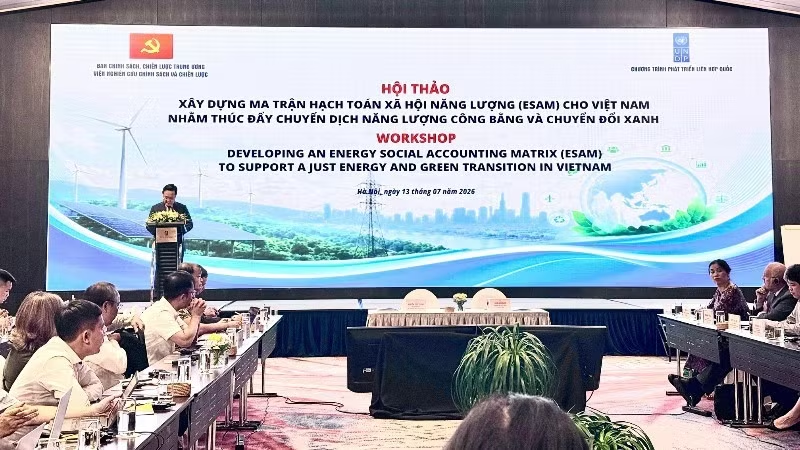
The findings were presented at a workshop introducing the study on “Developing an Energy Social Accounting Matrix (ESAM) to support an equitable energy and green transition in Viet Nam” jointly held by IPSS and UNDP in Viet Nam on July 13.
The conclusions were drawn from simulations of multiple policy scenarios using a newly developed analytical toolkit. At the core of the toolkit is the Energy Social Accounting Matrix (ESAM) — a comprehensive economic database that captures within a single analytical framework the relationships between production, energy consumption, household income, and greenhouse gas emissions. The tool has been developed since 2024 through a collaboration involving IPSS, the University of Copenhagen (Denmark), the General Statistics Office under the Ministry of Finance, and UNDP in Viet Nam.
According to Dr Dang Thi Thu Hoai, Head of the Industrial and Local Economic Research Department at IPSS, ESAM is an integrated economic database that illustrates the interconnections between production activities, energy use, household incomes, and emissions. When combined with a computable general equilibrium (CGE) model, the system can simulate alternative policy scenarios and quantify their economic, environmental, and income distribution impacts.
Simulation results indicate that if Viet Nam improves its energy efficiency by 10%, GDP could rise by approximately 1%, while both energy consumption and emissions would decline. At the same time, disposable income would increase across all household groups. According to the research team, these findings suggest that well-designed energy efficiency policies can simultaneously generate economic, environmental, and social benefits, thereby supporting the country's green growth and just energy transition objectives.
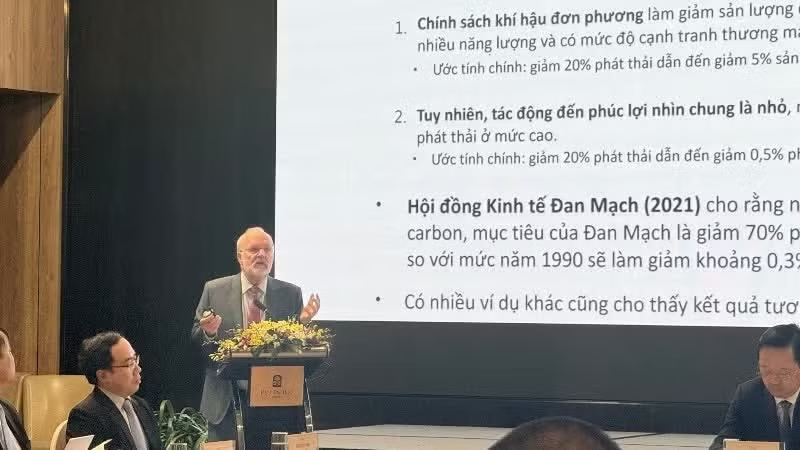
Professor Finn Tarp of the University of Copenhagen noted that, if appropriately designed, transition policies can simultaneously promote economic growth, strengthen energy security, reduce emissions, protect vulnerable groups, and enhance the overall competitiveness of the economy.
He emphasised that the green transition should be viewed not merely as an environmental imperative but as a fundamental component of Viet Nam's new development model.
Professor Tarp also recommended that Viet Nam continue refining its CGE model based on the ESAM framework and expand its application to simulate the impacts of policies such as carbon taxation, emissions trading systems (ETS), electricity tariff reforms, renewable energy auctions, and household support measures. In addition, he suggested that national energy and emissions databases should be updated every two to three years to ensure they accurately reflect changes in the economy.
According to Nguyen Duc Trung, Deputy Head of the Party Central Committee's Commission for Policies and Strategies, a just energy transition should be embedded within the broader transformation of the country's development model. This includes ensuring national energy security, improving energy efficiency, and promoting renewable energy in tandem with the development of power infrastructure and electricity markets.
He also stressed the importance of establishing an appropriate roadmap for carbon pricing mechanisms that ensures fairness for citizens, businesses, and localities affected by the transition. At the same time, energy transition policies should be closely linked to job transformation, workforce development, and social welfare, with businesses playing the central role while the state focuses on improving institutions and providing enabling policy support.

![[In Pictures] Bridge columns and underpasses in Ha Noi begin to turn green](https://en-cdn.nhandan.vn/images/nyM650OGFWrOVWc-xajqN-rTZ68Rlmc1fiGJOhBRYHH_N-Xs0TE8Psnfce7ORTs-KVfoJaEblqjNufFrgeF3e2xFkGtLQVaXm04VcmMKBEkANUyiOkpz4zAuIKgydVrrfBxmGez0E_YJIag0u_Uil0E7jpuJXsIxeMmGjoY1-W4/1791863309074-2994714492692222878-2994714492692222878-adb9ff3f4175c70066ed8bb80cfbead9.jpg.avif)