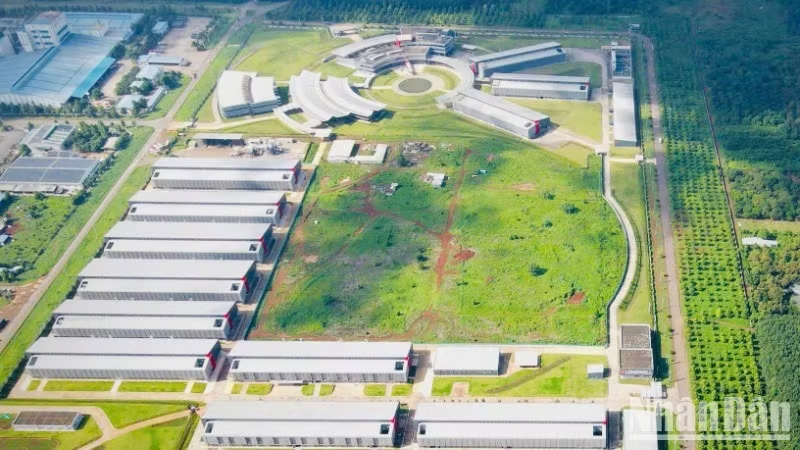
On the afternoon of July 28, the People's Committee of Dong Nai City, in coordination with the Vietnam Chamber of Commerce and Industry (VCCI) and relevant organisations, held a forum on building eco-industrial and smart industrial parks — a driver for investment attraction and green economic development in the South-East region.
An inevitable trend
Dong Nai City currently has 44 industrial parks operating effectively out of a total of 58 industrial parks that have been established. The city's People's Committee has issued a plan to guide the transformation of existing industrial parks into green industrial parks and eco-industrial parks by 2030, with a vision towards 2050. This marks a strategic shift in the locality's industrial development model towards greater modernity, intelligence, efficiency, and low-carbon emissions.
Nguyen Kim Long, Permanent Vice Chairman of the People's Committee of Dong Nai City, emphasised that building eco-industrial and smart industrial parks is not merely about complying with environmental standards; rather, it is a process of reorganising production in a modern manner that conserves resources, reduces costs, improves productivity, and strengthens participation in global supply chains.
With its extensive industrial park system, strategic geographical location, abundant land resources, and increasingly well-developed transport infrastructure, Dong Nai possesses favourable conditions to become one of Viet Nam's leading localities in the development of eco-industrial, smart, and high-tech industrial parks.
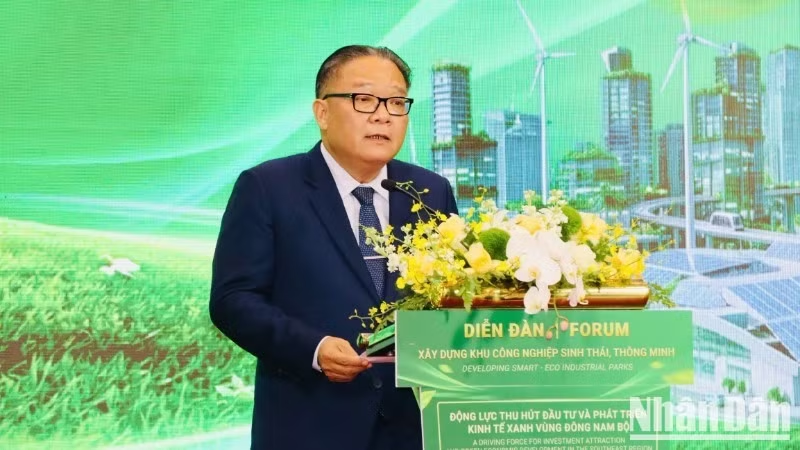
However, these advantages can only become real drivers of development if accompanied by new thinking, innovative approaches, and close coordination among the state, infrastructure investors, manufacturing enterprises, financial institutions, research organisations, and the wider community.
Dong Nai City will focus on attracting investment selectively, giving priority to high-tech and clean technology projects that generate high added value, use resources efficiently, and are environmentally friendly. At the same time, the city will gradually transform existing industrial parks into eco-industrial parks, promote energy efficiency, water reuse, waste recycling, and industrial symbiosis among enterprises operating within the same industrial park.
In parallel, Dong Nai will accelerate digital transformation in industrial park governance, particularly in environmental monitoring, energy management, waste management, and greenhouse gas emissions accounting. The city will also strengthen cooperation with ministries, sectors, international organisations, research institutes, universities, and the business community to mobilise resources for the green transition.
"The authorities of Dong Nai City clearly recognise that this process cannot succeed through general slogans alone. It must be translated into appropriate mechanisms, a clear roadmap, feasible resources, and measurable outcomes," Nguyen Kim Long said.

As for Tay Ninh Province, it currently has 34 industrial parks eligible to receive investment, with an occupancy rate of nearly 70%. The province also has three border-gate economic zones covering a total area of 68,561 hectares, providing significant potential for industrial development, logistics, and cross-border trade.
According to Huynh Van Son, Vice Chairman of the People's Committee of Tay Ninh Province, in the context of increasing sustainable development requirements, Tay Ninh considers the development of eco-industrial and smart industrial parks not only an inevitable trend but also a driving force for enhancing competitiveness and attracting high-quality investment.
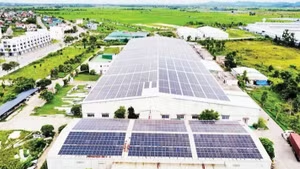
Accordingly, the province is focusing on developing industrial parks that use resources efficiently, promote the circular economy, strengthen the application of digital technologies in infrastructure management and operation, and encourage the use of clean and renewable energy.
This orientation is gradually being realised through practical action. The 400-hectare Prodezi Industrial Park, with total infrastructure investment of approximately 4.6 trillion VND, has already been converted to operate under the eco-industrial park model. This represents an important step in laying the foundation for expanding the eco-industrial and smart industrial park model throughout the province in the future.
Implementing comprehensive solutions
Ho Sy Hung, Chairman of the Vietnam Chamber of Commerce and Industry (VCCI), noted that traditional industrial parks have made significant contributions to economic growth and job creation but have also exposed several shortcomings, including environmental pollution, inefficient use of resources, and limited cooperation among enterprises.
For this reason, developing eco-industrial parks has become an urgent requirement for Viet Nam in the face of climate change and environmental degradation. Enterprises participating in this model not only gain economic benefits but also demonstrate their commitment to the international community regarding sustainable development, the circular economy, and carbon neutrality.
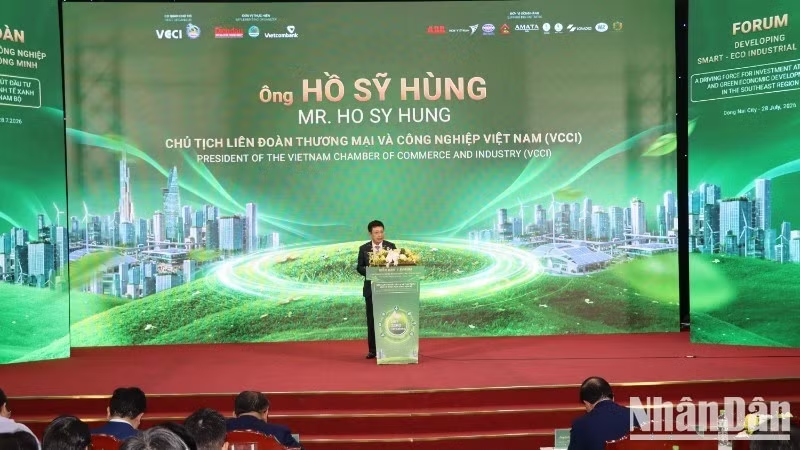
Today, the eco-industrial park model is not only the "key" to addressing environmental challenges associated with industrial development but also a strategy for building highly competitive industrial clusters, increasing the attractiveness of foreign investment, and progressively fulfilling Viet Nam's national commitments to green growth and sustainable development.
According to Ho Sy Hung, implementing the eco-industrial park model serves both the National Green Growth Strategy for the 2021–2030 period and the country's commitment to achieving Net Zero emissions by 2050, as pledged at the 26th Conference of the Parties (COP26) to the United Nations Framework Convention on Climate Change, thereby promoting green, inclusive, and sustainable development.
However, in practice, the number of industrial parks developed in accordance with new eco-industrial standards remains limited. Statistics indicate that Viet Nam currently has around 425 industrial parks, only 1–2% of which are in the process of transitioning to the eco-industrial park model.
The reasons include initial investment costs that are 15–30% higher than those of conventional industrial parks, insufficient incentive policies, limited cooperation and resource sharing among enterprises, slow technological transformation, difficulties in accessing green finance, and a shortage of professionals specialising in sustainable development.
Therefore, to promote the genuine and sustainable development of eco-industrial parks in the coming years, authorities at all levels and across sectors need to implement comprehensive and coordinated solutions, ranging from institutional and policy reforms to infrastructure and technology, in line with international practices and standards.
According to Dr Nguyen Duc Hien, Deputy Head of the Central Commission for Policy and Strategy, industrial park development is shifting from being merely a concentration of factories to becoming ecosystems for production, innovation, services and urban development. Resource-use efficiency, supply-chain connectivity, technological capability, and value added will serve as the key indicators of their value.

He identified five groups of criteria for smart eco-industrial parks: the eco-industrial park framework and governance; green buildings; carbon, energy, and environmental management; green finance and information disclosure; and smart technologies and operations.
The development of eco-industrial and smart industrial parks requires major solutions centred on institutional reform, the organisation of development space, and the transformation towards a new generation of industrial parks. This should be accompanied by modern industrial park governance and renewed approaches to investment attraction.
From a practical perspective, Dong Nai City now possesses all eight core conditions necessary for developing eco-industrial and smart industrial parks: a large industrial base, a strategic gateway location, multimodal logistics infrastructure, a green growth orientation, breakthrough institutions and policies, skilled human resources, innovation capacity, and strong digital and technological foundations.
Finally, Dong Nai also benefits from practical experience gained through the pilot implementation of the eco-industrial park transformation model. As such, the city has all the essential foundations in terms of spatial planning, industrial capacity, institutions, logistics, technology, and human resources to develop eco-industrial and smart industrial parks.



![[In Pictures] Bridge columns and underpasses in Ha Noi begin to turn green](https://en-cdn.nhandan.vn/images/nyM650OGFWrOVWc-xajqN-rTZ68Rlmc1fiGJOhBRYHH_N-Xs0TE8Psnfce7ORTs-KVfoJaEblqjNufFrgeF3e2xFkGtLQVaXm04VcmMKBEkANUyiOkpz4zAuIKgydVrrfBxmGez0E_YJIag0u_Uil0E7jpuJXsIxeMmGjoY1-W4/1791863309074-2994714492692222878-2994714492692222878-adb9ff3f4175c70066ed8bb80cfbead9.jpg.avif)