Scaling up from pilot models
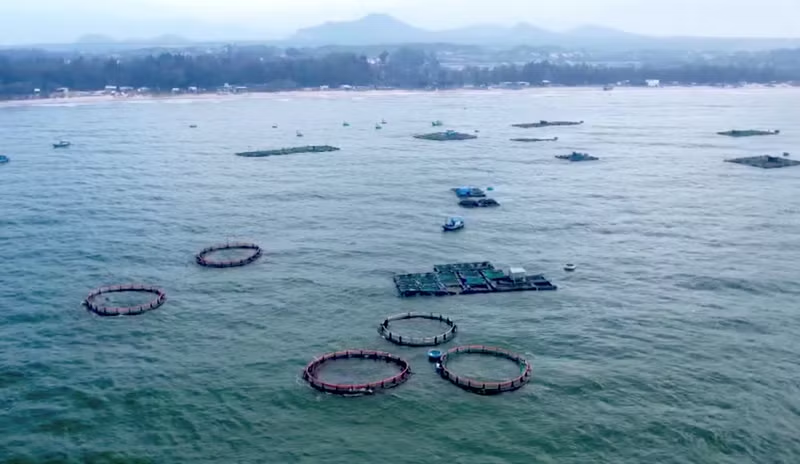
In early September, in the waters off Lien Huong Commune, wooden fish cages swayed in the waves and wind, while HDPE cages remained stable. Currently working with the Lam Dong Provincial Agricultural Extension Centre to deploy four HDPE cages containing 40,000 fingerlings, Vo Thi Hang said that the investment cost of HDPE cages was higher, however, in return they offered greater durability, better resistance to waves and wind, and required less repair. Compared with wooden cages, which require several people to operate, an HDPE cage requires only one person.
Over the years, pressure from fishing has led to a decline in fishery resources, creating a need to change production methods. Having worked with wooden cages for many years, Nguyen Van Sinh from Phan Ri Cua Commune said that since switching to HDPE cages, his family has harvested several batches of cobia and pomfret, generating fairly good profits. Previously, wooden cages required frequent repairs, from replacing nails and bolts to replacing wooden slats, whereas HDPE cages have significantly reduced these costs.
Lam Dong currently has seven localities engaged in marine aquaculture, with 3,093 cages, mainly farming cobia, pomfret, and grouper. According to the provincial Department of Agriculture and Environment, marine aquaculture is creating livelihoods, increasing incomes, and contributing to the shift of some fishermen from fishing to aquaculture. As the sea area has no large, sheltered bays and the coastline is exposed to waves and wind, wooden cages are easily affected during adverse weather. Although there are not yet any offshore industrial marine aquaculture projects, the potential for development and the application of HDPE cage technology is highly feasible.
From 2022 to 2026, the Lam Dong Provincial Agricultural Extension Centre has implemented numerous HDPE cage-based marine aquaculture models, with the aim of establishing aquaculture areas adapted to climate change. In 2022, a cobia farming model in the Phu Quy Special Zone, using eight HDPE cages, achieved a yield of 8.4kg/m³, with profits of nearly VND 200 million, and was subsequently expanded to 69 cages.
Vo Van said that because the island is frequently affected by storms, wooden cages are easily damaged, so in 2025 he invested in additional HDPE cages. According to him, a storm at the end of 2025 caused losses of approximately VND 10 billion to 40 households farming with wooden cages, while the HDPE cages remained safe. Based on this experience, residents hope that aquaculture areas will soon be planned and that policies will be introduced to attract investment in seafood purchasing and processing.
In Phan Ri Cua Commune, a white snapper farming model using circular HDPE cages, each with a capacity of 530m³, achieved a yield of 10.4kg/m³ and profits of approximately VND 33 million per cage, and was expanded to three cages. The cages are designed with load-bearing rims, making them convenient to relocate when necessary and suitable for conditions in open coastal and exposed sea areas. In addition, a grouper farming model using square HDPE cages of a size similar to wooden cages, making them suitable for residents' investment capacity, has been expanded to 14 cages.
In Tan Thanh Commune, marine aquaculture has been maintained stably, providing jobs and livelihoods for fishermen. The locality has many opportunities for development, but it also needs comprehensive preparation in terms of planning, infrastructure, technology, seed stock, environmental protection, and production organisation. In particular, determining environmental carrying capacity, allocating marine areas, and managing aquaculture areas must ensure consistency with planning.
Mobilising resources
Recognising the important role of the marine economy in the province's development, Lam Dong is focusing on implementing projects and programmes related to marine aquaculture in a modern and sustainable direction. At the end of 2025, the province approved the project “Developing Marine Aquaculture in Lam Dong Province to 2030, with a Vision to 2045”. By 2030, the province aims to maintain and expand 100-150ha of nearshore aquaculture areas; establish one to two industrial marine aquaculture zones/clusters; achieve marine aquaculture output of 50,000 tonnes, accounting for 22% of the province's total seafood production, with an estimated value of VND 5,000-5,200 billion; and achieve export turnover of USD 50 million. The project aims to create jobs for approximately 7,000 workers, including retraining 3,000 fishermen to shift from nearshore fishing to aquaculture.
What fishermen want is access to technology and knowledge so that they can take the initiative in production. The Fishermen Community Association of Tan Thuan Commune has proposed researching a “four-party” linkage model: the state provides support through mechanisms and policies and connects programmes; scientists provide technical advice, training, and process supervision; enterprises provide technology, materials, seed stock, and feed, as well as connect producers with markets; and local residents directly organise production as well as participate in and take responsibility for the model.
With a view to developing marine aquaculture into a high-tech commodity production sector, creating raw materials for processing and exports, Nguyen Van Chuong, Director of the Provincial Agricultural Extension Centre, said the centre is strengthening cooperation with research institutes and universities to develop economically effective models, transfer large-scale marine aquaculture processes, and encourage enterprises to collaborate in research and the application of new technologies. The province is also orienting efforts towards completing support mechanisms for infrastructure and occupational transition and attracting enterprises to invest in marine aquaculture zones and clusters, while also strengthening international cooperation to exchange experience, transfer technology, and train human resources.
The province will not “trade the environment for growth”, but must pursue sustainable development, proactively adapt, and rely on science and technology. The province will not allow spontaneous aquaculture development but will review and plan aquaculture areas in conjunction with an early-warning map for water pollution, ensuring that the available space is appropriate to the ecological carrying capacity of each area.
Nguyen Van Chien, Deputy Director of the Lam Dong Provincial Department of Agriculture and Environment
Marine aquaculture is not only a key economic sector that contributes to economic growth but also creates sustainable livelihoods for millions of households. Deputy Nguyen Van Chien, Director of the provincial Department of Agriculture and Environment, said the province will not “trade the environment for growth” but must pursue sustainable development, proactively adapt, and rely on science and technology. The province will not allow spontaneous aquaculture development but will review and plan aquaculture areas in conjunction with an early-warning map for water pollution, ensuring that the available space is appropriate to the ecological carrying capacity of each area. The department will continue to organise training courses on technology application skills, helping fishermen control the environment rather than relying entirely on natural conditions.
In addition, departments and sectors will prioritise resources to invest in separate water supply and drainage systems in concentrated marine aquaculture areas. The department will serve as a strong bridge, promoting the four-party linkage, and creating the most favourable conditions for high-tech enterprises to invest in and lead cooperatives and farming households towards sustainable development together.
Lam Dong has substantial room to develop an industrial, high-tech marine aquaculture ecosystem. With the support of scientists, enterprises, and fishermen, marine aquaculture can shift from fishing and small-scale production towards modern management, creating high-value products; at the same time, marine space can be organised in an integrated manner with the mainland, towards green, clean, and sustainable development.
![[In Pictures] Bridge columns and underpasses in Ha Noi begin to turn green](https://en-cdn.nhandan.vn/images/nyM650OGFWrOVWc-xajqN-rTZ68Rlmc1fiGJOhBRYHH_N-Xs0TE8Psnfce7ORTs-KVfoJaEblqjNufFrgeF3e2xFkGtLQVaXm04VcmMKBEkANUyiOkpz4zAuIKgydVrrfBxmGez0E_YJIag0u_Uil0E7jpuJXsIxeMmGjoY1-W4/1791863309074-2994714492692222878-2994714492692222878-adb9ff3f4175c70066ed8bb80cfbead9.jpg.avif)