Encompassing a majestic limestone mountain range, the area provides a unique natural habitat for the Delacour’s langur, known as Trachypithecus delacouri in scientific terminology.
The establishment of the Kim Bang Delacour’s Langur Conservation Area aims to conserve and restore limestone forest ecosystems; protect and develop endemic, endangered, rare and precious animal and plant species, especially the Delacour’s langur population.
Delacour’s langur is a primate species endemic to Viet Nam, first discovered in 1930. It is currently classified as critically endangered in both Viet Nam’s Red List and the IUCN Red List, and is among the world’s 25 most endangered primates.
In the 1990s, the species had approximately 16 isolated populations comprising around 300 individuals. Since then, many populations have disappeared, leaving just five populations in the wild, with a total estimated population of around 500 individuals.
Ninh Binh Province is currently home to more than 90% of the world’s remaining wild Delacour’s langurs.
The establishment of the conservation area also provides an important foundation for Ninh Binh Province to coordinate with central ministries and agencies in preparing a nomination dossier to seek UNESCO recognition of the conservation area as a World Heritage Site.
The establishment of a conservation area with a comprehensive legal framework, clearly defined boundaries and area, and a dedicated management structure is essential to demonstrating the outstanding universal value of the limestone mountain ecosystem’s biodiversity, particularly its Delacour’s langur population.
It will also help meet the requirements for integrity, protection and management under the criteria of the Convention Concerning the Protection of the World Cultural and Natural Heritage.
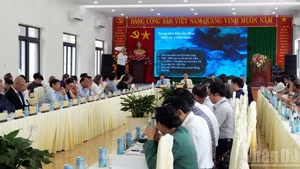
Speaking at the ceremony, Ninh Binh Vice Chairman Tran Anh Dung emphasised that the establishment of the conservation area would provide a legal basis for the unified, long-term management and protection of forests and habitats; safeguard the Delacour’s langur population and other rare animal and plant species; and create favourable conditions for scientific research, environmental education, ecosystem restoration, and sustainable ecotourism development.
He asked the Department of Agriculture and Environment to direct the Ninh Binh Protection and Special-Use Forest Management Board to deploy regular patrols and protection forces in areas inhabited by Delacour’s langurs, strictly prevent hunting, forest fires and habitat destruction, and implement forest protection and restoration programmes alongside monitoring of the langur population.
The wards of Ly Thuong Kiet, Tam Chuc and Nguyen Uy were requested to work closely with forest rangers and the conservation area management in patrolling and protecting forests and handling violations.
They were also asked to step up public awareness campaigns, encourage local residents to participate in forest protection, and support the development of sustainable livelihoods so that local communities can both contribute to and benefit from conservation efforts.