From ‘slaughtering beach’ to ‘maternity ward’
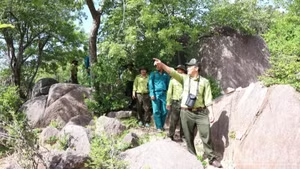
Set amid ancient forests, sea and sky, the turtle nesting beach appears as a stretch of pristine white sand framed by the rugged rocky shores of Nui Chua. From the Ninh Thuan Stone Park, reaching it requires a trek through the forest and a descent of nearly 200 steep steps.
“Exactly 186 steps,” says Pham Anh Dung, Deputy Head of the Natural Resources Management and Biosphere Reserve Division at Nui Chua National Park. Sun-tanned and middle-aged, he cannot remember how many times he has made this trek, day and night, rain or shine. Dung is a veteran “midwife” who has attended hundreds of mother turtles as they lay their eggs.
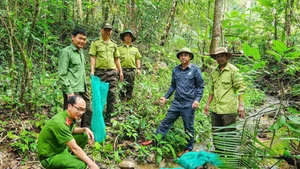
As the last rays of sunlight fade behind the mountains, the “midwives” begin their shift. They patrol the beach carefully, keep unauthorised visitors out and collect rubbish washed ashore by the waves. Each night, they take tens of thousands of steps along more than two kilometres of white sand.
This turtle nesting beach is known as Bai Thit. By the dim glow of a red torch, Dung recalls its painful past: “It was once called the ‘slaughtering beach’. The name came about because local people used to regard turtles as gifts from heaven. Whenever food was scarce, they would come here, turn the defenceless mother turtles onto their backs and slaughter them for meat.”
Turtles born on this very beach two decades ago have followed their instincts, returned to nest and continued the cycle.
Pham Anh Dung
Deputy Head of the Natural Resources Management and Biosphere Reserve Division at Nui Chua National Park
Nguyen Van Binh, a volunteer from Thai An Village, said: “That was several decades ago. Even our generation has never witnessed such scenes. For the past 20 years, local people have worked alongside Nui Chua National Park staff to conserve sea turtles.”
The work of the “midwives” is at its most fascinating when turtles come ashore to lay their eggs. Turtles usually come ashore between April and November, but they do not appear every night.
When a nest is found in a low-lying area where rising tides could wash away the eggs, the “midwives” carefully move each egg to higher, safer ground. If the nest is already in a safe position, Dung records its details for monitoring and waits for the hatchlings to emerge.
“The largest nests contain up to 120 eggs. About 45 days after laying, we cover the nest with a mosquito net to protect the eggs and hatchlings from predators,” Dung said.
When the eggs hatch, team members take turns watching over the hatchlings and helping weaker ones reach the water’s edge so they can make their way out to sea. Only when the hatchlings are safely in the water and swimming do the “midwives” feel able to leave.
In 2025, Nui Chua National Park had a record nesting season, with 68 nesting visits and 35 nests. Thanks to round-the-clock protection, 2,787 hatchlings reached the sea.
Reflecting on these figures, Dung says with pride: “Twenty years is a complete cycle for a turtle: it is born, grows to maturity and reproduces. Counting back exactly 20 years from 2025 takes us to when we began systematic conservation. That suggests turtles born on this very beach two decades ago have followed their instincts, returned to nest and continued the cycle. That is the fruit of our efforts, and a source of immense pride for our team.”
Community support helps sea turtles thrive
However dedicated they are, park staff such as Dung could not have achieved such remarkable results across this vast conservation area without the involvement of local people. The transformation of Bai Thit into a “maternity ward” is the product of years of persistent effort.
Binh embodies the gradual shift in attitudes seen over the past two decades. By day, he tends his vineyard and fishes inshore. By night, he becomes a sea turtle “midwife”.
“Through education and training, we have changed our attitudes and passed on what we have learnt to our neighbours and relatives. Gradually, a love of turtles, and of marine life in general, has taken deep root in the community, because we understand that conservation means safeguarding livelihoods for our children and grandchildren,” Binh said.
Thanks to residents such as Binh, the park’s conservation work has reached the wider community. Fishermen who once regarded turtles as “gifts from heaven” are now willing to cut sections out of nets worth millions of Vietnamese dong to free trapped turtles.
As well as nurturing a love of nature among local residents, Nui Chua’s “maternity ward” attracts volunteers from across the country. Every year, the park receives thousands of applications from people wanting to join the sea turtle conservation effort.
Besides caring for and protecting turtles, volunteers take part in community activities. Through these experiences, young volunteers find new meaning and values in life.
Gradually, a love of turtles, and of marine life in general, has taken deep root in the community, because we understand that conservation means safeguarding livelihoods for our children and grandchildren.
Nguyen Van Binh, Volunteer
After a week volunteering at Bai Thit, Nguyen Nhan from Ho Chi Minh City said: “I will remember the sleepless nights in the sea breeze, waiting for mother turtles to come ashore and lay their eggs. I will remember the scorching sun on the mudflats as we planted mangrove seedlings together. I will remember the hours spent teaching and sharing knowledge, and the bright smiles of the children in My Hoa and Thai An.”
Another volunteer, Ngoc Tuyen, a young woman who grew up in Ninh Thuan, said: “What we hope for most when we come here is to see turtles. But even if we are not lucky enough to encounter one, we are still very happy to have been part of such a meaningful journey. Most importantly, I believe that what we have done will contribute to the recovery of sea turtle populations and the wider ecosystem.”
Speaking about the role of the thousands of young people helping to safeguard marine life, Pham Van Xiem, Head of the Natural Resources Management and Biosphere Reserve Division under the Nui Chua National Park Management Board, said: “Our wider aim is not simply to recruit more people to help with conservation work. We hope that every young volunteer will become an effective advocate for conservation. This engagement also brings practical benefits: during the summer, volunteers teach English and computer skills to local children, integrating lessons on wildlife protection into their classes.”
Today, Bai Thit is peaceful, thanks to the combined efforts of conservation staff, local residents and young volunteers. The tiny tracks left by hatchlings in the white sand bear witness to the community’s love of nature and its commitment to conservation.