Q: How would you assess the current challenges facing the development of marine aquaculture projects in Viet Nam?
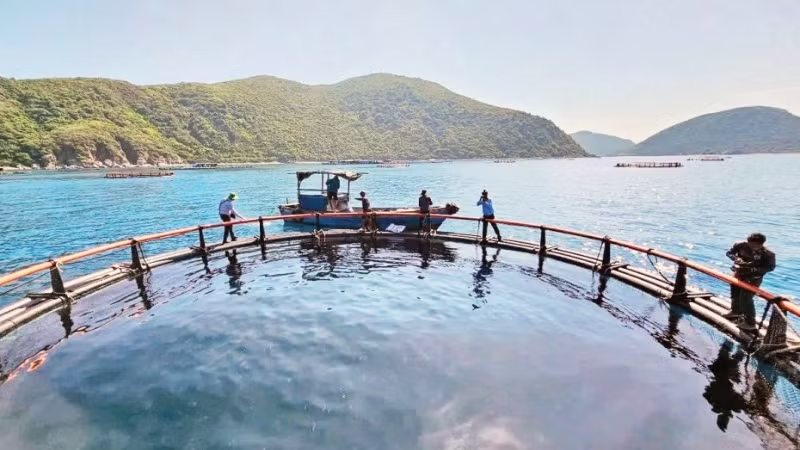
A: Marine aquaculture is being practised in more than 20 coastal provinces and cities, with activity concentrated in Quang Ninh, Hai Phong, Thanh Hoa, Nghe An, Dak Lak, Khanh Hoa, Ho Chi Minh City, and An Giang. Marine aquaculture can be divided into three zones: nearshore farming (within three nautical miles), coastal farming (from three to six nautical miles), and offshore/open-sea farming (beyond six nautical miles). In Viet Nam, nearshore and coastal farming still dominate. Nearshore marine fish farming involves around 244,000 cages and rafts; coastal farming has 4,300 cages and rafts; while offshore mariculture has only just over 130 cages and rafts.
According to the Food and Agriculture Organization of the United Nations (FAO), with today’s technology, countries can develop marine fish farming over 0.1% of their exclusive economic zone (EEZ), with yields of 9,900 to 11,600 tonnes per km² per year.
Alongside its potential and advantages, Viet Nam’s marine aquaculture sector continues to face many challenges. Most activities remain spontaneous and small-scale, relying on traditional manual methods. Farming rafts are often made of bamboo and wood, with low durability and limited capacity to withstand natural disasters. In enclosed nearshore waters, cage densities are commonly far too high – three to five times above the plan – threatening ecological balance. Excessive stocking density in cages leads to marine pollution and rapid disease transmission. When disease outbreaks occur, farmers often do not report them to the authorities, instead buying antibiotics on their own for treatment. This tends to be ineffective and also contributes to antibiotic resistance.
In addition, the planning of marine aquaculture zones has not been carried out on a solid scientific basis. Long-term allocation of sea areas to local people has not been implemented because administrative procedures remain complicated. As a result, marine aquaculture in our country has not developed as it should.
Q: How are Viet Nam’s modern mariculture models operating?
A: According to FAO, with today’s technology, countries can develop marine fish farming over 0.1% of their exclusive economic zone (EEZ), with yields of 9,900 to 11,600 tonnes per km² per year. On that basis, across 0.1% of Viet Nam’s EEZ, the country could farm 10 million tonnes of marine fish each year, not to mention molluscs, seaweed, echinoderms, and other species.
The “marine aquaculture industrial cluster” is an initiative proposed by the Viet Nam Marine Aquaculture Association to fundamentally address the spontaneous, fragmented, and outdated nature of traditional marine aquaculture. Australis Aquaculture Vietnam Co., Ltd (a member of the association) has effectively operated Viet Nam’s first marine aquaculture industrial cluster in Van Phong Bay (Khanh Hoa Province), applying international standards and advanced technology to a closed production chain – from seedstock and fingerling production to processing and distribution to global markets. It is currently the world’s largest barramundi producer, with output of more than 12,000 tonnes a year.
Building on that successful model, in recent times a number of member enterprises have developed proposals for pilot marine aquaculture industrial clusters and are working with state management agencies in provinces such as Quang Ninh, Khanh Hoa, and An Giang to implement them.
Q: In your view, what needs to be done to tap Viet Nam’s high-tech marine aquaculture potential effectively?
A: To make Viet Nam a leading country in ASEAN in the sustainable development of high-tech marine aquaculture, the first task is to overcome fragmented and spontaneous farming. Coastal provinces and cities need marine aquaculture planning, for example: zoning concentrated production areas for each specific group of farmed species (marine fish, molluscs, and seaweed), creating large-scale production zones with consistent quality that are certified to international standards such as GlobalGAP and ASC.
Priority should be given to marine and coastal planning for establishing marine aquaculture industrial clusters, treating them as concentrated production areas with clearly defined geographic boundaries; providing technical infrastructure and services for marine aquaculture production; and enabling professional investment by large enterprises.
To harness multi-sector strengths and make maximum use of marine spatial potential, planning should prioritise an integrated approach that combines marine aquaculture with tourism, wind power, and other marine economic sectors.
Regarding legal procedures related to allocating sea areas to local people, adjustments could be made to encourage people to participate in marine aquaculture while protecting the environment. For mariculture activities with limited adverse environmental impacts – such as farming molluscs, benthic species, or seaweed cultivation – it may be worth considering abolishing the environmental impact assessment reporting requirement, with investors only needing to provide an environmental protection commitment.
In addition, a reasonable method for calculating fees for mariculture could be considered, based on these principles: fees should be charged only on the area actually used for marine aquaculture; different fee levels should apply to zones with different conditions and to different farmed species. Priority in sea-area allocation should be given to cooperatives and enterprises that reorganise production, shifting from traditional manual marine aquaculture to sustainable commercial mariculture.
Reporter: Thank you very much!