In Thai Nguyen, the Provincial Party Committee has rolled out a number of key policies to translate the Party’s strategic directions into action, turning the private sector into a stronger engine of growth.
Affirming its role
Thai Nguyen is an economic, science and technology hub of the northern mountainous region. In that development, the private sector’s contribution has been substantial —creating jobs and raising incomes for local people.
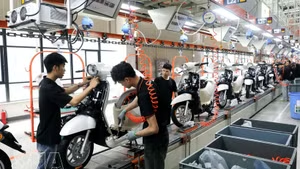
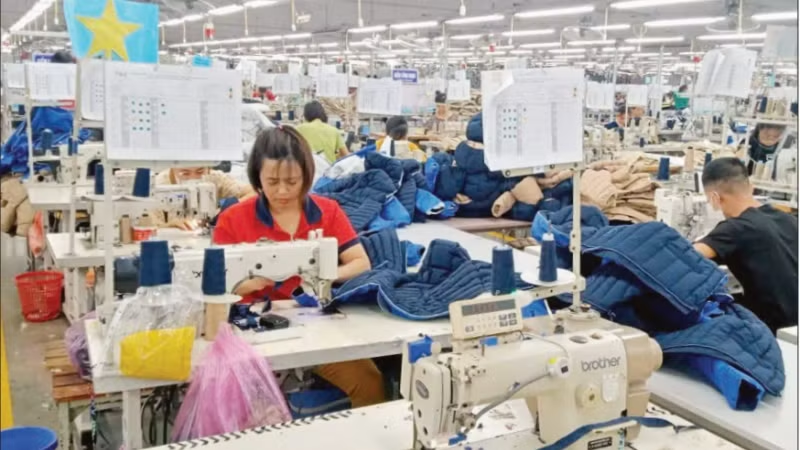
TNG Investment and Trading Joint Stock Company in Thai Nguyen is a bright spot in Viet Nam’s textile and garment industry. With 41 years of development, it has ranked among the top 10 exporters and the top 500 largest private enterprises nationwide. From a small enterprise established in 1979, the company was equitised and listed on the stock exchange in 2007; it has grown into a leading garment manufacturer.
Its products are mainly exported to Europe, the US and Russia. Alongside production and business operations, the company consistently places emphasis on community contributions through scholarships and support for workers facing difficulties.
According to the Thai Nguyen Provincial People’s Committee, by the end of 2025, the province had more than 14,700 operating enterprises with total registered capital of over 197,224 billion VND. In the 2021–2025 period, Thai Nguyen recorded an annual average of more than 800 newly established enterprises.
Thai Hung Trading Joint Stock Company has for many years been a flagship enterprise of Thai Nguyen Province and is among the 50 largest private businesses in Viet Nam. Operating across steel production and trading, steel billets, logistics, real estate and education, it reported revenue of more than 15 trillion VND in 2024, created jobs for around 700 workers with average incomes of over 11 million VND per person per month.
Under the leadership of Chairwoman Nguyen Thi Vinh, the company has not only led in production and business but has also built a strong Party organisation within the enterprise. Its Party Committee comprises seven Party cells with 129 Party members, and all key management positions are held by Party members. Each year, the company contributes 2–3 billion VND to the province’s social welfare programmes.
According to the Thai Nguyen Provincial People’s Committee, by the end of 2025, the province had more than 14,700 registered enterprises with total capital of over 197,224 billion VND. In the 2021–2025 period, Thai Nguyen recorded an annual average of more than 800 newly established enterprises. In January, the province alone saw more than 148 newly-established enterprises. By the number of enterprises with tax-generating activities, more than 88% had registered capital of 10 billion VND or below; more than 4.8% had capital of 10–20 billion VND; more than 3.2% had capital of 20–50 billion VND; more than 1.7% had capital of 50–100 billion VND; and more than 1.6% had registered capital above 100 billion VND.
Thai Nguyen’s business landscape is still dominated by small and micro enterprises. Firms with large registered capital account for just over 1.6% of the total, yet they make significant contribution to budget revenues and economic momentum. In the 2021–2025 period alone, budget revenue from the enterprise sector reached nearly 66 trillion VND. The private sector now contributes more than 45% of GRDP, provides about 15% of total budget revenue, and accounts for jobs for over 72% of the employed workforce.
From 2021 to 2025, Thai Nguyen issued numerous policies to support and accompany enterprises, improved its Provincial Competitiveness Index, and effectively implemented the index for assessing the competitiveness of departments and agencies.
The province has developed 19 industrial parks, covering more than 6,400 hectares, to create “clean” land funds for investment attraction. It currently has 891 cooperatives and more than 52,700 business households —considerable space and potential to be developed into enterprises in the time ahead.
Elevating the growth driver
The Resolution of the Thai Nguyen Provincial Party Congress (first term), for the 2025–2030 tenure, sets the goal of developing the private sector into the most important driver of the economy — one of three key breakthroughs for the term.
According to the Thai Nguyen Provincial Party Committee, creating a favourable environment for strong private-sector growth is the “key” to achieving fast and sustainable growth while addressing social issues in a balanced way. It is also the condition for Thai Nguyen to reinforce its role as a regional hub of the northern midland and mountainous area and to become a new economic growth pole for the region.
The province’s determination to unlock potential and make the private sector the most important engine of growth has been evident from the start of the new term. The concept of a “green lane” has been selected and implemented as a distinctive mechanism, requiring high speed in handling administrative procedures—especially for investment attraction. This has been operationalised by the Thai Nguyen Provincial People’s Committee through the “24-hour green lane” and the “60% green lane”, to be implemented starting in 2026.
Under the “24-hour green lane”, administrative procedures and even tasks that are not administrative procedures must be processed and completed within 24 hours of receipt. Under the “60% green lane”, the time required to handle administrative procedures and non-procedure tasks must be reduced by at least 60%. These mechanisms apply to projects in science and technology, industry, industrial clusters, inland container depots, and social housing.
After the merger, newly expanded space and room for growth have opened up fresh opportunities for the province’s private business community. However, a major challenge is that most firms are small and micro enterprises, with weak linkages and cooperation, and many are concentrated in real estate trading and mineral extraction — sectors where sustainability is limited.
To address this, on December 10, 2025, the Thai Nguyen Provincial Party Committee issued Scheme No. 15-DA/TU on private-sector development for 2026–2030. The province targets having 36,000 enterprises or more by 2030, equivalent to 20 operating enterprises per 1,000 people.
The province targets average private-sector growth of at least 10.5%, with the sector contributing about 50–55% of GRDP and accounting for roughly 18–20% of total budget revenues. It also aims to provide jobs for around 76–77% of the province’s workforce, while labour productivity is expected to rise by an average of 8.5–9.5% per year or more. Technology capability, innovation and digital transformation are to reach an advanced level within Viet Nam, helping position Thai Nguyen among the country’s leaders in the Digital Transformation Index.
Thai Nguyen Province has decided to invest more than 428 trillion VND to realise these goals, including more than 480 billion VND in recurrent spending, more than 23,000 billion VND in public investment, and more than 404,000 billion VND in off-budget capital.
The province has set out eight core groups of measures under a unified direction. These include strengthening leadership by Party committees and Party organisations at all levels; delivering support that is practical and effective; refining mechanisms and policies to create a more enabling business environment; making it easier for the private sector to access key resources — land, capital and high-quality human resources; and accelerating science and technology, innovation and digital transformation.
According to Chairman of the Thai Nguyen Provincial People’s Committee Vuong Quoc Tuan, the province consistently identifies enterprises as the centre and driving force of socio-economic development. Provincial leaders have pledged to engage in substantive dialogue and to address the business community’s recommendations in a satisfactory manner, using effectiveness as the yardstick and treating business satisfaction as a key criterion in decision-making and governance.
Another major goal set by the Thai Nguyen Party Committee is the rapid formation and development of large and medium-sized enterprises and private economic groups of regional and global stature underscoring the province’s strong political determination. This will be a key driver for Thai Nguyen to strengthen the private sector as a leading engine of growth, promoting fast and sustainable economic development in the period ahead.