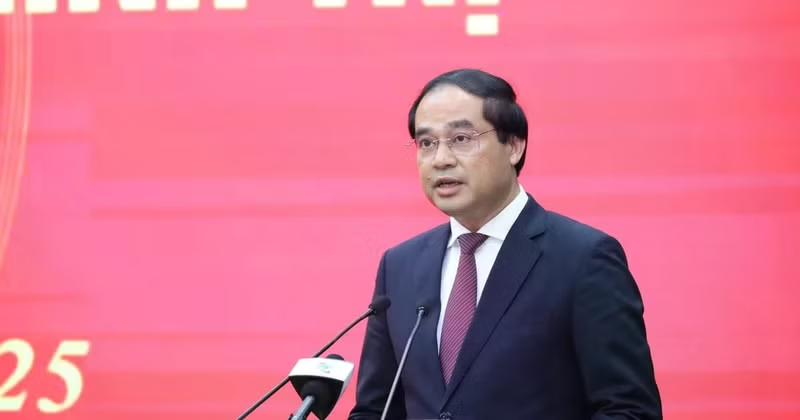
According to the provincial Party chief, Thai Nguyen holds a particularly important strategic position as a gateway linking the northern midland and mountainous region with the Red River Delta and Hanoi. Its convenient road and rail networks facilitating good connectivity to major airports, combined with notable industrial development achievements in recent years, provide a solid foundation for further breakthroughs.
In addition, the locality serves as a regional hub for education, training and health care, with a young, dynamic workforce and an increasingly favourable investment environment. These advantages are key to accelerating economic restructuring towards modern industry.
Truong said that to achieve the set objectives, the province has identified three strategic pillars. The first is developing synchronous and modern infrastructure, with connectivity infrastructure seen as a core driver for attracting investment and promoting production, trade and logistics.
The second is attracting investment and shifting the economic structure towards high technology, prioritising processing and manufacturing industries, electronics, high-precision mechanical engineering and clean energy, alongside administrative reform and innovation promotion.
The third is developing high-quality human resources, linking training with business demand and strengthening cooperation with domestic and international training and research institutions.
Alongside these pillars, Thai Nguyen will focus on mobilising and effectively utilising both domestic and foreign investment resources, particularly public investment, to create strong momentum towards achieving upper-middle income status before 2030.
The development of Thai Nguyen into a modern industrial centre is not only a goal of the province itself but also an important component of the national development strategy in the new period, contributing to deeper integration into regional and global value chains, said the local leader.