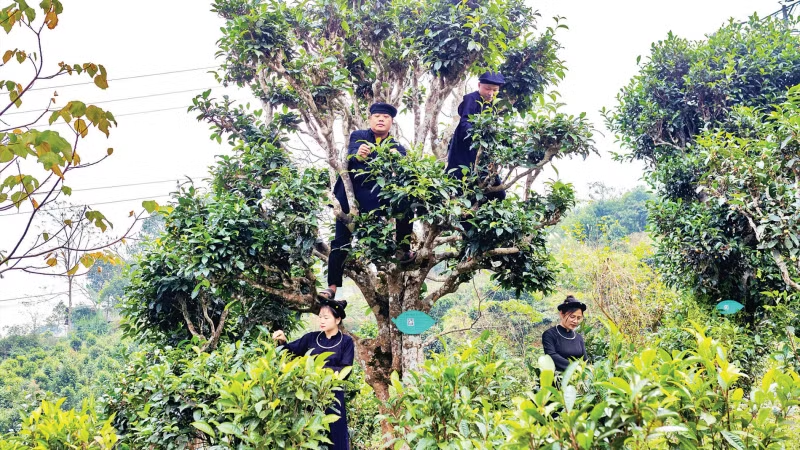
The province aims for the total value of products collected from tea to reach 25 trillion VND by 2030, to consolidate its position as the “Finest Tea” and number one in Viet Nam, and to target the leading position in Southeast Asia, becoming Asia’s tea capital in the future.
Affirming its position
Thai Nguyen currently has more than 24,000 ha of tea, with annual output of around 280,000 tonnes, accounting for over 18% of the national tea-growing area and more than 24% of the country’s fresh tea bud output. The province is identified on the tea map with the brand “Finest Tea”. In the heart of the north mountainous region, tea is grown in most communes and wards, forming the “Five Great Tea Regions”: Trai Cai, Khe Coc, Tan Cuong, La Bang, and Bang Phuc.
At an altitude of thousands of metres above the sea level, Dong Phuc Commune has 740 ancient Shan Tuyet tea trees aged from 65 to nearly 100 years.
According to Trieu Quang Hung, Chairman of the Dong Phuc Commune People’s Committee, besides these ancient tea trees, the commune has also developed nearly 320 ha of Shan Tuyet tea. Many cooperatives and enterprises have connected with households to process products into black tea and white tea, sold at 500,000 VND/kg or higher, and some are exported to the US market. Notably, in December 2025, a cluster of 12 Shan Tuyet tea trees here was recognised as Viet Nam Heritage Trees, opening a development direction combining tea with tourism in the commune.
In lowland communes, tea has been a sustainable livelihood, enriching thousands of households. Binh Thanh Commune has more than 950 ha of tea, with output of nearly 7,700 tonnes of fresh tea/year, produced in a safe manner and linked to the OCOP programme.
So far, the commune has seven production groups and three cooperatives processing VietGAP-standard tea. Some tea products have been introduced on e-commerce platforms. Alongside expanding area and improving output and quality, Thai Nguyen Province has effectively implemented the building and protection of intellectual property; built geographical indications and collective trademarks; organised trade promotion activities and tourism associated with tea culture.
Currently, Thai Nguyen has the Tan Cuong Geographical Indication, protected by the European Union (EU) under the EU-Vietnam Free Trade Agreement (EVFTA), making it one of the few Vietnamese agricultural products to enter this market. In addition, 10 collective trademarks for tea in the province have been granted certificates by the Intellectual Property Office of Viet Nam. The collective trademark “Thai Nguyen Tea” is protected in six countries and territories.
The province has more than 200 tea products meeting OCOP standards from three to five stars, including three products achieving national five-star status, connected to major e-commerce platforms. The value generated by tea for Thai Nguyen exceeds 13 trillion VND per year, with an average income of 400 million VND per hectare per year.
Elevating development
At present, the global tea industry is shifting strongly towards convenient products with high technological content, posing significant challenges for the Thai Nguyen tea sector.
According to Dr. Bui Ba Chinh, Director of the National Barcode Centre under the Commission for Standards, Metrology and Quality of Viet Nam, Ministry of Science and Technology, to help Thai Nguyen tea further develop, traceability codes and barcodes and transparent product information are indispensable requirements. These are not only technical tools but also a foundation for brand protection, enhancing market trust and helping products effectively access domestic and international markets.
Keeping pace with this trend and with determination to elevate the value of tea, households, cooperatives, and grassroots authorities in the province have made timely changes.
In Tan Cuong Commune, Hao Dat Tea Cooperative is a pioneer in applying science and technology to tea production, independently researching, improving, and introducing enzyme-killing tubes into its traditional tea-processing process.
Compared with the manual pan-firing method, enzyme-killing tubes shorten the firing time per batch to just three to five minutes, ensure evenly cooked tea leaves that are soft and maintain their natural dark green colour and characteristic aroma. One enzyme-killing tube can replace eight manual pans, requiring two less workers per batch, while increasing output by three to five times.
Thai Nguyen has directed and supported units to step up the application of science and technology in tea production and processing. The province has deployed the iMetos smart weather station to provide accurate weather forecasts and warnings for tea cultivation and care; applied automatic water-saving irrigation systems and shade nets; registered planting area codes; and attracted investment in large-scale, modern, environmentally friendly processing plants.
The province targets that by 2030, around 70% of tea-growing area will be certified as meeting GAP and organic standards; 70% of the area will be granted planting area codes; and 100% of processing and trading facilities will meet food safety regulations.
According to Duong Thi Thu Hang, Secretary of the Tan Cuong Commune Party Committee, the commune is implementing a variety of solutions to make Tan Cuong become a community-based eco and resort tourism service centre associated with tea production areas.
Accordingly, the commune is planning and developing tourism infrastructure while expanding area and improving the quality and value of tea products and tea culture. At the same time, it is upgrading the scale and diversifying the forms of festivals and events, such as the Tan Cuong Tea Culture Festival; organising experiential tourism tours such as: “A day as a Tan Cuong resident”; building a model in which each tea-growing household is a “Tea Culture Ambassador”; and developing the brand “Tan Cuong – The Capital of Viet Nam Tea Tourism”.
Thai Nguyen Province has decided to invest more than 500 billion VND to support full costs for new planting or replacement of old tea varieties; support up to 70% of the cost of organic and microbial fertilisers during the first year; and support 100% of the first certification costs for VietGAP and organic standards. Cooperatives and enterprises are supported with costs for building smart irrigation systems and purchasing modern processing machinery.
The province also supports costs for granting planting area codes, electronic labels, registration for intellectual property protection, and development of OCOP products; supports tea sector stakeholders in promotion and participation in domestic and foreign fairs and exhibitions; and encourages the development of community-based tourism and eco-tourism associated with tea-growing areas.
In December 2025, the Thai Nguyen Provincial Party Committee issued a project on tourism development for the 2026–2030 period, identifying the development of community-based tourism and agricultural and craft village tourism associated with tea culture as one of the pillars, towards enhancing experiences and affirming the position of “The Capital of Community-based Tea Culture Tourism of Viet Nam.”
According to Vuong Quoc Tuan, Chairman of the Thai Nguyen Provincial People’s Committee, after merger, the value and space of the province’s tea sector continue to be expanded. The province has organised the Thai Nguyen Festival – Fragrance and Colours of Finest Tea, marking an important initial step in preparing the Vietnamese tea culture dossier for submission to UNESCO for inscription on the List of Good Safeguarding Practices for Intangible Cultural Heritage under the 2003 Convention. This is an opportunity to promote the image of the country and people of Viet Nam, including Thai Nguyen, to the world, in association with heritage preservation and the tourism and cuisine development.










![[Infographic] GRDP growth scenarios for 34 provinces and cities in fourth quarter of 2026](https://en-cdn.nhandan.vn/images/nyM650OGFWrOVWc-xajqN-rTZ68Rlmc1fiGJOhBRYHFSa4DhrHNDxEFdnz313Vk5dNJuxdkHglPA3rLeaPeiaUheNuCI723k2lNssd-YLJuKR58epWq7s21lV5WjM-HR2-Qpbi4MwAzqt9wRjL4WjGkfEz7RO9qhcwg8o8LQFK8/grdp-growth-scenarios-for-34-provinces-and-cities-in-q42026-anh-dai-dien.jpg.avif)