Three strategic breakthroughs to expand growth space
Q: The year 2026 is the first year Viet Nam enters a period of double-digit economic growth. In your view, what are the foundations that create momentum for and realise this growth target?
A: In my view, several foundations are creating momentum for and enabling the realisation of the 2026 growth target.
First of all, there is innovation in thinking, vision, and approaches in the new development era; major orientations, policies, and programmes following the adoption of the documents of the 14th National Party Congress; the establishment of a new growth model aligned with global trends, enhancing labour productivity and the efficiency of resource use, with science and technology, innovation, and digital transformation serving as the main driving forces.
Another important factor is that the breakthrough resolutions of the Politburo are increasingly taking effect; new policies and regulations passed by the National Assembly in 2025 are being implemented more clearly in practice; and the acceleration of strategic infrastructure projects with the capacity to reshape the development trajectory from as early as 2026. This constitutes a solid framework shaping the country’s future development objectives.
In addition, the synchronised and effective operation of the two-tier local government system, associated with a public administration that serves the people and creates development; the inheritance and promotion of achievements recorded in 2025 and throughout the 2021–2025 term; and the expectations of people and businesses regarding growth prospects also form a foundation for momentum and the realisation of the 2026 growth target.
Notably, GDP growth in 2025 reached 8.02%, the highest in the region and among the leading rates globally; many localities recorded growth of over 10%. GDP per capita is estimated at 5,026 USD, marking Viet Nam’s transition into a high middle-income country.
The average consumer price index (CPI) for the year rose by 3.31%, below the set target. State budget revenue exceeded estimates by 35.5%. Production and business activities grew positively; the trade surplus surpassed 20 billion USD. Foreign direct investment inflows and international tourist arrivals continued to be bright spots.
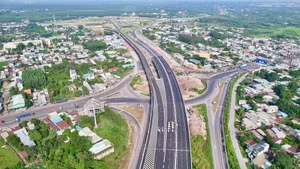
Energy security, food security, and labour balance were ensured. Infrastructure development recorded breakthroughs, with many large-scale, modern projects featuring connectivity, spillover effects, and future-shaping potential. At the end of 2025, 3,345 km of expressways and more than 1,700 km of coastal roads were completed.
Perspectives, orientations, development objectives, mechanisms, and policies for the entire 2026–2030 period have basically been completed; the organisational apparatus has accumulated experience and implementation capacity; development targets as well as methods and tools have been clearly identified. What remains is to focus on rapid implementation to translate these into tangible socio-economic development outcomes.
Q: Which pillar do you consider the most crucial for Viet Nam to expand growth space in a context of still-limited resources?
A: In my view, it is necessary to focus on implementing three strategic breakthroughs and the following key priorities:
Creating a strong breakthrough in development institutions; promoting decentralisation and delegation of authority; synchronously building development institutions, with a focus on the legal system, mechanisms, and policies; advancing breakthroughs in science and technology, innovation, and digital transformation; and developing new productive capacities, new models, and new modes of production and business.
Focusing on structural transformation and improving the quality of human resources; developing high-quality, highly skilled human resources; valuing and effectively utilising talent; strongly reforming personnel work; and encouraging and protecting dynamic, creative cadres who dare to think, dare to act, dare to take responsibility, and dare to sacrifice for the common good.
Developing a socialist-oriented market economy; enhancing the efficiency of the State economic sector; developing the private economic sector; establishing a new growth model; restructuring the economy; and accelerating industrialisation, and modernisation.
Continuing to synchronously improve and achieve strong breakthroughs in building socio-economic infrastructure, especially transport infrastructure, technology infrastructure, and energy infrastructure.
Focusing on implementing breakthroughs in science and technology, innovation, and digital transformation, creating a foundation for the development of modern new productive forces and more efficient new modes of production.

A decisive shift from broad-based support to targeted fiscal incentives
Q: With a consistent focus on socio-economic development goals and multiple breakthroughs, aiming for double-digit growth over the coming years, the 14th National Party Congress has set out the requirement to build a new development model. For the finance sector, what are the reform pillars for the 2026–2030 period?
A: The very positive socio-economic development results of 2025 constitute an important foundation, but they also clearly show that to realise the aspiration of double-digit growth during 2026–2030 in line with the spirit of the 14th National Party Congress, Viet Nam cannot continue operating under the old development model.
For the finance sector, this is the time to implement foundational, long-term reforms that can be considered transformative, repositioning the role of financial policy from “budget management” to development creation and leadership.
The first and overarching reform pillar is building a modern digital finance system, with data as a strategic resource and governance based on results, and impact.
The digital economy accounted for around 14% of GDP in 2025; however, the 2026–2030 period requires a higher leap, aiming for a share of 30% of GDP or more, associated with growth quality and labour productivity.
The Ministry of Finance will go beyond merely digitising administrative procedures to form a digital finance system, a digital budget, and smart fiscal governance, applying AI, big data, and predictive analytics. Operating smart tax, customs, and budget systems will not only significantly reduce compliance costs for businesses but also enhance transparency, fiscal discipline, and the efficiency of resource allocation, facilitating faster capital flows throughout the economy.
The second pillar is the synchronous development of modern financial markets, with capital markets and green finance serving as key drivers for mobilising resources for the new growth model.
To achieve double-digit growth over many years, total social investment demand will be very large and cannot rely solely on the State budget or bank credit. The Ministry of Finance is finalising the legal framework for carbon credit markets, green bonds, infrastructure bonds, and other long-term financial instruments, considering them as core medium- and long-term capital channels for green transition, digital transformation and high-tech industries.
The third pillar is reforming fiscal policy in a proactive, flexible, and focused manner with growth-leading capacity. The finance sector will decisively shift from broad-based support policies to targeted fiscal incentive packages, concentrating on science and technology, innovation, digital transformation, foundational industries, and sectors with high spillover effects. Taxation will not only be a budget revenue tool but will become a macroeconomic regulation instrument, encouraging enterprises to innovate, invest in R&D, and enhance productivity.
The fourth pillar is improving the efficiency of public resource allocation and use, associated with modernising national financial infrastructure and ensuring sustainable public debt management. The Ministry of Finance will continue to prioritise resources for strategic infrastructure projects capable of creating new development space for the economy, while strictly controlling public debt and maintaining national financial safety indicators to preserve long-term policy space.
The fifth pillar, and the decisive one, is reforming institutions, human resources, and the financial apparatus. The finance sector identifies the 2026–2030 period as a phase to build a professional, upright financial workforce that masters digital technology and modern governance thinking.
This is the prerequisite for other reform pillars to operate effectively, ensuring that all fiscal policies truly translate into practice, reach the right targets and beneficiaries, and generate the highest added value for the economy.
If these reform pillars are implemented in a synchronous, resolute, and consistent manner, the finance sector will truly become one of the key driving forces of the new development model, contributing to the realisation of double-digit growth, improving growth quality and ushering Viet Nam into a new stage of development with stronger internal capacity, greater resilience, and a higher position in global value chains.
Q: Inflation and exchange rate pressures in 2025 have been assessed as relatively significant. What tools and policy scenarios does the Ministry of Finance have to control inflation and exchange rate risks in 2026 while still creating space to support growth?
A: Price management and administration in 2025 clearly reflected close, proactive, and flexible coordination between the Ministry of Finance and other ministries, agencies, and localities. The results to date show that macroeconomic stability has been basically maintained, major balances ensured, and market confidence further strengthened.
However, in the final months of 2025, interest rates and exchange rates tended to rise, creating cost pressures and affecting inflation expectations, thereby increasing inflationary pressure. In addition, the global monetary policy environment remains fragmented, and prices of many strategic commodities are evolving unpredictably, posing risks to price stabilisation efforts in 2026.
In this context, the overarching objective of the Ministry of Finance is to maintain macroeconomic stability, control inflation and exchange rates, and ensure fiscal and budgetary safety, while proactively creating appropriate space to support growth.
To control inflation and exchange rate risks while supporting growth, the Ministry of Finance will, in the coming period, focus on operating fiscal policy in a disciplined yet flexible manner, associated with quality and efficiency.
It will enhance forecasting quality and build inflation management scenarios based on risk levels; proactively and closely monitor global strategic commodity prices, global economic and inflation trends, supply chain fluctuations, and transport costs; develop flexible response scenarios for each “shock” and prepare corresponding response packages in advance to avoid passive policy responses.
The Ministry will proactively regulate supply and demand and strengthen market stabilisation. It will coordinate closely with ministries, sectors, and localities to implement measures ensuring supply and circulation of goods and preventing localised disruptions; intensify inspections, supervision, and handling of hoarding, speculation, and price manipulation; and flexibly use stabilisation tools for State-priced and essential goods, especially during peak periods, thereby reducing inflation expectations and ensuring social welfare.
Synchronous coordination of fiscal and monetary policies will be promoted to both stabilise the macroeconomy and support growth, alongside the effective operation of the national price database for policy management. Data updates will be accelerated, information standardised and the national price database effectively utilised to enhance monitoring, forecasting, and early warning capabilities, enabling more proactive and transparent price management in 2026.
Targeted, time-bound support policies will be implemented. Tax and fee policies will continue to be implemented in line with National Assembly resolutions; impacts on citizens, household businesses, and small and medium-sized enterprises will be carefully assessed to determine appropriate scale and timing; and social welfare, employment creation, and public investment disbursement policies will be coordinated, thereby supporting short-term growth while strengthening the economy’s internal resilience over the medium and long term.
Reporter: Thank you very much!