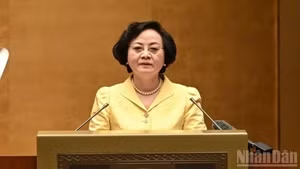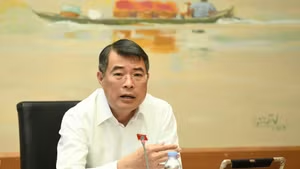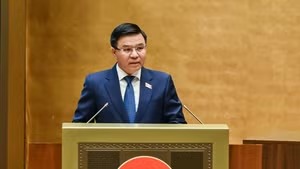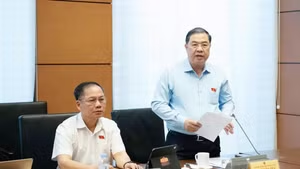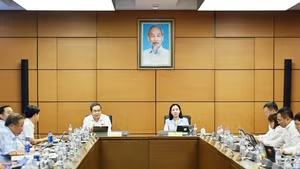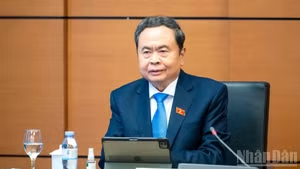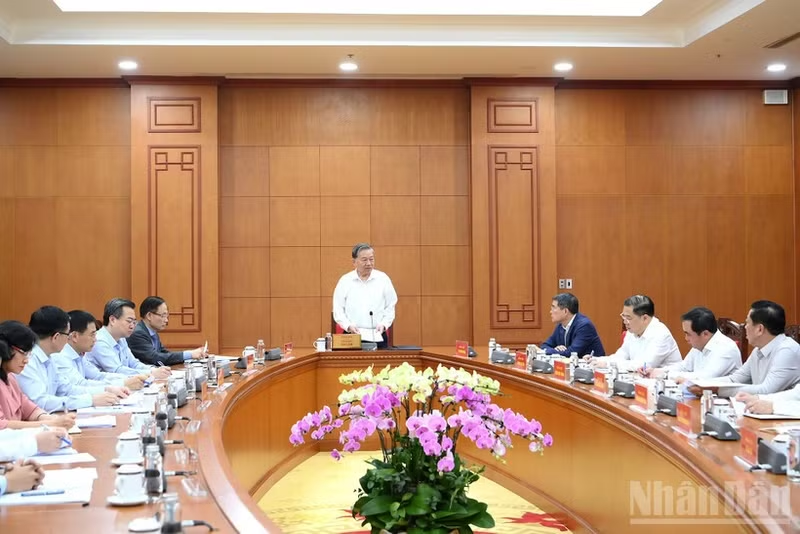
After hearing reports from the MoIT and comments from participants, General Secretary Lam acknowledged and commended the sector’s achievements in 2025, urging the ministry to continue its efforts to fulfil key tasks in 2026 and live up to its role as a core pillar of the national economy.
He requested the ministry to thoroughly study and absorb opinions raised at the meeting, promptly review and report to the Politburo and the Party Central Committee on remaining issues in economic and trade relations between Viet Nam and its key partners, and propose solutions to address them.
Regarding the orientation for developing economic and trade relations in the coming period, the Party leader underscored that Viet Nam consistently pursues a foreign policy of independence, self-reliance, peace, friendship, cooperation and development, while diversifying and multilateralising international relations and placing national interests at the highest priority.
Based on the Resolution of the 14th National Party Congress and the Politburo's Resolution No. 66-NQ/TW dated April 30, 2025 on reforming law-making and enforcement to meet development requirements in the new era with a strategic autonomy viewpoint, he called on relevant agencies to formulate a concrete strategy to restructure the national economy, gradually balance the trade balance while maintaining growth momentum, and break away from outdated mindsets.
He stressed the need to strike a balanced approach between promoting cooperation and managing risks, and to link trade with technological upgrading, modern equipment and high-quality investment, alongside stricter requirements on localisation rates, technology transfer and enhancing the position of Vietnamese enterprises in global production chains.
The Party chief instructed the Standing Board of the Government's Party Committee to focus resources on implementing key orientations, including accelerating sustainable exports, strengthening domestic production capacity and diversifying import-export markets; reviewing and improving inspection and supervision processes related to production, quality management, testing, quarantine, planting area management and traceability; reviewing commodity flows; and developing substantive and balanced industrial cooperation plans aimed at increasing localisation rates and added value for Vietnamese industrial products.
He assigned the Standing Board of the Government's Party Committee, the MoIT's Party Committee and relevant ministries and sectors to urgently study and propose solutions to implement these orientations, ensuring the principle that one agency may handle multiple tasks but each task must have a single leading agency responsible for its implementation.
The General Secretary emphasised that the implementation must be resolute, methodical and innovative, producing tangible and substantive results.