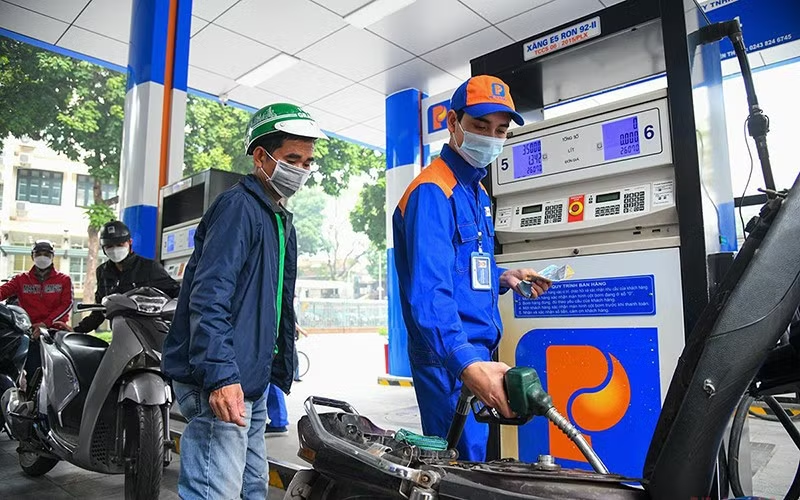
Stabilisation fund reduces price pressures
The Ministry of Industry and Trade reports that the Fund currently holds around 5.6 trillion VND. The fund is being used at 4,000 VND per litre for petrol, kerosene, and mazut, and 5,000 VND per litre for diesel. At this rate, the Fund can sustain interventions for about 15 days.
This mechanism has been applied continuously in recent price adjustment periods. Without using the stabilisation fund in the adjustment period on March 13, base prices for popular petrol and diesel products could have risen sharply, from 9.1% to nearly 30% compared to the previous adjustment. E5 RON92 petrol might have reached almost 29,000 VND per litre, RON95-III petrol over 32,000 VND, and kerosene more than 40,000 VND.
By combining price management with Fund drawdowns, domestic increases have been significantly moderated, stabilising both the market and consumer sentiment.
By combining price management with Fund drawdowns, domestic increases have been significantly moderated, stabilising both the market and consumer sentiment.
Flexible management in response to global volatility
Tran Huu Linh, General Director of the Agency for Domestic Market Surveillance and Development under the Ministry of Industry and Trade, explained that fuel prices were previously adjusted on a fixed weekly cycle, based on world market prices from the preceding period.
However, given rapid and unpredictable global oil price swings due to geopolitical tensions, this mechanism has been made more flexible. With Prime Ministerial approval, the Ministry of Industry and Trade may now consider daily adjustments if world prices fluctuate strongly, particularly when increases exceed 7%.

“Thanks to this flexible mechanism combined with the stabilisation fund, domestic prices have tracked global trends while avoiding sudden spikes,” Linh noted.
This approach also supports import enterprises during volatile periods and reduces hoarding behaviour among consumers when rumours of sharp increases circulate. Still, the Fund’s resources are finite. If global prices continue to rise and the Fund is exhausted, the Ministry of Industry and Trade and Ministry of Finance will report to higher authorities to consider advance funding from contingency reserves. Additional fiscal tools are also under review.
Linh added: “We are coordinating with the Ministry of Finance to propose that the Government report to the National Assembly Standing Committee on reducing the environmental protection tax on petrol and diesel, thereby adding another tool to stabilise prices amid ongoing global energy market fluctuations.”
Ensuring long-term supply
Recent global energy volatility highlights the need to refine Viet Nam’s fuel price management mechanism and strengthen strategic reserve.
Alongside price management, the Ministry of Industry and Trade is implementing measures to secure domestic supply. By diversifying sources and strengthening import coordination, current petrol and diesel supplies are expected to meet demand until the end of April 2026.
Nonetheless, experts warn that recent global energy volatility highlights the need to refine Viet Nam’s fuel price management mechanism and strengthen strategic reserves. Current reserves cover only 30–50 days of consumption, lower than many regional peers.
In response, the Ministry of Industry and Trade has proposed amending aspects of the price management mechanism to better reflect new market realities and enhance resilience against future energy shocks.