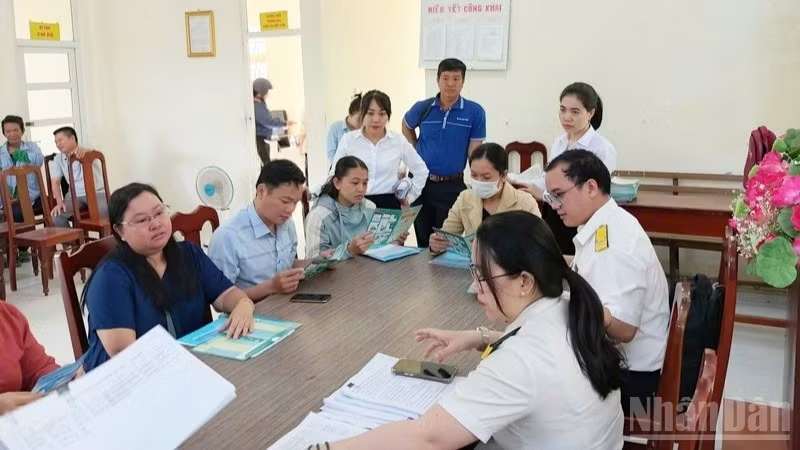
Raising the revenue threshold for tax exemption from 500 million VND to 1 billion VND per year is not merely a technical adjustment; it conveys a consistent message: a shift from a “collect immediately” mindset to one of “nurturing revenue”, accompanying business households and small enterprises amid ongoing market uncertainties.
Policy impact felt in daily life
In Khanh Hoa, in the early days of the policy taking effect, information about the new tax threshold quickly spread from traditional markets to service streets. The reception has therefore been more vibrant than usual.
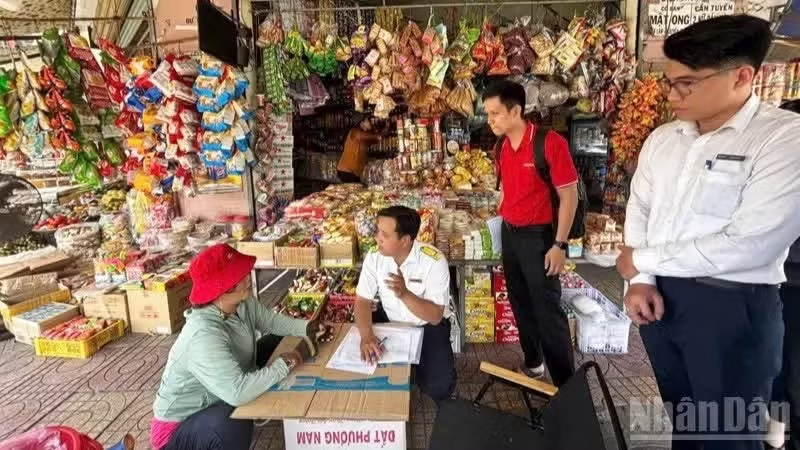
In Phan Rang Ward, Phung Thi Hoa, a small business owner, shared that under both the presumptive tax regime and the declaration-based system, tax obligations had always been a recurring expense to consider. “Now that the threshold has been raised to 1 billion VND per year, I am no longer subject to tax, giving me more room to manage finances and sustain my business,” she said.
Observations at many traditional markets in the locality show a general sentiment of consensus and optimism among traders. In a context where “labour is the main source of profit” remains common, reducing fixed cost pressures not only helps balance finances but also improves business confidence — a soft factor, yet a crucial one during the recovery phase.

According to Tax Unit No. 6 in Phan Rang, under the new threshold, the number of business households subject to tax has dropped from 8,800 to around 300 with annual revenues exceeding 1 billion VND. Across Khanh Hoa Province, the number of taxable households and individuals has fallen to about 2,900 out of nearly 64,000 currently under management.
These figures demonstrate the significant scale of the policy’s impact. However, the core issue is not “short-term revenue reduction”, but rather a long-term objective: enabling business households to accumulate resources, reinvest, and gradually expand. This approach aligns with modern tax administration — supporting development rather than merely maximising short-term revenue.
From a governance perspective, Khanh Hoa’s tax authorities aim to strike a balance between support and management. Alongside simplifying procedures and reducing compliance costs, authorities are accelerating the application of technology and digital transformation, adopting data-driven management and risk analysis to ensure accurate and sufficient tax collection, minimise revenue losses, and maintain a fair competitive environment.

Enhancing transparency in operations
A notable highlight of Decree 141 is its stricter requirements on e-invoices. Accordingly, business households with annual revenues exceeding 1 billion VND are required to use e-invoices authenticated by tax authorities or invoices generated from connected cash register systems. This regulation helps enhance transparency, standardise operations, and reduce revenue leakage.

For those below the threshold, the use of e-invoices is encouraged according to a roadmap, facilitating a gradual transition towards modern governance. This also lays the groundwork for the small-scale economic sector to align with enterprise-level operational standards.
Notably, for the first time, small enterprises are subject to a corporate income tax exemption threshold of 1 billion VND per year. This policy not only ensures fairness between different business models but also creates incentives for business households to transition into formal enterprises — an overarching objective in the strategy for developing the private sector.

Strengthening the foundations for growth
According to Nguyen Ngoc Tu, Head of the Tax Department of Khanh Hoa Province, on the surface, this represents a notable shortfall in revenue. However, within the logic of fiscal management, it is a “targeted investment”: reducing immediate revenue to create space for recovery, accumulation, and development within the small-scale economic sector, which forms the broad foundation of the economy.
As business households and small enterprises grow stronger, expand operations, transform their models, and enhance competitiveness, state budget revenues will be reinforced in a more stable and sustainable manner. This is the positive cycle the policy aims to create.
Raising the tax threshold to 1 billion VND per year is therefore a strategic step in fiscal policy reform. As the “health” of the small-scale economic sector improves, the foundation for growth is strengthened. More than a technical adjustment, it is a strategic move to underpin inclusive growth.
From the experience in Khanh Hoa, it is evident that when policy is effectively implemented — through coordinated efforts in communication, support, and transparent management — its impact extends beyond tax reductions, opening up expectations for a stable, dynamic, and sustainable business environment in the new phase.