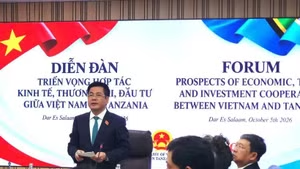
In 2025, Viet Nam's total overseas investment will reach over 1.36 billion USD, an 88.7% increase compared to the previous year. In the first four months of 2026, overseas investment will continue to reach 713.9 million USD, 2.3 times higher than the same period in 2025.
Developing many new fields
After 20 years of overseas investment, the Viettel brand is now present in 16 countries. International business operations currently bring the Viettel Military Industry and Telecoms Group revenue of over 3 billion USD annually, thanks to maintaining a growth rate of approximately 20% for many consecutive years.
Notably, Viettel holds the leading position in seven out of the top 10 telecommunications markets. Viettel has also officially launched 5G services in five key markets: Laos, Cambodia, Timor-Leste, Burundi, and Tanzania. In the future, Viettel is determined to shift from an “overseas investment” model to a global business strategy (Go Global 2.0).
According to Chairman of Viettel Global Dao Xuan Vu, while Viettel previously expanded globally primarily through telecommunications, the road ahead will be a “Go Global” journey, leveraging the combined capabilities of a high-tech industrial group. Future growth will be driven by four main drivers: strengthening traditional telecommunications, promoting digital services, exploring new business areas, and researching market expansion in promising regions.
Accordingly, several of Viettel’s international markets, including Timor-Leste, Tanzania, Burundi, and Cambodia, have been allocated additional next-generation frequencies, creating an important foundation for deploying advanced technology infrastructure and expanding business opportunities.
Not stopping at the telecommunications sector, Viettel has officially launched its logistics service in Laos and plans to continue expanding to two other potential markets: Cambodia and Myanmar.
The digital and financial services sector has also expanded with the establishment of NatTransfer, a company specialising in remittance services in Haiti, marking a strategic step in expanding the group's digital financial ecosystem. Simultaneously, Viettel is actively seeking investment opportunities in new markets such as the Dominican Republic, Panama, and Ecuador.
As for the Viet Nam Posts and Telecommunications Group (VNPT), in its transformation from a traditional telecommunications provider to a digital technology group, VNPT has chosen AI technology as its strategic weapon to “go abroad and conquer the world.” The corporation has established VNPT AI Company with the goal of leading in the research, development, and mastery of AI models.
VNPT AI Director Nguyen Tien Cuong shared: The company will focus on developing the AI ecosystem and GenAI, with the main focus on bringing AI products to the international market, first in the US, Japan, the Republic of Korea, and some other potential markets. The unit also aims to become the number one AI brand in Viet Nam, playing a new driving role in the corporation's long-term development strategy.
Strengthening sustainable presence
Recently, the Prime Minister officially approved the “Go Global” programme outlining Viet Nam’s strategic initiative to support the private sector in expanding into international markets for the 2026–2030 period. The highlight of the programme affirms that private sector enterprises are a crucial force in leading the process of expanding into international markets.
The programme aims to comprehensively, effectively, and sustainably increase Viet Nam’s private sector presence abroad in terms of both scale and quality through international investment and business activities, and deeper integration into regional and global supply and value chains.
To achieve this goal, the programme outlines five tasks and solutions:
First, establishing a synchronised, transparent, and favourable institutional framework to encourage, support, and mitigate risks for businesses investing and operating in foreign markets.
Second, building a foundation of information, awareness, and capacity to expand into foreign markets.
Third, encouraging and facilitating overseas investment by businesses, especially M&A investments, to access global resources, expand economic growth opportunities, and strengthen Viet Nam’s position internationally.
Fourth, promoting deeper participation of businesses in global supply chains and value chains to enhance added value in exports and strengthen the strategic independence and autonomy of the economy and sustainable development.
Finally, facilitating businesses in promoting cross-border digital trade activities to foster growth based on technology, data, innovation, and sustainability.
According to Mai Thu Hien, Deputy Director of the Planning, Finance and Business Management Department (Ministry of Industry and Trade), the Ministry of Industry and Trade will build a foundation of awareness and capacity for integration through training, consulting, and providing in-depth information to businesses on investment strategies, international governance, and foreign legal standards. In addition, the “Go Global” programme focuses on promoting online exports through cross-border e-commerce platforms, helping Vietnamese businesses, especially small and medium-sized enterprises, participate effectively in the global market at lower costs.
The programme also aims to establish at least 20 large enterprises in key strategic sectors by 2030, participating in regional and global supply and value chains. Vietnamese businesses will truly “Go Global” with their own products, intellect, and brands, rather than just doing contract manufacturing for others.