Technologies such as artificial intelligence (AI), semiconductor chips, and 5G/6G mobile networks have been included in the list of strategic technologies and products promulgated by the prime minister, thereby establishing a legal framework to mobilise resources and develop breakthrough mechanisms to quickly acquire and master these critical technologies.
Laying the groundwork
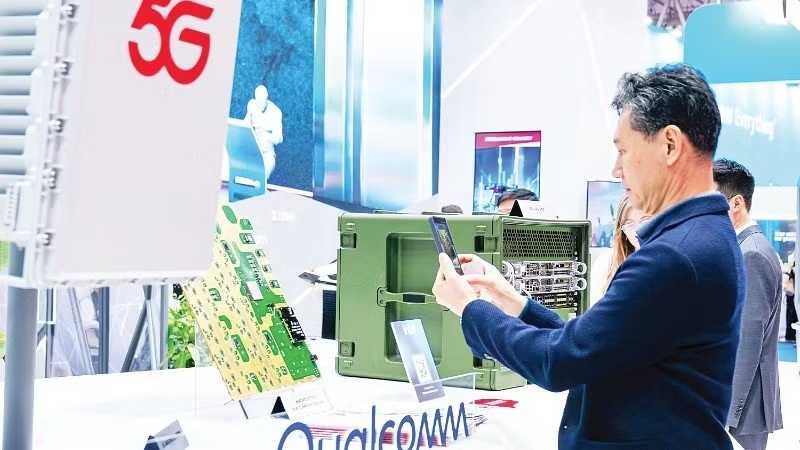
At the Mobile World Congress (MWC 2026) in Barcelona, Spain, on March 4, Viettel High Technology Industries Corporation (Viettel High Tech) — a member of the Military Industry and Telecommunications Group (Viettel) — announced that it had established strategic partnerships with a number of leading global technology corporations, while officially joining the 6G development alliance initiated by Qualcomm.
Specifically, Viettel will cooperate with Intel to jointly develop and test key technologies for 5G Advanced and 6G, including AI optimisation in RAN telecommunications systems and cloud-native architecture; collaborate with AMD to build high-performance computing architecture for AI-integrated networks and edge computing; and work with ID Quantique to research long-term system and data security solutions, among others.
With a strategy that positions 5G Advanced as a bridge, Viettel is transforming its 5G capabilities into readiness for 6G, participating early in the development of global architecture and standards. This marks a shift from being a technology implementer to becoming one of the creators of the 6G ecosystem in the coming decade.
Through the establishment of VNPT AI Company, Viet Nam Posts and Telecommunications Group (VNPT) is also demonstrating strong determination to focus resources on AI development — a key technology sector identified by the Party and the state in major policy directions.
Huynh Quang Liem, General Director of Viet Nam Posts and Telecommunications Group, stated that the group has proposed that the government assign it four key AI-related tasks: deploying a national GPU system to accelerate the development of Viet Nam’s AI ecosystem; building a Vietnamese large language model as a foundation for domestic AI applications; implementing AI platforms and applications to support civil servants in handling and operating administrative procedures nationwide; and working with local authorities to develop comprehensive smart city models based on advanced technologies. The group believes these proposals will soon be implemented in practice, delivering tangible results and creating strong spillover effects across the community.
Completing the semiconductor value chain
Viettel broke ground on Viet Nam’s first semiconductor chip manufacturing plant at the Hoa Lac Hi-Tech Park in Ha Noi in January 2026. According to the plan, by the end of 2027, the plant will complete construction work, receive technology transfer, and begin trial production. Experts believe that this investment will help complete and localise the entire semiconductor production process within the country.
Lieutenant General Tao Duc Thang, Chairman and General Director of Viettel Group, shared that semiconductor manufacturing is among the most sophisticated and discipline-intensive technological processes today. Therefore, both the construction and future operation of the plant will face significant challenges. However, without taking the first step, Viet Nam will never be able to grasp the manufacturing stage and ultimately master the entire semiconductor value chain.
At this plant, Viettel aims to produce the first chips made by Vietnamese engineers, thereby working alongside other enterprises to build a modern, self-reliant semiconductor industry that is deeply integrated into the global market.
Also in January, FPT Group announced the establishment of the first semiconductor chip testing and packaging plant in Viet Nam operated by Vietnamese professionals. This move contributes to completing the domestic semiconductor ecosystem, covering all stages from research, design, manufacturing, training, testing, and packaging to commercialisation.
Truong Gia Binh, Chairman of FPT Group, said that FPT will closely coordinate with Viettel and domestic partners so that as chips are produced, FPT will simultaneously carry out packaging and testing, helping “Make in Viet Nam” technology products quickly enter everyday life.
Resolution No. 57-NQ/TW has identified AI, advanced materials, semiconductors, quantum technology, robotics, and automation as strategic technologies and industries — forming the foundation for Viet Nam to achieve breakthroughs in its next development phase. Within the strategy for the development of Viet Nam’s semiconductor industry to 2030, with a vision to 2050, is the goal for Viet Nam to have at least one small-scale semiconductor fabrication plant and 10 semiconductor packaging and testing facilities by 2030.
Bui Hoang Phuong, Deputy Minister of Science and Technology, noted that Viet Nam has strengths in chip design human resources and is increasingly playing an important role in the packaging and testing stages of the global semiconductor supply chain, although these segments are still largely controlled by foreign enterprises.
Viettel’s launch of a chip manufacturing plant and FPT’s plan to operate a packaging and testing facility represent strategic advances, contributing to completing and closing Viet Nam’s semiconductor ecosystem. Units under the Ministry of Science and Technology will work closely with enterprises to promptly address obstacles during the construction and operation of these plants, enabling Viet Nam to participate more deeply in the global semiconductor value chain.