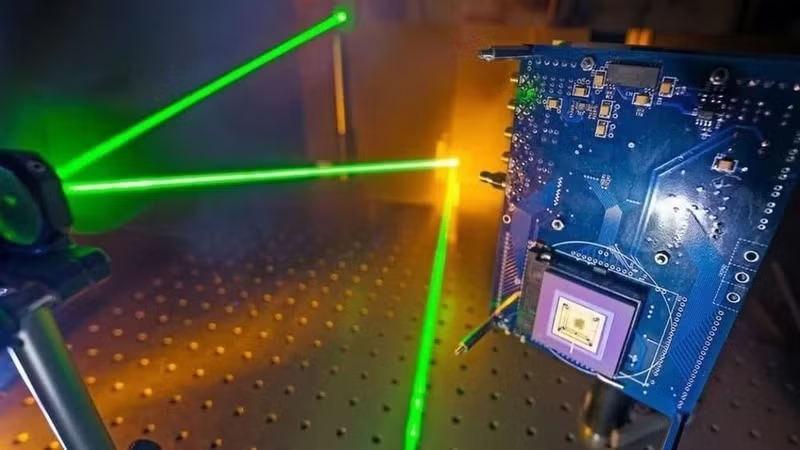
While the world is still marvelling at the rapid advances of AI, global strategists and scientists have quietly shifted the chessboard to a new coordinate: Quantum technology. If AI changed how data is optimised, then quantum technology is predicted to create far more disruptive impacts, completely reshaping the structure of global security and the economy.
Amidst this increasingly heated global race, Viet Nam has signalled its strong entry into the game at the highest level with a clear strategy: Viet Nam cannot lag behind again. And in this pivotal transformation, the pioneering steps taken by major technology corporations to attract talent are becoming the core leverage to realise the nation's aspirations.
Quantum technology’s impact could outpace AI
Quantum technology will open doors that even the most powerful supercomputers today would take billions of years to decipher. This is not just a technological leap; it’s a complete game-changer, according to Dr. John Preskill, Professor of Theoretical Physics at Caltech, who laid the foundation for the concept of quantum supremacy.
A complex supply chain optimisation problem or molecular simulation for new drug development, which would normally take thousands of years for traditional supercomputers, can now be solved by a quantum computer in minutes. This far-reaching and disruptive impact is why quantum computing is predicted to create a more powerful and radical impact than AI.
It’s no coincidence that leading consulting firms and nations are pouring all their resources into the quantum race. The power of quantum computers doesn’t evolve arithmetically, but rather exponentially thanks to the principles of quantum physics (quantum superposition and entanglement).
According to the latest McKinsey Quantum Technology Monitor report, the total public investment (government budget) committed globally to quantum technology has officially surpassed 42 billion USD. The race is seeing significant investment from major powers. Leading the way is China with a record commitment of 15.3 billion USD, closely followed by the European Union (EU) with an accelerated increase of over 8.4 billion USD, and the US with a budget plan of nearly 4 billion USD to protect its leading position in this proprietary technology.
Viet Nam elevates quantum technology to a strategic level; the big challenge: the need for talented people.
In Viet Nam, quantum technology has officially reached the highest strategic level of the nation. General Secretary and President To Lam chaired a meeting of the Standing Committee of the Central Steering Committee at the Party Central Headquarters on May 21, 2026, to review and approve the project on research, application and development of quantum technology to serve socio-economic development and ensure national defence and security.
At this historic meeting for the country’s science, the General Secretary and President emphasised: It is necessary to unify the understanding that quantum technology is a national strategic issue, a core competitive advantage for the country in the future, not just a purely scientific research project. The head of the Party and State affirmed: As a latecomer, Viet Nam must choose a strategy of “following but not lagging behind,” focusing investment on key areas to meet the requirements of strategic autonomy and national security in the new era.
However, the biggest obstacle for this field worldwide is human resources. Quantum physics is an extremely difficult field of science, requiring a deep intersection of theoretical physics, advanced mathematics, and computer science.
To realise the directives of the General Secretary and President on urgently completing this strategic project, Viet Nam needs a “leapfrog” strategy by attracting top talent from around the world, especially the network of Vietnamese experts and scientists abroad — those who have spent a long time working in major technology centres such as the US, Japan, and Europe. The knowledge and patriotism of overseas Vietnamese are invaluable endogenous resources to bring Vietnamese technology up to par with the world.
FPT rolls out the red carpet to welcome quantum “eagles” to their nest
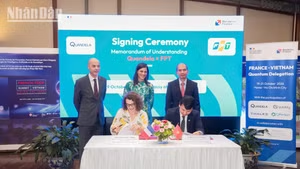
Understanding its national mission and the urgency of the times, FPT Corporation has proactively taken the lead, not only seeking solutions for businesses but also contributing to building the foundation of quantum technology for Viet Nam. This strategy is realised through two core actions: attracting talent and creating educational infrastructure.
FPT established the Quantum AI & Cyber Security Research Institute (QACI), with Professor, Doctor of Science Ho Tu Bao as Scientific Director and Associate Professor, Doctor Ngo Xuan Bach as Director, in December 2025. QACI focuses on key activities including research and development of solutions; training PhDs and senior experts; and international cooperation. This is one of the first quantum research centres of a Vietnamese enterprise to date, with an expected investment of up to 100 million USD from FPT.
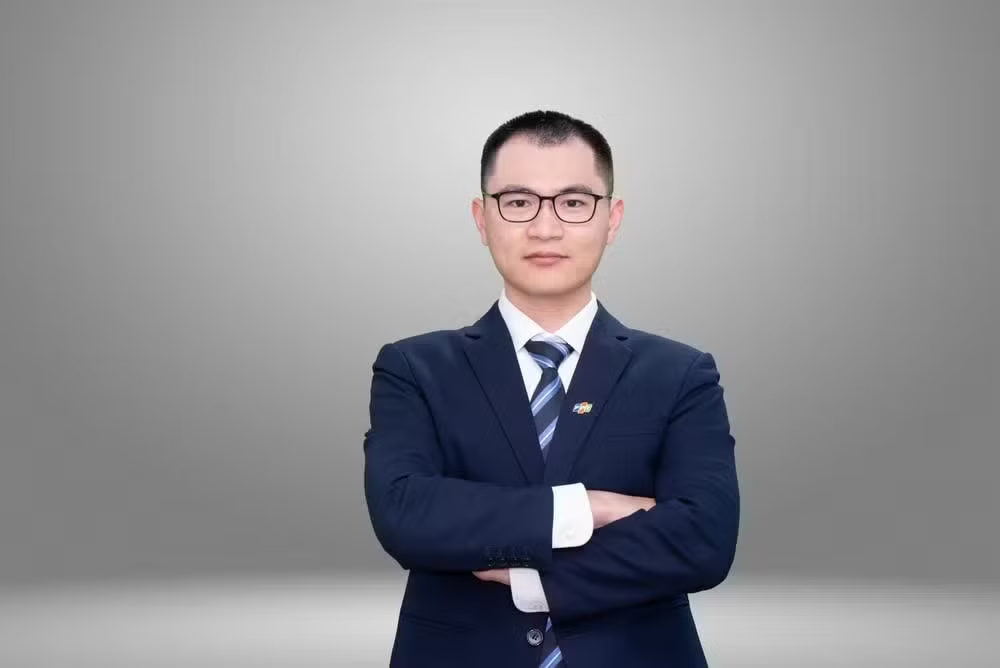
Besides building infrastructure, FPT is rapidly recruiting top talents to bring them back to Viet Nam. Recently, Dr. Vo Van Tuan, a Vietnamese expert with an extremely impressive academic record, returned from Japan and joined FPT as the Director of Quantum Lab. He graduated with a Bachelor's and Master’s degree and successfully defended his doctoral dissertation in Information and Communication Engineering at the University of Tokyo — Japan’s most prestigious university. He then continued his work as a Postdoctoral Researcher at Kyoto University.
Dr. Vo Van Tuan was the author of numerous cutting-edge research papers on statistical physics and quantum mechanics, published in prestigious international scientific journals, before joining FPT in March 2026. He also serves as an expert for the Viet Nam National Data Association. Furthermore, FPT stated that it is actively connecting and exchanging ideas to welcome more leading Vietnamese quantum experts from the US, the Republic of Korea, and other countries to contribute to the nation.
Sharing his reasons for leaving a major global technology hub to return home, Dr. Vo Van Tuan said: “Quantum technology is no longer an early stage for Viet Nam. If we wait until this technology is fully established globally before starting, the gap will be insurmountable.” Quantum physics is an extremely difficult and new field of science for the whole world, so the greatest resource for Viet Nam to avoid falling behind is the intellectual capital of the network of Vietnamese experts and intellectuals abroad.
After many years of studying and researching at the University of Tokyo and Kyoto University, Tuan decided to return because he recognised that the global talent migration wave towards his homeland was at its most ripe moment.
He emphasised: "For this intellectual flow to truly create value, we need corporate platforms of sufficient scale and determination. I chose FPT because I found here a long-term strategic vision, along with a free, internationally standardised research space at the Quantum Institute, where scientists are given full resources to focus on their expertise.
In the future, besides shaping cutting-edge research directions in quantum computing, my biggest goal and that of my colleagues is to make the Lab a solid bridge to continue attracting, connecting, and bringing more outstanding minds from the US, Japan, and Europe to join us, together building a self-reliant technology ecosystem for our country.”
Building an internationally standardised training ecosystem
Recognising that high-quality human resources from abroad are a decisive key, FPT Group has proactively taken a step ahead by establishing a comprehensive ecosystem from research labs to university lecture halls. Not content with just theoretical solutions, FPT is realising its aspiration to bring Viet Nam up to par with the world through groundbreaking goals in both technical infrastructure and training platforms.
FPT representatives stated that the biggest goal of Quantum Lab in the near future is to proactively collaborate with leading technology partners to find solutions to bring quantum computing to Viet Nam. This is expected to be one of the steps contributing to changing the digital technology infrastructure and significantly enhancing the nation’s computing capabilities.
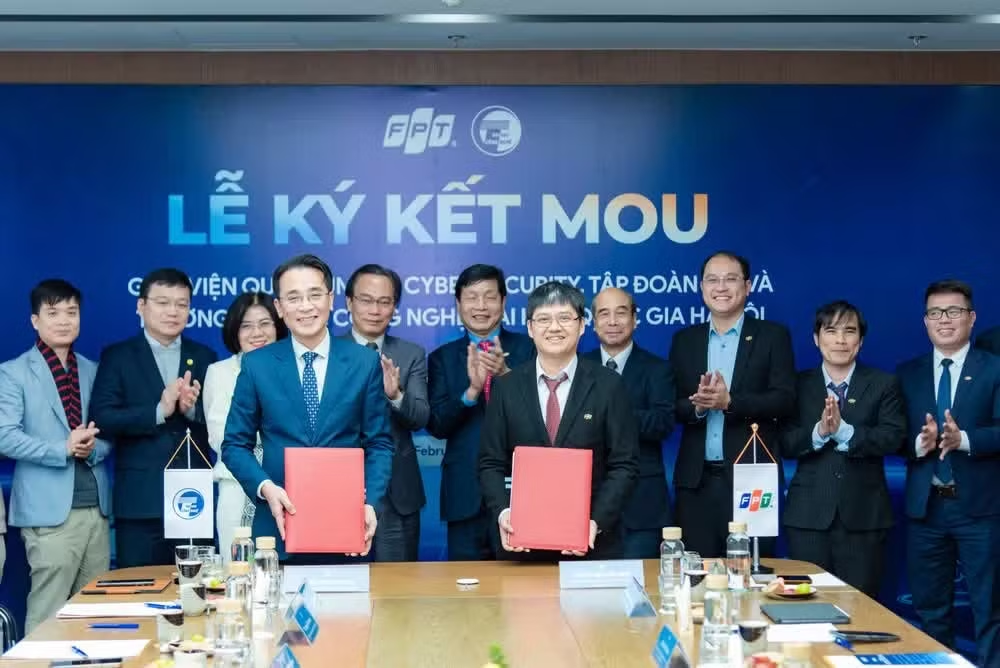
The Group is also cooperating and discussing with Ha Noi University of Technology to jointly establish the first Department of Quantum Technology in Viet Nam. The combination of the company’s practical capabilities, its international expert network, and the academic foundation of a leading technology university will be a solid springboard, directly nurturing and supplying high-quality quantum human resources for the nation within the next 5 to 10 years.
The quantum revolution has begun, and the world waits for no one. Under the decisive leadership of the General Secretary and President To Lam, along with the pioneering efforts of universities, major technology corporations, and the return of talented Vietnamese individuals globally, Viet Nam has every right to be confident in its aspiration to master strategic technologies and achieve breakthroughs in the quantum era.