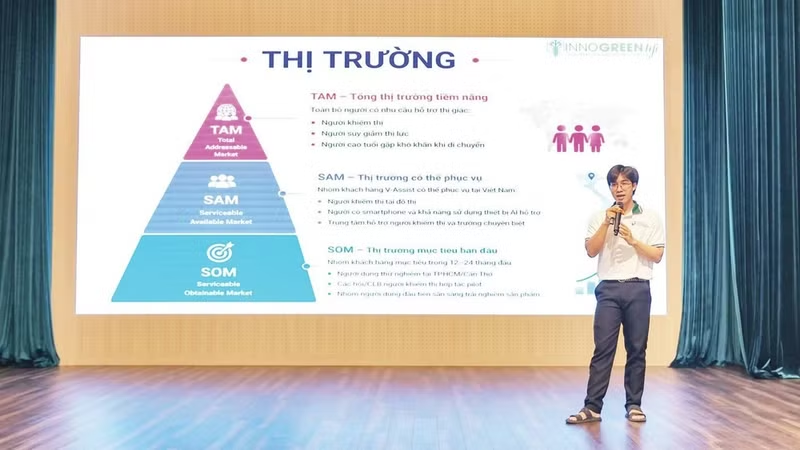
In recent years, innovation, green entrepreneurship and sustainable development have received increasing attention in the educational environment. Many competitions not only seek new ideas but also require learners to assess market demand, feasibility, commercialisation potential and impacts on the community. These competitions have encouraged learners to approach green development challenges with interdisciplinary thinking, with agricultural knowledge connected to technology, design, economics, communications and supply chains, so that an idea can become a complete product.
For example, in 2026, the Vietnam National University of Agriculture continued to organise the “Innovative Agricultural Entrepreneurship” competition for students from universities, colleges and academies, as well as high school students and young people nationwide. Projects are encouraged to apply scientific and technological achievements in agriculture and food, enhance competitiveness and create sustainable development solutions.
Through the “Agricultural Entrepreneurship” competition, which has been held annually since 2018, Ho Chi Minh City University of Agriculture and Forestry continues to focus on projects with practical applications that are in line with the requirements of developing a modern and integrated agricultural sector. Meanwhile, at Ho Chi Minh City University of Industry and Trade, the “Food Innovation and Development” competition links product innovation with food security, green agriculture, climate change and social responsibility.
It can be seen that, despite differences in themes and organisational methods, the competitions all reflect a common trend of shifting from the mindset of creating products to that of developing value chains. Previously, many ideas focused only on technical aspects or processing, whereas learners now have to take into account raw material areas, quality standards, packaging, traceability, distribution methods and the potential to expand markets at the same time. This is also an increasingly clear requirement for green products in the context of developing a circular economy and international integration.
The development of local products is also considered from the perspective of supply chains. For example, the Go Global competition, organised by the logistics sector of FPT Polytechnic College, features a range of agricultural products, with aspects ranging from raw material sources, preservation and traceability to e-commerce and the ability to participate in supply chains.
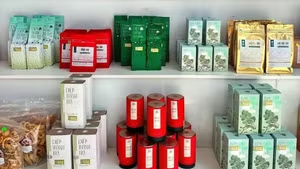
The winning idea of the competition focused on rattan and bamboo products from Phu Vinh craft village and Viet Quang Rattan and Bamboo Handicraft Facility in Ha Noi, with a message of environmental protection and addressing practical limitations of handicraft products. Student Nguyen Thi Phuong, representing the team, said: Rattan fibre and bamboo strips, if not properly treated using appropriate techniques, can retain moisture, affecting durability and quality during storage and transport. Therefore, the team proposed developing a drying system and controlling the moisture content of raw materials before they are put into production. Each product is proposed to carry a QR code providing information on its origin, instructions for use, preservation methods and how to handle signs of mould or dampness.
According to the Competition Organising Committee, this is an approach relatively close to value-chain thinking. A green product needs natural raw materials and must ensure stable quality, extend its useful life and provide transparent information to consumers. The use of QR codes shows that traceability is not only meaningful for food products but can also help handicraft products tell the story of their materials, artisans and craft villages, while also guiding customers on proper use. This shows that developing green products does not necessarily have to start with complex technologies but can originate from solutions suited to the characteristics of each product and the practical needs of businesses.
Competitions in schools can generate new ideas, but the gap between an idea and an actual product remains quite large. In general, students have the advantage of being able to access technology and grasp trends, but they lack production data, testing conditions, financial resources and market experience. For initiatives to continue developing, entrepreneurship experts believe that stronger connections are needed among educational institutions, producers, businesses and experts. Proposals such as raw material drying, packaging, traceability or transport need to be tested at businesses and adjusted according to specific production conditions.
According to experts, alongside organising competitions, it is necessary to establish post-competition support mechanisms so that feasible ideas have an opportunity to develop into products. Educational institutions can coordinate with local authorities, cooperatives and businesses to select a number of outstanding projects for pilot implementation; at the same time, they can support the completion of production processes and quality standards, brand development, intellectual property protection and market connections. Only when tested under actual production conditions can students’ initiatives continue to be refined and create socio-economic value, gradually translating policies on green growth, the circular economy and sustainable development into reality.
According to Vu Chi Thanh, Rector of FPT Polytechnic College, the national strategy on green growth and the project on developing the circular economy in Viet Nam have provided a basis for promoting the efficient use of resources, innovating growth models and harmonising economic development with environmental protection. “Greening” products should not stop at the use of natural materials but needs to be carried out throughout the entire process, from raw material areas, production and packaging to preservation, transport, distribution and the handling of products after use. Educational institutions need to strengthen training activities, encourage innovation and create conditions for students to develop ideas linked to practical production, business and sustainable development.