To capitalise on these opportunities, the province needs to prepare infrastructure, human resources and business capabilities in a coordinated manner, while ensuring safety and sustainable livelihoods for people in the project areas.
A stable supply for the national power system
The National Assembly adopted Resolution No. 174/2024/QH15 on continuing the implementation of the investment policy for the Ninh Thuan Nuclear Power Project. Subsequently, Resolution No. 189/2025/QH15 was issued, stipulating a number of special mechanisms and policies to support investment in the construction of the project. The revised Eighth National Power Development Plan (Power Plan VIII) also sets out a direction for developing nuclear power as part of the national electricity generation mix.
Under the revised Power Plan VIII, the two nuclear power plants, Ninh Thuan 1 and Ninh Thuan 2, are expected to come into operation during the 2030–2035 period, with a combined capacity of approximately 4,000–6,400 MW. By 2050, the power system could add approximately 8,000 MW of nuclear power capacity, depending on development needs.
Dr Nguyen Manh Cuong of the Institute of Energy under the Ministry of Industry and Trade said that calculations of the power capacity balance indicated that nuclear power could operate at a level equivalent to around 7,000 hours at maximum capacity per year. Its ability to maintain high output for extended periods, with little dependence on weather conditions, enables this power source to meet part of baseload demand, particularly as the proportion of renewable energy continues to rise. “Unlike wind and solar power, whose output fluctuates according to natural conditions, nuclear power can provide a continuous electricity supply in accordance with the operating plan. This characteristic helps improve the reliability of electricity supply, supports the balancing of supply and demand, and eases pressure on system operations when consumption demand peaks,” Dr Nguyen Manh Cuong emphasised.
Nuclear power also contributes to achieving greenhouse gas emissions reduction targets. With its high energy density, long fuel-reloading cycles and low emissions during electricity generation, this power source helps diversify the energy mix and reduce dependence on fossil fuels.
However, nuclear power is subject to stringent requirements concerning safety, security and technology management. Developing this power source requires substantial investment, a comprehensive legal framework, specialised regulatory and supervisory capabilities, and a highly qualified workforce. These requirements must be met throughout every stage, from investment preparation and construction to plant operation and decommissioning.
Dr Tran Quang Tuan, Deputy Director General of the Viet Nam Agency for Radiation and Nuclear Safety under the Ministry of Science and Technology, said that the key task at present was to complete the institutional framework and system of legal documents governing atomic energy, in line with the safety standards and security guidance of the International Atomic Energy Agency (IAEA) and international practices.
“The Viet Nam Agency for Radiation and Nuclear Safety has been assigned the role of focal agency for developing competency standards, coordinating training and professional development for personnel serving the nuclear power programme, as well as the strategy for the development and peaceful application of atomic energy through 2035, with a vision to 2050. At the same time, the Agency is strengthening cooperation with the IAEA and international agencies and organisations specialising in nuclear energy,” Dr Tran Quang Tuan said.
Ensuring people’s livelihoods
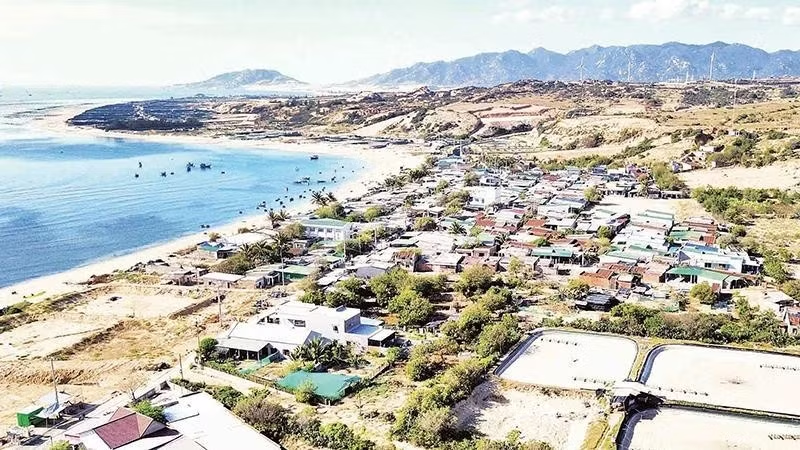
For Khanh Hoa, the nuclear power projects will not only supplement the national power system’s electricity supply but also create opportunities for industrial development and technical services in the southern part of the province, providing a growth driver for the South Central Coast and Central Highlands.
Trinh Minh Hoang, Vice Chairman of the Khanh Hoa Provincial People’s Committee, affirmed that the province had favourable conditions for developing a diverse energy ecosystem comprising nuclear power, wind power, solar power, liquefied natural gas (LNG), pumped-storage hydropower, and 500 kV and 220 kV electricity transmission infrastructure. “As a stable baseload source, nuclear power can effectively complement variable renewable energy sources. Combined with pumped-storage hydropower and a modern transmission system, these power sources will help establish a stable, flexible and low-carbon energy system,” Trinh Minh Hoang said.
Building on these advantages, Khanh Hoa is well positioned to develop green industries, high technology and high-value-added technical services. Large-scale energy projects will create opportunities for businesses to modernise equipment and technology, improve management methods, enhance workforce quality and participate in supply chains across such fields as mechanical engineering, electrical and electronic engineering, automation, materials, construction, inspection and testing, logistics, digital technology, maintenance and specialised technical services.
Vu Ngoc Minh, Deputy Head of the Investment and Construction Management Board of the Viet Nam Electricity Group (EVN), said that the implementation of the Ninh Thuan 1 Nuclear Power Project needed to be accompanied by coordinated preparations for energy infrastructure, grid connections and the technical infrastructure required by the plant. EVN is responsible for providing information on technical requirements, project schedules and infrastructure needs so that competent authorities, local administrations and relevant units can formulate plans and make appropriate investments.
Infrastructure investment for the project should follow a multi-purpose approach, meeting the plant’s technical requirements while also supporting development in the southern part of the province and improving residents’ lives. Local authorities and relevant agencies need to coordinate their reviews and assessments of transport, seaport, water supply, electricity transmission, digital infrastructure, healthcare, fire prevention and firefighting, search and rescue, and incident response facilities, ensuring that these are consistent with planning schemes and the locality’s development needs.
Alongside preparations for infrastructure and human resources, safeguarding the rights, living conditions and livelihoods of people in the project areas is an important requirement for implementing nuclear power projects. Compensation, assistance and resettlement must go beyond providing new accommodation and handing over cleared land. These measures must be linked to job creation, vocational training, education, healthcare and social services, ensuring the quality of life and development opportunities for people relocated from affected areas.
To achieve this objective, local authorities and relevant agencies need to provide complete information regularly and in an open and transparent manner, while receiving and responding to community feedback. At the same time, agencies and units responsible for labour and vocational training need to assess workforce demand, organise training and connect people with employment opportunities, enabling local residents to participate in services, construction, logistics and other sectors suited to their capabilities and actual circumstances.
Nuclear power development requires coordinated preparations in terms of institutions, technology, human resources, infrastructure and social welfare. For Khanh Hoa, the success of these projects will be measured not only by their generating capacity but also by their ability to develop production, expand opportunities for businesses and improve people’s living standards. Linking energy development with industry, science and technology, while ensuring people’s livelihoods, will help these projects become a driver of sustainable growth for the province and the South Central Coast and Central Highlands.