
According to the “Unlocking Viet Nam’s AI Potential 2026” study, recently unveiled at AWS Cloud and AI Day in Ha Noi, around 26% of Vietnamese businesses, equivalent to 245,000 enterprises, have adopted AI in their operations. Of these, 78% expect AI to remain a driver of growth over the coming year.
Conducted by Strand Partners, the study surveyed 1,000 business leaders and 1,000 citizens to provide a comprehensive overview of AI adoption and cloud computing across the country.
The study surveyed 1,000 business leaders and 1,000 citizens to provide a comprehensive overview of AI adoption and cloud computing across the country.
Businesses that have integrated AI into their operations are already recording positive results. Some 73% consider AI a key component of their overall business strategy; 72% report increased productivity, up from 66% the previous year; and 64% say AI has helped boost their average revenue by 15%.
Growth momentum is building, but ambition alone will not be enough to sustain it. As more businesses move from experimentation to implementation, the pace of transformation will depend on three fundamental factors: a clear AI strategy underpinned by sound governance, reliable methods of measuring return on investment (ROI), and the skills needed to use AI responsibly.
Every business has its own AI journey
Vietnamese businesses have high expectations for AI-driven transformation. Some 69% say AI adoption is a top or high priority, while 84% expect their use of AI to increase over the coming year. This trend spans large enterprises, small and medium-sized enterprises (SMEs), and AI-native startups, each with its own priorities and needs. Although 61% of businesses that have adopted AI say they are still at the experimentation stage, early results are encouraging, with 71% reporting that their AI investments have broken even or generated returns.
Some 69% of businesses say AI adoption is a top or high priority, while 84% expect their use of AI to increase over the coming year.
The financial services and healthcare sectors provide two clear examples of how AI ambitions are being translated into practice.
In financial services, 41% of businesses have adopted AI, compared with the overall average of 26%, and 79% report productivity gains.
In healthcare, the AI adoption rate stands at 23%, with 69% of businesses reporting increased productivity.
Despite facing stricter compliance requirements, innovation continues apace. OmiGroup, a Vietnamese digital healthcare company, has developed OmiKG on AWS, an AI-powered research tool designed to trace the root causes of chronic diseases. In a controlled research evaluation, OmiKG identified 15 of the 17 molecular mechanisms associated with type 2 diabetes, significantly outperforming two conventional AI approaches. The tool helps clinical professionals understand the biological reasons behind a medical condition, such as whether its underlying cause lies in toxin exposure or dietary habits, thereby informing more precise treatment plans.
Agentic AI: Accelerating growth for Vietnamese businesses
Some Vietnamese businesses have incorporated AI agents into their operational processes, accelerating innovation and supporting international expansion. Among the businesses surveyed, 38% said they were familiar with agentic AI. Of these, 8% had integrated AI agents into core workflows, while 19% were experimenting with or piloting the technology.
Early adopters are seeing results that exceed expectations, with 81% recording significant productivity improvements. Of these, 68% cited greater operational efficiency or workforce productivity, 61% said they could make decisions and execute them more quickly, and 49% found it easier to scale their operations.
NoteX is an AI-powered voice intelligence and speech recognition platform developed in Viet Nam with global ambitions. Running on AWS, the platform has reduced latency and AI processing costs by 30%, while attracting more than one million users in Viet Nam and over 20 other countries in its first year. It also operates on AWS Local Zone infrastructure in Ha Noi to meet local data residency requirements in highly regulated industries.
From AI agents to global markets: How AI-native startups are accelerating growth
Vietnamese AI-native startups are pulling ahead of the wider business community. Unencumbered by legacy technology systems, they are bringing AI products to market faster and expanding their reach. As a result, these cloud-first startups have recorded average revenue growth of 147% over the past year.
Notably, they are 4.8 times more likely to achieve annual revenue exceeding 1 million USD, and 96% believe AI will continue to drive revenue growth over the coming year. In addition, 74% say AI has significantly shortened innovation cycles, compared with 66% across businesses as a whole.
Diaflow demonstrates this potential. Founded by a team in Viet Nam, the enterprise-grade AI agent platform has attracted more than 40,000 customers, 75% of whom are based in the US. Built on Amazon Bedrock, Diaflow handles AI agent orchestration and governance while giving clietns the flexibility to choose the advanced AI capabilities best suited to their needs. To date, users have carried out more than 100 million AI tasks on the platform.
Building the foundations for Viet Nam’s AI ambitions
With 61% of businesses that have adopted AI still at the experimentation stage, moving to full-scale implementation requires stronger foundations in three key areas.
First, strategy and governance will determine how quickly each business can transform. Currently, 23% of businesses using AI say they have a formal, comprehensive AI strategy, nearly double the 12% recorded in 2025. Among these businesses, 28% have established structured data governance frameworks, while 19% have implemented robust responsible AI frameworks covering governance, oversight, and risk management.
Second, measuring returns on investment will help clarify the true impact of AI adoption. However, only 13% of businesses surveyed say they have a clear framework for measuring AI ROI applied consistently. Meanwhile, 46% acknowledge that they lack a reliable mechanism to measure returns.
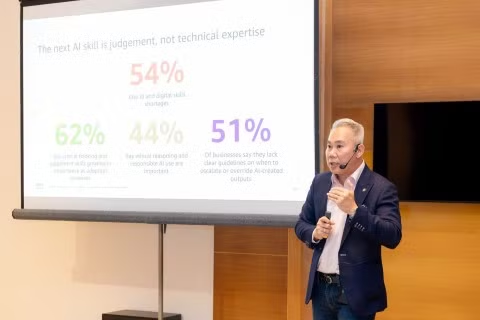
Third, skills for the AI era remain an urgent priority. Some 54% of businesses acknowledge that shortages of digital and AI skills are hampering AI adoption and scaling. Meanwhile, 87% of employers say upskilling existing employees is an important part of their AI strategy, helping workers use AI ethically and learn to interpret, challenge, and verify AI-generated outputs. In Viet Nam, progress is being made: 26% of workers received training over the past year, up from 19% in 2025.
However, the types of AI skills businesses need are changing. As AI systems become more powerful, businesses are recognising human judgement as a critical capability. Some 62% of business leaders say critical thinking and judgement will be decisive, while 57% emphasise that the ability to interpret, verify, and, in particular, challenge AI-generated outputs will become increasingly important over the next five years.
Businesses are also prepared to invest in talent. Companies say they are willing to offer an average salary premium of 41% to employees with AI skills.
The road ahead for Viet Nam
Vietnamese businesses can act now to turn AI adoption into measurable business results.
Viet Nam is gradually realising its ambition to become an ASEAN AI hub by 2030, driven by growing interest in and adoption of technology.
Eric Yeo,
Managing Director of
AWS Viet Nam
AWS is committed to supporting the ambitions of Vietnamese businesses. AWS recently announced the launch of an AWS Local Zone in Ha Noi, bringing AWS infrastructure closer to organisations in Viet Nam. To date, AWS has also trained more than 157,000 people in the country in cloud computing and AI skills. In addition, the “AWS Vietnam First Cloud & AI Journey” programme is helping to develop Viet Nam’s developer community, with more than 15,000 participants since 2021.
Eric Yeo, Managing Director of AWS Viet Nam, said: “Viet Nam is gradually realising its ambition to become an ASEAN AI hub by 2030, driven by growing interest in and adoption of technology. Every organisation starts its AI journey from a different point, but the direction is clear. Businesses that make a structured transition from experimentation to implementation, supported by cloud infrastructure, a transparent regulatory environment, and the right skills, will be best positioned to compete and grow.”