At Parallel Session 1, themed “Strategic technologies in transforming industrial development models and high-tech urban areas”, experts focused on various aspects of high-tech urban development.
Topics ranged from strategic technology orientations in Ho Chi Minh City and applications of nanomaterials to smart food safety management and assessments of urban readiness in terms of digital infrastructure, innovation capacity, and human resources.
These discussions highlighted the need for closer coordination between technology research, organisational capacity, and the ability to deploy solutions in practice.
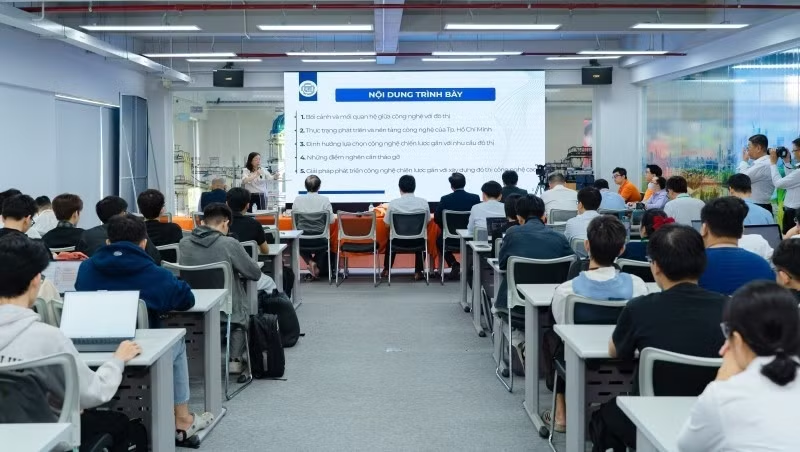
Duong Gia Thinh, a K21 student majoring in semiconductor integrated circuit design at FPT University, said the presentations and discussions helped him gain a better understanding of emerging technologies and their potential applications in practice.
“I learned more about new technologies and how they can be applied in real-world settings. The thematic session also made me realise how rapidly technology is advancing, which means I need to be more proactive in learning and constantly updating my knowledge,” Thinh said.
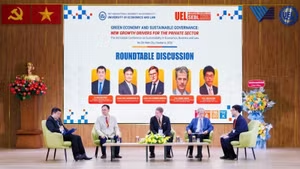
At Parallel Session 3, themed “High-tech human resource development and international cooperation”, experts and scientists focused on strengthening links among higher education institutions, technology enterprises, and the start-up ecosystem to develop human resources that better meet practical needs.
Dinh Vu Trang Ngan, President of Fulbright University Viet Nam, raised the question of how geographical proximity among universities, research institutes, and businesses could be translated into substantive cooperation that creates value for the innovation ecosystem.
According to her, the advantage of a high-tech park lies not only in bringing organisations together in one location but also in its ability to facilitate knowledge exchange, resource sharing, and the translation of research results into practical applications.
From this perspective, Ngan suggested that instead of merely accepting interns or recruiting graduates, businesses could participate directly in education and research, from identifying real-world challenges to jointly guiding, testing, and developing solutions with lecturers and students.
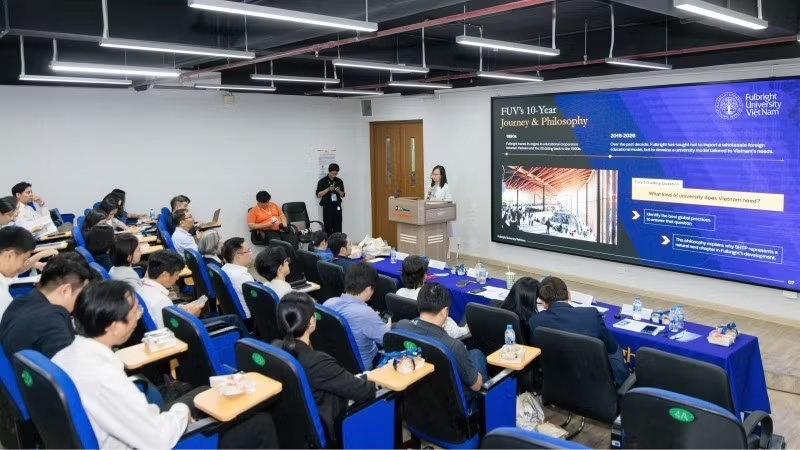
“This is not simply a relationship between a training institution and an employer. It is a co-creation partnership: jointly identifying problems, developing people, generating knowledge, and sharing responsibility for outcomes,” Ngan said.
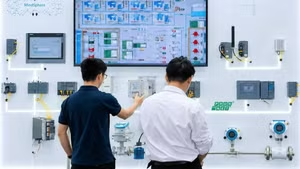
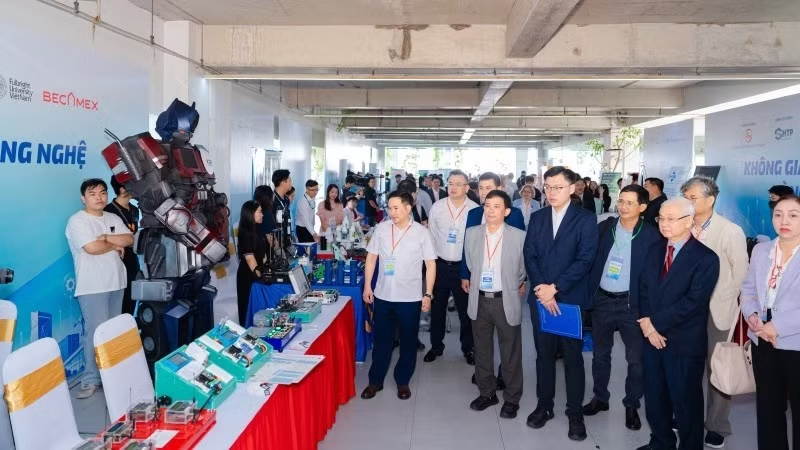
At the Strategic Technology Exhibition for High-Tech Urban Development held as part of the conference, FPT University showcased student start-up projects, products, technology models, and innovative ideas, including projects developed within the university’s training programmes.
These products help bridge academic knowledge and practical application, while also demonstrating the role of education in promoting research, technology application, and the development of the innovation ecosystem.