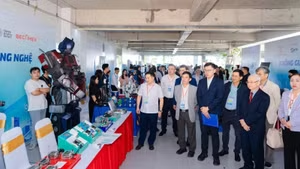
For a long time, the Mekong Delta has been known as a fertile land that is rich in potential and endowed with an abundant labour force. However, in terms of workforce quality and skills composition, the region faces considerable challenges. The comprehensive restructuring of development space, resource allocation, and local governance following the administrative mergers has raised complex issues for both the public and private sectors.
Bottlenecks in the new context
One of the biggest bottlenecks at present is the mismatch between labour supply and demand. Shortages of digital and green skills, as well as supply chain management capabilities across sectors ranging from fisheries and logistics to tourism, are hampering the region's ability to absorb technology and transform its growth model. Meanwhile, labour migration and the continued movement of highly skilled young people to major economic centres outside the region remain persistent challenges.
The lack of mechanisms to attract and retain talent has left many localities facing an acute shortage of specialists and capable managers. In the public sector, the operation of the two-tier local government model following the mergers requires officials and civil servants to not only improve their implementation capacity but also overcome the challenge of “technostress” amid the digital transformation process.
At the recent national scientific conference in Vinh Long entitled “Developing high-quality workforce — The foundation for restructuring provinces in the Mekong Delta in the post-merger period”, policymakers and researchers candidly identified the key issues facing the region.
Assoc Prof, Dr Bui Quang Hung, Director of the University of Economics Ho Chi Minh City, said: “The greatest challenge today lies not in the size of the workforce, but in its quality, skills composition, adaptability, and mobility. No matter how streamlined the administrative apparatus becomes or how much the development space expands, the ultimate effectiveness still depends on people: the right person, with the right capabilities, in the right position.”
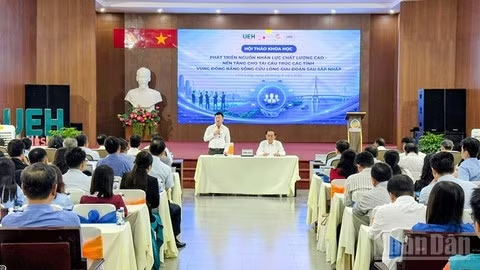
Dr Bui Quang Hung stressed that addressing the Mekong Delta's workforce challenges cannot be left to any single stakeholder. Instead, it requires coordinated action across the entire ecosystem, including the state, educational institutions, businesses, scientists, and workers.
From the local perspective, Nguyen Van Hieu, Head of the Vinh Long Provincial Party Committee's Organisation Commission, representing the provincial leadership, underscored the particular importance of human resources in the public sector. Building a contingent of officials with strong professional expertise, sound judgement, digital proficiency and effective implementation capabilities is essential to improving the efficiency and effectiveness of the administrative apparatus following the mergers, thereby attracting investment and accelerating local socio-economic development.
Echoing this view, researchers also identified gaps in capabilities across the region and issued a warning: if existing workforce capabilities fall short of the requirements of the region's new development agenda it will directly affect labour productivity, the implementation capacity of the public sector, and the region's ability to adapt to economic and environmental changes.
Practical solutions
Experience gained after more than a year of operating the two-tier local government model shows that civil servants at the grassroots level, including those working in communes and wards, are facing heavier workloads and increasing pressure to process digitised documents quickly.
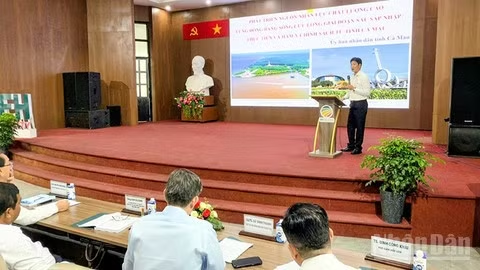
Dr Dinh Cong Khai, Deputy Director of the University of Economics Ho Chi Minh City, proposed a fundamental overhaul of training programmes for commune-level civil servants. Rather than providing generic theoretical instruction, he argued, training should focus on a “competency-based implementation model”, involving practical exercises in handling real-life situations and managing work within the new governance framework.
According to Pham Thi Ngoc Han, a lecturer at Ton Duc Thang Political School, addressing “technostress” among officials and civil servants requires more than providing infrastructure and software. It is also necessary to systematically strengthen their digital capabilities and foster a smoother psychological adjustment to technology, enabling them to master digital tools rather than feel overwhelmed by them.
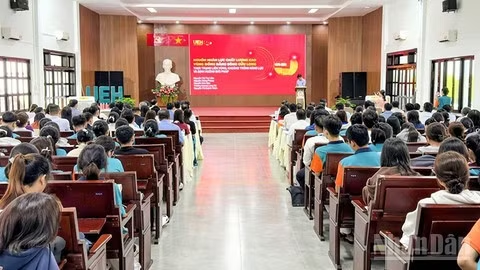
To ensure that human resources truly become a key driver of the region's development, many researchers proposed improvements to institutional frameworks, financial policies, and modern governance tools.
Dr Phan Van Thanh of the University of Medicine and Pharmacy at Ho Chi Minh City, together with Nguyen Thi Ngoc Chan, a master's degree holder from Vinh Long University of Technology Education, proposed improving institutional arrangements and establishing more flexible financial mechanisms. These measures could include reviewing public-sector salary policies and offering personal income tax incentives to experts, scientists, and senior professionals working in the Mekong Delta, thereby creating a stronger pull to attract and retain talent.
A high-quality workforce is the “golden key” to unlocking new development opportunities for the Mekong Delta. With major training and research centres committed to supporting the region, alongside the political resolve of local leaders, the Mekong Delta is expected to overcome its existing bottlenecks and turn challenges into opportunities for a sustainable leap forward in the new era.