Awakening private sector growth from rural land
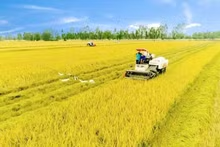
In the Mekong Delta, where livelihoods are closely tied to land, unlocking rural potential as a space for business is seen as key to fostering private sector development and improving farmers’ incomes.
#Mekong Delta
Có 27 kết quả
In the Mekong Delta, where livelihoods are closely tied to land, unlocking rural potential as a space for business is seen as key to fostering private sector development and improving farmers’ incomes.
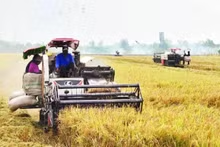
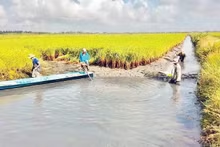
Dong Thap province is striving to become a representative economic hub for the rice sector in the Mekong Delta region, playing a core role in linking and spreading the model of ecological, circular and low-emission rice production.
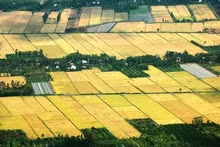
In the days approaching the Lunar New Year of Binh Ngo of the Horse, I had the opportunity to accompany the E-917 helicopter squadron on a flight over the southern land. From an altitude of 1,500 m, at a speed of 200 km per hour, the land of the Mekong Delta appears like a gigantic masterpiece. The space here seems more vibrant, the colors fresher, and people’s hearts more overflowing.
The Resolution of the 1st Congress of the Can Tho City Party Committee for the 2025–2030 term sets out the objective for Can Tho to strive to become a national growth pole and a driving force for development, expanding and leading the entire Mekong Delta.
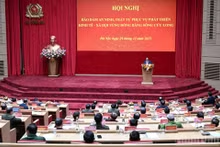
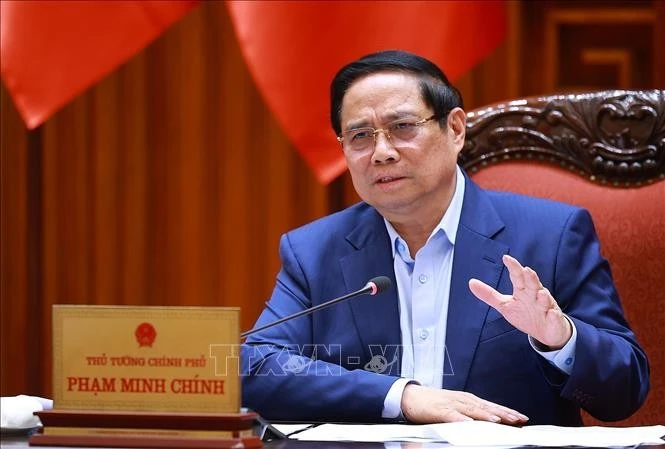
Prime Minister Pham Minh Chinh chaired a conference in Ha Noi on December 29, with a focus on ensuring security and public order to support socio-economic development in the Mekong Delta region.
On the morning of December 29, Prime Minister Pham Minh Chinh chaired a conference on ensuring public security and social order to serve socio-economic development in the Mekong Delta.
On the afternoon of December 17, the World Bank held a conference in Can Tho City to launch its report entitled “Stay or migrate: life in Viet Nam’s Mekong Delta.”
Prime Minister Pham Minh Chinh on December 5 called for mechanisms and policies to diversify funding sources, especially through public–private partnerships, to tackle land subsidence, landslides, flooding, drought, and saltwater intrusion in the Mekong Delta, noting that these efforts demand significant resources.
The coconut tree in Viet Nam is known as a climate-resilient crop, but it faces many challenges in development. Strategy to restructure Viet Nam’s coconut industry towards an ecological, circular, and low-emission model is considered an optimal solution to build the “Green and safe Vietnamese coconut” brand.
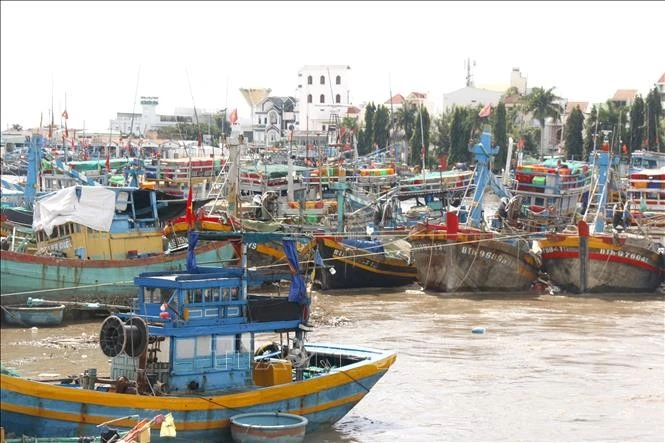
Provinces across the Mekong Delta are intensifying coordinated measures to curb illegal, unreported, and unregulated (IUU) fishing, as part of nationwide efforts to have the European Commission (EC)'s “yellow card” warning against Vietnamese seafood lifted.
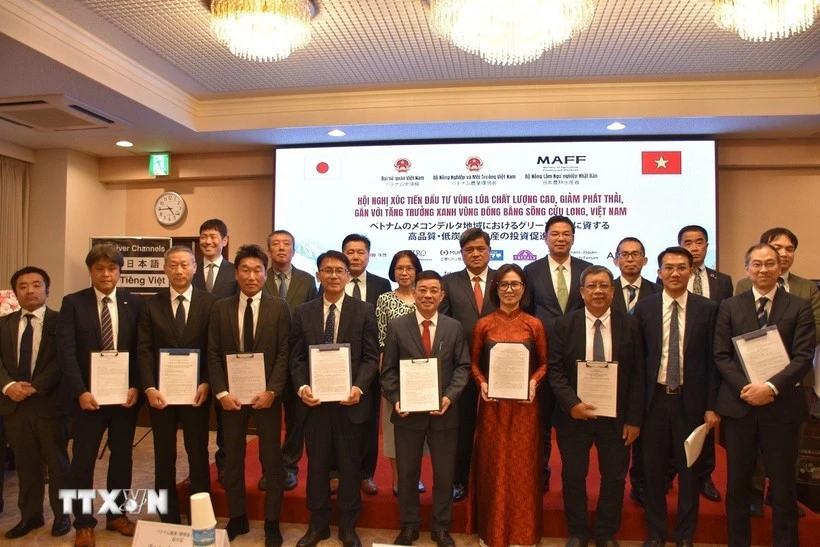
The Vietnamese Ministry of Agriculture and Environment, in collaboration with Japan’s Ministry of Agriculture, Forestry and Fisheries (MAFF) and the Vietnamese Embassy in Japan, held a conference on promoting investment in high-quality, low-emission, green rice production in Viet Nam’s Mekong Delta in Tokyo on October 21.
Since the merger, the new Ca Mau Province has become one of the localities with large areas of shrimp farming and rice cultivation in the Mekong Delta. Notably, many of the farming households in former Bac Lieu Province have demonstrated their dynamism and creativity through the “fragrant rice–clean shrimp” model, enriching from the land and water of their hometown.
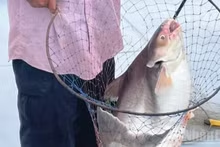
Together with linh fish, basa fish is a natural speciality bestowed on Dong Thap, the headwater province of rivers and waters, during the flood season. The further downstream towards other provinces, the scarcer basa fish becomes.
The Viet Nam Union of Friendship Organisations, the US Mission to Viet Nam, and the Can Tho People’s Committee jointly held the Viet Nam–US Friendship Festival in the Mekong Delta city of Can Tho on September 13.
To promote start-ups, innovation, and intellectual property development, over the past time, the Department of Science and Technology of Dong Thap Province has actively supported individuals and organisations in completing projects and initiatives. As a result, they have successfully developed products that bring effectiveness in production and business activities.
An Giang Province is one of the key rice growing areas in the Mekong Delta, with a total annual output of more than 8 million tons. This is a favourable condition for the province to participate in the "One million hectares of high-quality rice project" associated with green growth in the Mekong Delta.
The People’s Committee of the Mekong Delta city of Can Tho held a working session on August 7 with a delegation from the Australian Consulate General in Ho Chi Minh City, aiming to expand cooperation across a range of fields.
National Assembly Chairman Tran Thanh Man and his spouse Nguyen Thi Thanh Nga on July 28 (local time) visited the family of Jacques Savary in Switzerland’s Vevey, who has made substantial contributions to the healthcare sector and communities in Viet Nam’s Can Tho city.
With total investment exceeding 8.5 trillion VND (325.3 million USD), the Mekong Delta Integrated Climate Resilience and Sustainable Livelihoods Project (ICRSL or WB9) has helped improve climate resilience and sustainable livelihoods for nearly 2 million people in the region, 49% of them women, heard a workshop in Can Tho city on June 20.
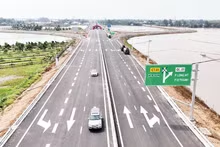
The inland waterway transport route (Mekong Express) linking Cai Cui Port (Can Tho) with Cai Mep Port (Ba Ria–Vung Tau) officially commenced operations on May 30. This new route reduces transportation time in the Mekong Delta region from 48 hours to just 15—a 70% decrease.