“Lighting up” the cultural industries
Although only recently launched, The programme “The Charm of Ha Noi Cheo (Vietnamese traditional opera)” at Dai Nam Theatre on Hue Street, produced by the Ha Noi Cheo Theatre, has already been incorporated into the itineraries of many tour operators and attracted considerable public attention.
Running for around 60 minutes, the programme captivates audiences from beginning to end, drawing enthusiastic applause. “The Charm of Ha Noi Cheo” skilfully weaved together excerpts from celebrated traditional cheo plays such as Luu Binh–Duong Le, Thi Mau Goes to the Pagoda and The Sorcerer Afraid of Ghosts, taking audiences through a wide range of emotions.
Le Thi Anh Mai, Deputy Director of the Ha Noi Department of Culture and Sports, said “The Charm of Ha Noi Cheo” was the first in a series of high-quality performing arts programmes developed by the city, combining the essence of traditional cheo with the spirit of contemporary Ha Noi. The show has been designed as a regular performance product aimed at attracting both domestic and international visitors.
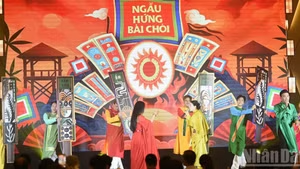
Just days after “The Charm of Ha Noi Cheo” was introduced to the public, the Thang Long Song, Dance and Music Theatre launched “Stories of Ha Noi – A Very Ha Noi Day” in early August. Through music, dance and performance art combined with modern stage technology, the programme recreates the rhythm of life in Ha Noi from dawn until late at night.
Alongside the performances, audiences are also introduced to Ha Noi’s culinary culture through spaces where they can enjoy lotus tea, traditional cakes and delicacies evoking the flavours of the Old Quarter.
Audience Hoang Quyen said: “Many traditional musical instruments are presented in contemporary forms. The different performances are woven together through an emotional narrative about Ha Noi. I think this programme has enough authentic ‘Ha Noi character’ to appeal to audiences.”
Following “The Charm of Ha Noi Cheo” and “Stories of Ha Noi – A Very Ha Noi Day”, the city is set to introduce several more programmes in August and early September, including “The Daughter of Ha Noi” by the Ha Noi Cai Luong (reformed theatre) Theatre, “Children of Ha Noi” by the Ha Noi Drama Theatre, and a new high-quality artistic programme by the Thang Long Water Puppet Theatre.
In addition to programmes developed by Ha Noi-based theatres, numerous other artistic productions by professional theatres and private organisations are being staged on a regular basis.
Puppetry traditionally appeals to a relatively niche audience. Yet under the direction of People’s Artist Nguyen Tien Dung, “In bong Long Thanh” (Silhouette of Thang Long) has consistently played to full houses every week at Area 75 – Art & Auction on Luong Van Can Street, Hoan Kiem Ward.
More recently, at the art space at 66 To Ngoc Van Street in Tay Ho Ward, “CADAO Collective” programme has brought a fresh dimension to heritage by bringing together three representative forms of Ha Noi’s traditional arts: Xam singing (ballads sung by wandering blind musicians), evoking the rhythms of urban life; ca tru (ceremonial singing) embodying the elegance of the ancient Thang Long capital; and water puppetry, rich in the atmosphere of traditional festivals and folk legends. Together, they create an immersive journey through Ha Noi’s culture.
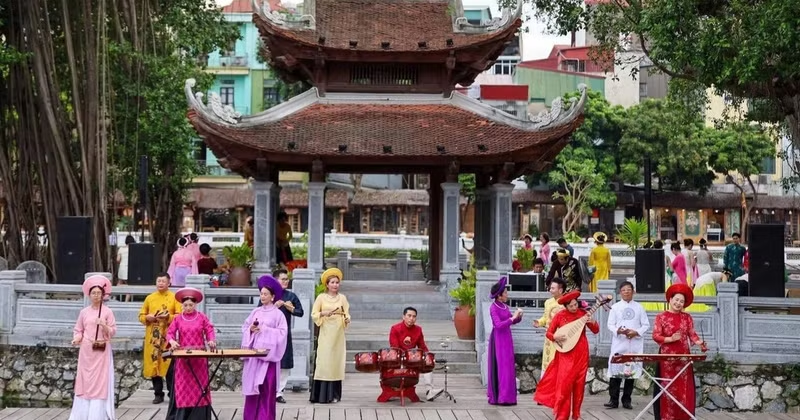
A number of art and public spaces, including the Bat Giac (Octagonal) House in Ly Thai To Flower Garden, Hoan Kiem Ward, and Van Lake within Van Mieu – Quoc Tu Giam (Temple of Literature), have also become venues for professional performing arts programmes, breathing new life into the city’s performing arts scene.
Breakthroughs driven by innovation
The performing arts form the “backbone” of the cultural industries. While Ha Noi’s performing arts scene in 2025 was marked by large-scale “concerts”, 2026 has seen the growth and wider reach of regular small- and medium-scale artistic programmes.
Enjoying “Stories of Ha Noi – A Very Ha Noi Day”, audiences were surprised to be handed whistles, chopsticks and even fans before the performance. Once the show begins, the reason becomes clear. Guided by the artists, audience members become “co-performers”, blowing whistles, tapping chopsticks and dancing with fans. This interactive element keeps the atmosphere lively throughout the show.
People’s Artist Thu Huyen, Director of the Ha Noi Cheo Theatre, said: “Cultural industries involve harnessing and creatively developing cultural resources, transforming heritage into products with artistic, educational and economic value. We preserve the spirit and character of traditional cheo while presenting it through an entirely new and more concise staging approach. This does not diminish the value of cheo; rather, it opens a door for audiences to understand and appreciate the art form, encouraging them to explore it more deeply.”
For CADAO Collective, the diverse range of artistic “offerings” adds to its appeal, giving audiences in general and tour operators in particular more options to meet visitors’ needs. The opportunity for guests to interact and converse directly with artisans and artists is another significant advantage.
Meanwhile, “In bong Long Thanh” blended stage puppetry with dance and symbolic visual art. Audiences also enjoyed chau van (spiritual singing), ca tru and other forms of traditional music. The production is essentially a streamlined version of “Cam xuc Long Thanh” (Emotions of Thang Long), adapted for an intimate venue accommodating around 100 spectators.
The combination of large-scale concerts, international artistic programmes, recent events such as “Crescendo – Symphony of Connection”, upcoming performances by BIGBANG, and regular small- and medium-scale productions is gradually shaping a vibrant performing arts “ecosystem” in Ha Noi.
People’s Artist Trung Hieu, Director of the Ha Noi Drama Theatre, proposed that alongside greater attention to scripts and creative quality, arts organisations should boldly incorporate technology into stage productions to offer audiences new experiences. Technology and artificial intelligence should also be applied to management, promotion and audience-demand analysis to improve the operational effectiveness of theatres.
According to Le Thi Anh Mai, Deputy Director of the Ha Noi Department of Culture and Sports, close coordination between the cultural and tourism sectors and relevant organisations is essential if these programmes are to remain effective and sustainable over the long term. Such cooperation will help create a comprehensive ecosystem of artistic products and turn performing arts programmes into highlights of visitors’ journeys of discovery through Ha Noi.