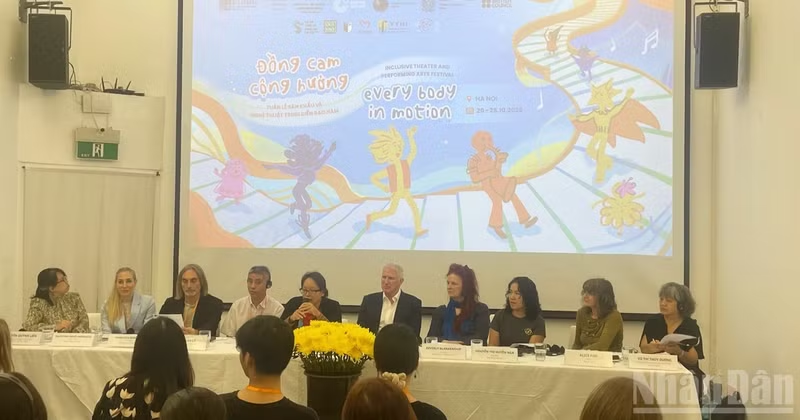
The inclusive theatre and performing arts week is taking place in Ha Noi from October 21 to 25. Organised by EUNIC Viet Nam — the network of European Union National Institutes for Culture in Viet Nam — the event is produced under the direction of filmmaker Nguyen Hoang Diep. This also marks the first time the female director has undertaken an inclusive performing arts programme of this kind.
The programme has been conceived and presented to audiences as a journey of exploration, beginning with Shakespeare's masterpiece “A Midsummer Night's Dream” and continuing with choral performances by the Hope Choir, theatrical productions by visually impaired artists, contemporary dance shows, interactive performances, artistic workshops, seminars, documentary screenings, and non-verbal theatre and opera stagings.
Ranging from European theatrical classics reinterpreted through contemporary perspectives to original works spanning dance, music, opera, and drama, the programme seeks to highlight the creative contributions of artists with and without disabilities across diverse artistic forms and disciplines.
Beyond raising questions about accessibility in the arts, the programme aims to explore how perspectives shaped by experiences of disability can broaden the ways in which artistic and theatrical aesthetics are understood and defined.
It also seeks to bring attention to perspectives that are frequently overlooked or marginalised, particularly in a cultural landscape largely shaped by people without disabilities.
Director Nguyen Hoang Diep said that accepting the Goethe-Institut's invitation to organise such a distinctive arts week — the first of its kind not only in Ha Noi but also in Viet Nam — presented an enormous challenge.
Throughout her filmmaking career, she had encountered various creative challenges. However, the event represented a different kind of challenge, requiring not only commitment and understanding but also the courage to cross boundaries she had previously hesitated to confront.
According to Diep, the programme offers her a genuine opportunity to explore ways of bringing different communities into the arts, not merely as audiences but also as contributors, practitioners, and creators.
Discussing the projects selected for the week, the director explained that each had its own criteria, but the most important was the close involvement of communities as active participants in the creative process. Their contributions and artistic practice had to be integral to the projects themselves.
“We do not select projects simply because they are about people with disabilities. We choose them because they offer opportunities for people from different communities to come together, create art, and engage with it collectively,” Diep said.
Dinh Huong Thuy, an artist from the Youth Theatre, is among those participating in the project as a trainer and mentor for artists with disabilities.
She said the experience of creating art alongside the project's participants had brought her invaluable personal rewards. “I was deeply moved by my involvement in this project. We had just 10 days to prepare and perform an entire five-act Shakespeare play, something that initially seemed almost impossible,” Thuy recalled.
“This was particularly remarkable for my students, who had only just completed their second year of study. Our group of 24 students was joined by five participants from a centre for people with disabilities.
Thuy added that she found it especially meaningful to see her students gradually recognise that, beyond performing their own roles, they also had a responsibility to collaborate with and support their fellow performers.
Speaking from the perspective of an artist with a disability, Hoang Van Ly, a visually impaired performer and founder of the Art Without Distance group, said he has spent nearly 20 years working in communications and social activities and has participated in numerous projects involving people with disabilities. The arts week has given him an opportunity to reconnect with people who have accompanied him throughout that journey.
“That motivation encouraged three of us, including two people with disabilities and one person without disabilities who specialises in arts coordination, to establish the Art Without Distance group. We hope to continue finding opportunities to connect and create together after the festival,” Ly said.
The group's production, scheduled to be performed at Chuong Theatre on the evening of Friday, October 23, was developed through a co-creation process. Its artistic material draws directly on the experiences, feelings, and personal stories of performers with and without disabilities, including visually impaired artists and people with cerebral palsy.
As the first inclusive arts week dedicated to people with disabilities, the organisers hope the event will not only become an annual fixture but also help make inclusive artistic practice part of everyday cultural life.
Thai Mai Lan, Director of the Goethe Institute in Ho Chi Minh City and Head of Cultural Programmes at the Goethe Institute in Ha Noi, expressed the hope that the initiative would go beyond a single event. She said the ultimate goal was to “make this part of our everyday lives and creative practices, helping us develop a more comprehensive understanding of the world.”