Invisible barriers
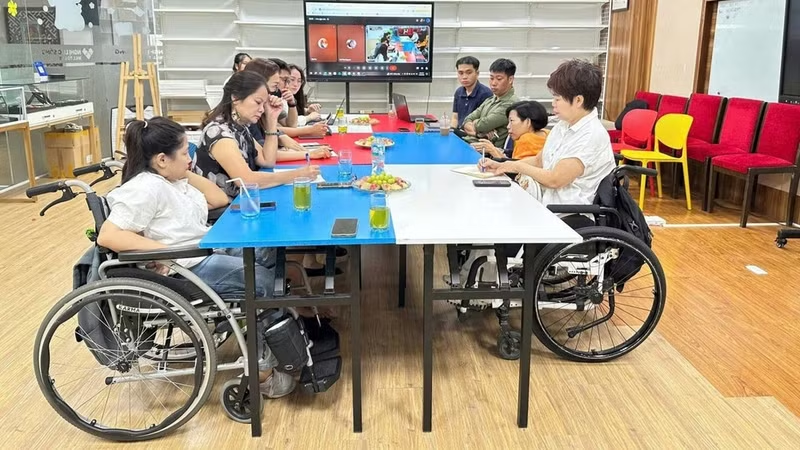
A former police officer, Nguyen Quang Trung, 43, from Dai Mo Ward, Ha Noi, has spent the past 21 years using a wheelchair after a serious traffic accident. Instead of seeking opportunities at businesses, Trung chose to take a course in video production and affiliate marketing on TikTok and Shopee, organised by Khat Vong Social Enterprise Joint Stock Company. He now earns a stable income of around 3 million VND a month from home.
Luong Thi Minh Nguyet, 55, a leader at the company where Trung was trained, also shares a similar journey of overcoming adversity. Completely paralysed after a spinal cord injury, Nguyet deeply understands the burden of monthly medical expenses faced by people with particularly severe disabilities. The enterprise currently creates jobs in handicrafts for around 50 workers with disabilities, combined with rehabilitation and peer counselling.
In reality, although the social security system has made significant progress, the gap between people with disabilities and the ability to live independently through their own labour remains substantial. Nguyet said that under Decree No. 28/2012/ND-CP, production and business establishments employing people with disabilities accounting for at least 30% of their total workforce are eligible for certain state incentive policies. Ordinary businesses that employ a few workers with disabilities may have to fund workplace adaptations themselves, such as ramps, accessible toilets, or suitable equipment. Therefore, a mechanism providing support based on individual workers should be studied, including direct assistance with the costs of adapting workplaces, providing assistive equipment, or covering part of social insurance contributions during the initial period. This would create better conditions for businesses to employ people with disabilities.
It is clear that alongside state support, the role of businesses and social organisations is a decisive link in turning social security objectives into reality.
Expanding social enterprise models run by people with disabilities themselves would not only create workplaces with appropriate infrastructure but also foster deep understanding and mutual support among people facing similar circumstances.
When empowered and given equal working conditions, people with disabilities are no longer merely recipients of passive support. Instead, they become economic actors who directly contribute value to society and gain confidence in their own abilities.
For people with visual impairments, barriers to access lie in vocational training methods and mechanisms for managing loans. Dinh Viet Anh, Vice President of the Viet Nam Association for the Blind, said that alongside higher education, vocational training centres within the association's system continue to be the most practically effective option for people who are blind. From 2026, employment-support credit mechanisms have been implemented under new regulations, with funding centrally managed through the Viet Nam Bank for Social Policies.
“We hope to maintain close coordination mechanisms so that the association can continue to act as a bridge, directly identify members' needs, and support them in using loans. At the same time, social security policies need to be reviewed to ensure consistency in the criteria and avoid situations where people with disabilities who are already receiving other preferential benefits face difficulties in accessing social assistance packages,” she said.
The situation in remote and isolated areas also highlights difficulties in implementing policies. Thai Vinh Lieu, Chairman of the Quang Tri Association of People with Disabilities, Agent Orange Victims, Disability Support and Child Rights Protection, said that many people in mountainous areas are not fully aware of the policies, while commune-level officials have numerous responsibilities to handle, meaning that reviews and guidance are sometimes not provided in a timely manner. In terms of livelihoods, people with disabilities who have not received vocational training face many obstacles when seeking employment because businesses often prioritise workers who already possess relevant skills.
Based on these realities, Lieu proposed that vocational training for people with disabilities should be linked to specific jobs, together with access to capital and guaranteed outlets for products. The state should study a mechanism allowing this group to access interest-free loans, while providing premises, technical support, and market access for businesses owned by people with disabilities.
Stepping up breakthrough solutions and sustainable support
In response to practical barriers in people's lives, the legal system is being adjusted towards proactively creating opportunities for people with disabilities to participate in the labour market. On June 16, 2025, the National Assembly passed the Employment Law, which took effect on January 1, 2026, introducing a number of preferential provisions aimed at making significant breakthroughs. To put the law into practice, the government issued Decree No. 338/2025/ND-CP, detailing a number of provisions on employment-support policies.
Ngo Xuan Lieu, Director of the National Centre for Employment Services under the Department of Employment, explained that the amended 2025 Employment Law provides a priority mechanism enabling people with disabilities to access low-interest loans from the Viet Nam Bank for Social Policies, support for vocational skills assessment and certification granting, and assistance with unemployment insurance contributions for employers who are people with disabilities. More broadly, the law supplements provisions giving priority in accessing loans to workers who directly raise or provide care for people with particularly severe disabilities.
“To overcome mobility barriers, we are designing specialised modules on the National Employment Exchange, strengthening electronic connections, and proactively bringing counselling services directly to people, helping people with disabilities access employment information as conveniently as possible. Employment service centres in localities also need to proactively coordinate with families and relevant organisations to bring information, counselling, and job opportunities to people with disabilities, reduce the need for travel, and create more favourable conditions for them to maintain employment,” Lieu said.
From the perspective of an agency responsible for implementing social security policies, Le Hung Son, Director General of Viet Nam Social Security, emphasised the need to narrow the gap between regulations and practice. A survey by the Statistics Department published in 2023 showed that people with disabilities accounted for around 6.11% of the population, with significant demands for healthcare, employment, and social security.
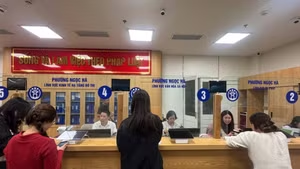
However, according to Son, barriers related to equipment and technological skills continue to affect some people's ability to access and use social security policies. Therefore, digital transformation needs to go hand in hand with direct support, while also maintaining grassroots counselling services so that people can access policies more easily.
According to Son, to ensure that vulnerable groups can truly access policies conveniently, equally, and fully, Viet Nam Social Security will continue to study and propose improvements to policies in ways that are more appropriate for each group. For people with disabilities, the focus is on ensuring their rights to health, social, and unemployment insurance; providing assistance with procedures; improving their ability to use services, particularly for those facing difficulties with mobility, information, and technology; and coordinating employment and income support so that they can participate in social security over the long term. For poor and near-poor people, low-income earners, ethnic minority people, residents of disadvantaged areas, and elderly people without pensions, it is necessary to promote policies supporting contribution payments and to enhance counselling and the integration of social insurance and health insurance with social assistance.
The ultimate goal of social security is to give every vulnerable person in society greater capacity for self-reliance, protection when risks arise, and opportunities to build an appropriate livelihood. When policies reach the right people, meet the right needs, and create the ability to live independently, the social security safety fulcrum can truly fulfil its role.