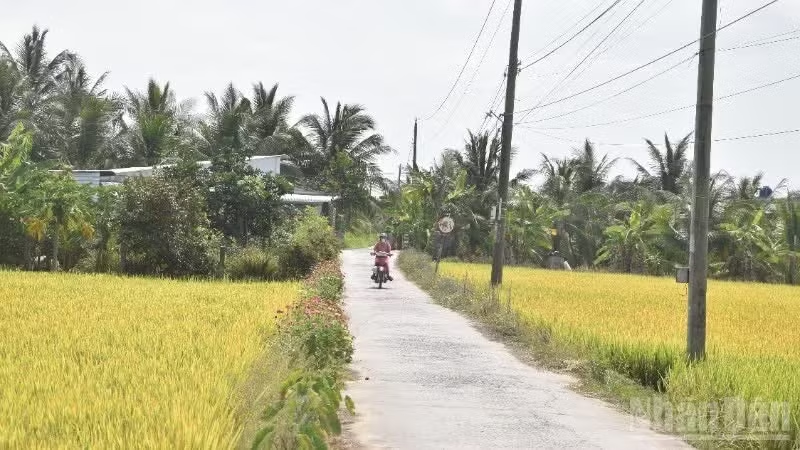
In reality, the rural economy in the Mekong Delta still largely operates on a small household scale. This is often viewed as a limitation, but on closer examination, it is the result of uneven development conditions. A household may have land, labour, and the desire to do business, but without convenient transport, stable electricity, proactive irrigation, and adequate information connectivity, it is difficult to shift from pure production to higher value-added business activities.
Geographical factors also help explain this situation. The Mekong Delta has a dense river network with low-lying and fragmented terrain and is frequently affected by floods, high tides, and saltwater intrusion. These characteristics increase infrastructure investment costs and make the connection between production spaces and goods circulation more complex than in many other regions.
Meanwhile, industrial zones and clusters — often seen as spaces for business development — have yet to become accessible options for most rural residents. Many households remain hesitant to approach these models. Requirements related to capital, procedures, and operational standards, along with differences in production environments, make these spaces seem out of reach for many.
This gap indicates that if development focuses solely on concentrated economic spaces without adequately considering people’s ability to participate, private sector growth in rural areas will struggle to expand.
In this context, it becomes necessary to re-examine what is already available within rural areas. In the Mekong Delta, most households possess a form of natural economic space: residential land associated with adjacent gardens, ponds, or fields. This is a distinctive advantage that allows small-scale production and business activities with relatively low costs. However, in many cases, land is still used mainly for traditional purposes and is rarely seen as a space that can integrate processing, services, or on-site trade.
At the same time, rural community culture, characterised by strong family and village ties, creates a favourable social foundation for local economic development. Trust-based relationships and mutual support help reduce start-up costs and enhance the adaptability of small-scale economic models. This can be a significant “soft advantage” if organised appropriately.
However, for these potentials to truly translate into valuable economic activities, the decisive factor remains rural technical infrastructure. Infrastructure not only reduces production and circulation costs but also opens possibilities to reorganise economic space in a more flexible and efficient manner.
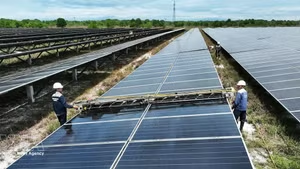
A well-invested transport route can enable goods to move directly from households to markets. A stable electricity system allows the operation of production and preservation equipment. Effective Internet connectivity opens opportunities for transactions as well as access to information and markets. When these conditions are improved, each household’s land can gradually shift from a purely production space to a multifunctional economic space.
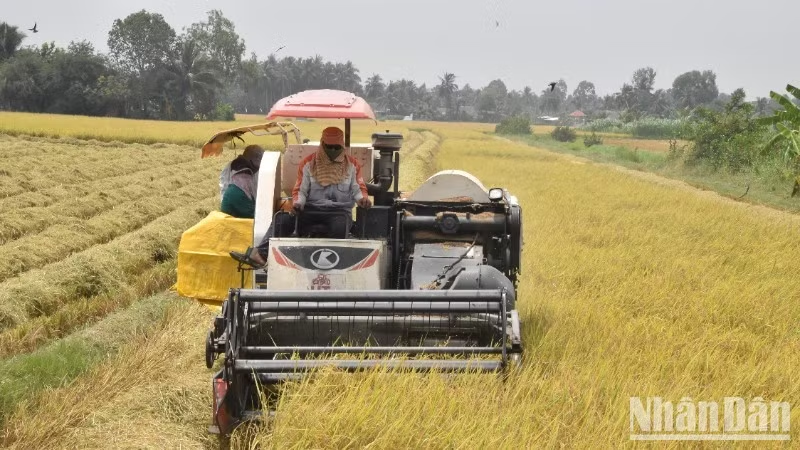
From another perspective, developing on-site economic activities also opens opportunities to effectively utilise and absorb agricultural by-products — resources that have long been underutilised across the region. If properly organised, the straw left after rice harvests along with fruit by-products and materials from livestock and aquaculture can become inputs for various household and small-scale economic activities such as processing, organic fertiliser production, animal feed, or other value-added products.
As infrastructure improves, these activities can be established directly in rural areas, helping reduce costs, minimise resource waste, and generate additional income for households. This is also a way to make use of idle labour time, gradually improving labour efficiency and diversifying livelihoods in the agricultural sector.
Beyond production, infrastructure also facilitates the development of new economic forms, including agricultural tourism. With improved transport, enhanced landscapes, and better living environments, many rural areas can become experiential destinations linked to agriculture, culture, and riverine lifestyles. This not only diversifies livelihoods but also creates more space for private sector activities, especially small- and medium-scale models.
At the same time, infrastructure investment often drives the development of social infrastructure such as healthcare, education, services and commerce. As living conditions improve, rural areas gradually become not only places of production but also places worth living — where people can settle, work, and develop economically locally. This is an important factor in retaining labour, especially young workers. A progressive pathway for private sector development can gradually take shape: from household businesses to cooperative groups, cooperatives, and eventually small and medium-sized enterprises.
When each plot of land can become an economic node and each village a dynamic production and business space, the private sector will gradually become a natural flow within the rural fabric of the Mekong Delta.